

Cyber threats are becoming more difficult to detect because attackers no longer rely only on obvious malware. They can use stolen credentials, malicious scripts, legitimate administrative tools, and compromised devices to move through an organization. This makes visibility across laptops, desktops, servers, and other endpoints an important part of a modern security strategy.
This is where endpoint detection and response cybersecurity becomes valuable. EDR continuously monitors endpoint activity, detects suspicious behavior, helps security teams investigate incidents, and supports response actions that can limit potential damage.
For businesses that want stronger endpoint visibility without depending entirely on traditional antivirus tools, EDR can provide an additional layer of protection.
What Is Endpoint Detection and Response Cybersecurity?
Endpoint Detection and Response (EDR) is a cybersecurity approach designed to monitor endpoint activity and identify potentially malicious behavior.
Endpoints can include:
- Employee laptops and desktops
- Business servers
- Workstations
- Remote employee devices
- Company-managed systems
- Other devices connected to corporate environments
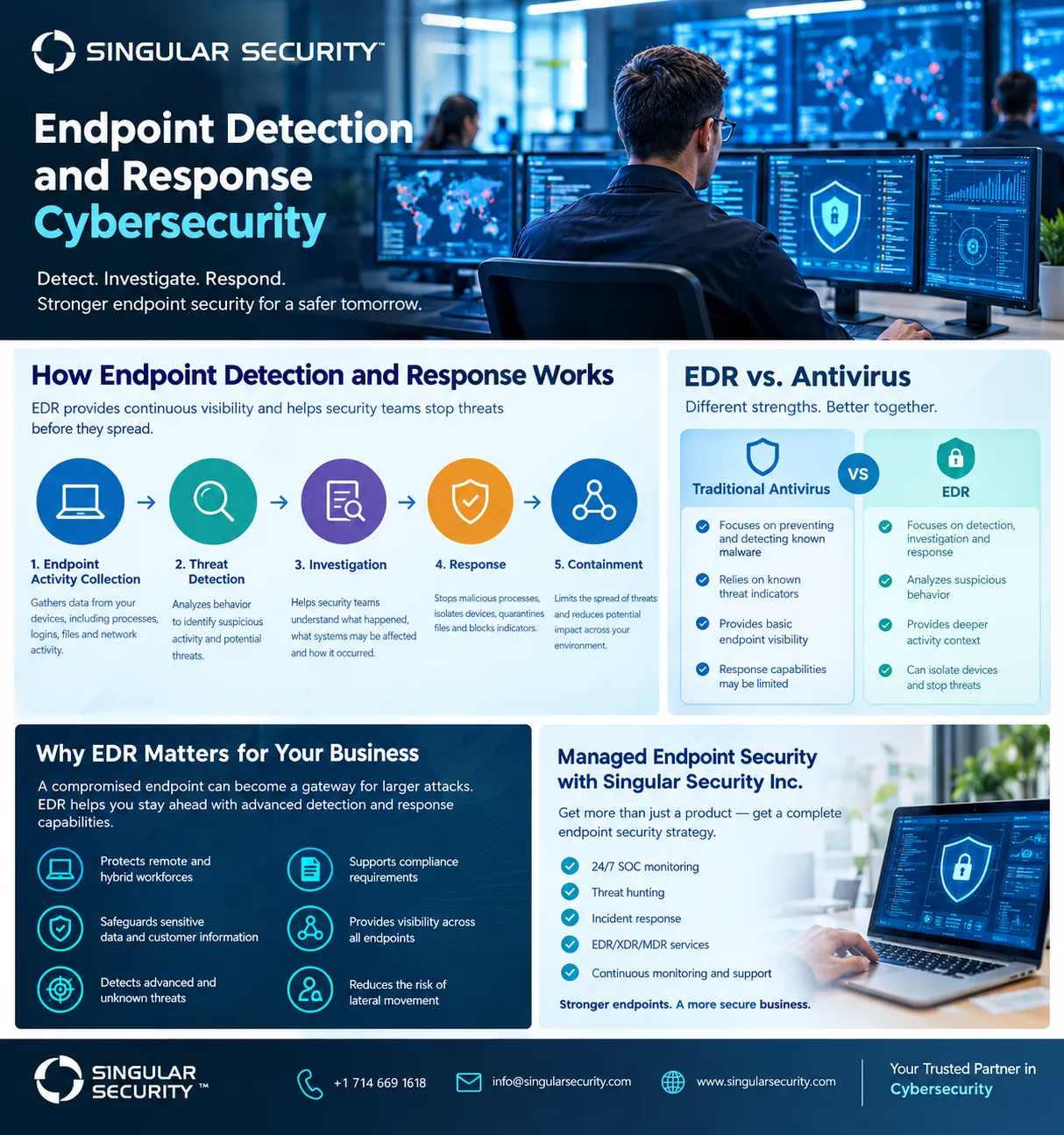
Instead of focusing only on whether a known malicious file exists, EDR can examine processes, applications, network connections, login activity, files, and system changes. This additional context can help security teams investigate suspicious events and determine whether an attack is taking place.
How Does EDR Work?
A typical EDR process involves several connected activities.
1. Endpoint Activity Collection
EDR collects security telemetry from protected devices. Depending on the platform, this may include process activity, network connections, user logins, file changes, scripts, and other system events.
This information gives security analysts greater visibility into what is happening on individual endpoints.
2. Threat Detection
The system analyzes endpoint behavior to identify suspicious activity. For example, unusual processes, unexpected scripts, unauthorized changes, or abnormal network connections could trigger an alert.
Modern EDR solutions can provide near-real-time detections that give analysts actionable information for investigation.
3. Investigation
When an alert occurs, security teams need to determine what happened.
EDR can help analysts establish:
- Which endpoint was affected
- Which user account was involved
- What process initiated the activity
- How the suspicious activity developed
- Whether other systems may be affected
This context can reduce the time required to investigate an incident.
4. Response and Containment
Detection is only one part of cybersecurity. Organizations also need to respond quickly when a threat is confirmed.
Depending on the EDR platform and configuration, response capabilities can include isolating a device, stopping a malicious process, quarantining a file, or blocking specific indicators.
By containing an affected endpoint, organizations may be able to reduce the opportunity for attackers to spread further across the environment.
Why Is EDR Important for Businesses?
A compromised endpoint can become an entry point for a much larger attack. Once attackers gain access to a device, they may attempt to steal credentials, establish persistence, move laterally, or access sensitive information.
EDR helps security teams focus on behavior and activity, rather than relying solely on known malware signatures.
This is particularly important for businesses with:
- Remote or hybrid employees
- Large numbers of endpoints
- Sensitive customer information
- Cloud-connected devices
- Distributed IT environments
- Limited internal security staff
- Strict compliance requirements
CISA guidance also identifies EDR as a useful capability for monitoring and responding to threats on endpoint devices, including ransomware-related risks.
EDR vs. Traditional Antivirus
Antivirus and EDR are not necessarily competing technologies. They can serve different roles within a broader endpoint security strategy.
Traditional antivirus typically focuses on preventing and detecting known malicious software. EDR adds deeper visibility into endpoint behavior and provides investigation and response capabilities.
| Traditional Antivirus | EDR |
|---|---|
| Focuses heavily on malware prevention | Focuses on detection, investigation, and response |
| Often relies on known threat indicators | Can analyze suspicious behavior |
| Provides basic endpoint visibility | Provides deeper activity context |
| Response capabilities may be limited | Can support endpoint isolation and other actions |
For many organizations, using endpoint protection together with EDR provides a stronger defensive approach than relying on a single security layer.
What Threats Can EDR Help Detect?
EDR can help identify different types of suspicious endpoint activity, including:
- Ransomware behavior
- Malware infections
- Credential theft
- Malicious scripts
- Suspicious processes
- Unauthorized access
- Persistence mechanisms
- Unusual network connections
- Potential insider activity
EDR can also help security teams investigate the sequence of events surrounding an alert instead of viewing the event in isolation.
EDR Is More Effective as Part of a Wider Security Strategy
Although EDR is powerful, it should not operate as an isolated security tool.
A stronger cybersecurity program can combine EDR with:
- Multi-factor authentication
- Identity and access management
- Email security
- Firewalls
- Security awareness training
- Vulnerability management
- SIEM solutions
- Threat intelligence
- Data backups
- Incident response planning
- Security monitoring
This layered approach helps organizations address different stages of an attack.
For example, MFA can make stolen credentials harder to abuse, while EDR can help identify suspicious activity occurring on a compromised endpoint.
Challenges Businesses Should Consider
Implementing EDR does not automatically solve every endpoint security problem.
Organizations should consider alert volume, configuration, endpoint coverage, integration with existing security tools, and the availability of personnel who can investigate alerts.
Poorly configured EDR can produce excessive notifications, while insufficient monitoring can leave security events unnoticed.
This is why businesses should consider not only the technology itself but also who will monitor alerts and how incidents will be handled.
How Singular Security Inc. Supports Endpoint Security
Businesses that do not have the resources to maintain a large internal security operations team can work with a managed cybersecurity provider.
Singular Security Inc provides cybersecurity services that include endpoint protection, 24×7 SOC monitoring, threat hunting, incident response, and managed security support. Its approach combines endpoint security capabilities such as EDR/XDR/MDR with continuous monitoring and analyst support.
This can help organizations move beyond simply deploying an endpoint security product and toward a broader process of monitoring, investigation, and response.
For organizations evaluating endpoint detection and response cybersecurity, Singular Security Inc. can help assess the environment, identify security priorities, and develop an endpoint protection strategy aligned with business requirements.
Building a Stronger Endpoint Security Strategy
Endpoints remain an important part of the modern attack surface. Employees work from different locations, businesses rely on cloud applications, and devices regularly connect to corporate resources.
EDR provides organizations with greater visibility into endpoint activity and gives security teams tools to detect, investigate, and respond to suspicious behavior.
However, technology works best when combined with appropriate policies, monitoring, trained security personnel, identity controls, and incident response procedures.
A well-planned endpoint detection and response cybersecurity strategy can therefore become an important component of a broader program designed to identify threats earlier and reduce their potential impact.
Frequently Asked Questions
1. What is endpoint detection and response cybersecurity?
Endpoint detection and response cybersecurity refers to security technologies and processes that monitor endpoint activity, detect suspicious behavior, investigate potential threats, and support response actions.
2. Is EDR better than antivirus?
EDR and antivirus serve different purposes. Antivirus primarily focuses on preventing and detecting malware, while EDR provides deeper endpoint visibility, investigation capabilities, and response functions. Organizations can use both as complementary security layers.
3. What does EDR detect?
EDR can help detect suspicious processes, malware, ransomware behavior, malicious scripts, unusual network connections, credential-related activity, persistence attempts, and other abnormal endpoint behavior.
4. Does EDR protect remote employees?
Yes. EDR can monitor supported company-managed endpoints used by remote employees. This provides security teams with visibility even when employees are working outside the traditional corporate network.
5. Can EDR stop ransomware?
EDR can help identify suspicious ransomware-related behavior and, depending on the platform and configuration, support actions such as isolating affected devices or stopping malicious processes. CISA recommends considering EDR as part of ransomware defenses.
6. Do small businesses need EDR?
Small businesses can benefit from EDR, particularly when they manage sensitive information, have remote employees, or lack extensive internal security resources. The appropriate solution depends on the organization's environment and risk profile.
7. Is EDR enough for cybersecurity?
No. EDR is one component of a broader cybersecurity strategy. Organizations should also consider identity security, MFA, network security, email protection, vulnerability management, backups, security awareness, and incident response.
8. How can Singular Security Inc. help with endpoint security?
Singular Security Inc. provides endpoint protection, continuous monitoring, threat hunting, SOC services, and response support designed to help organizations strengthen their overall security posture.






























Sign in to leave a comment.