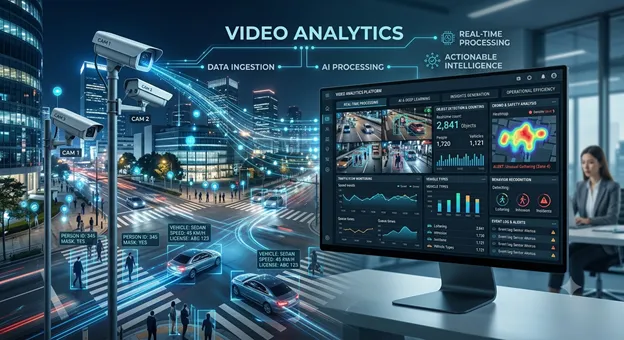

AI-Powered PPE Detection is transforming how organizations across the UAE protect their people on-site. As construction, oil and gas, manufacturing, and logistics operations grow more complex, safety teams need instant, dependable visibility into helmet, vest, glove, and mask compliance. Backed by advanced Video Analytics, this technology closes the gaps that manual spot-checks routinely miss, helping supervisors prevent incidents before they happen rather than reacting after the fact.
From Dubai's high-rise construction corridors to Abu Dhabi's energy facilities, employers are under growing pressure to meet stringent HSE regulations while keeping large, distributed workforces safe. Traditional CCTV systems only record footage for after-the-fact review — they cannot flag a missing hard hat in real time or alert a site manager the moment a worker enters a hazardous zone without proper gear. This is precisely the gap that intelligent, camera-based safety automation is built to close.
The Growing Need for Workplace Safety Automation in the UAE
The UAE's rapid infrastructure growth, ambitious industrial diversification, and Vision 2031 goals have placed workplace safety firmly at the center of national policy. Regulators such as Dubai Municipality and the Ministry of Human Resources and Emiratisation continue to tighten HSE compliance requirements for construction, manufacturing, and energy sectors. At the same time, site footprints are expanding, workforces are more transient, and supervisors are stretched thin across multiple zones.
This is where Video Analytics UAE deployments are proving indispensable. Instead of relying on a limited number of safety officers to physically patrol a site, organizations can now equip their existing camera infrastructure with computer-vision models that continuously monitor compliance, flag violations instantly, and generate audit-ready reports for regulators and insurers alike.
What Is AI-Powered PPE Detection?
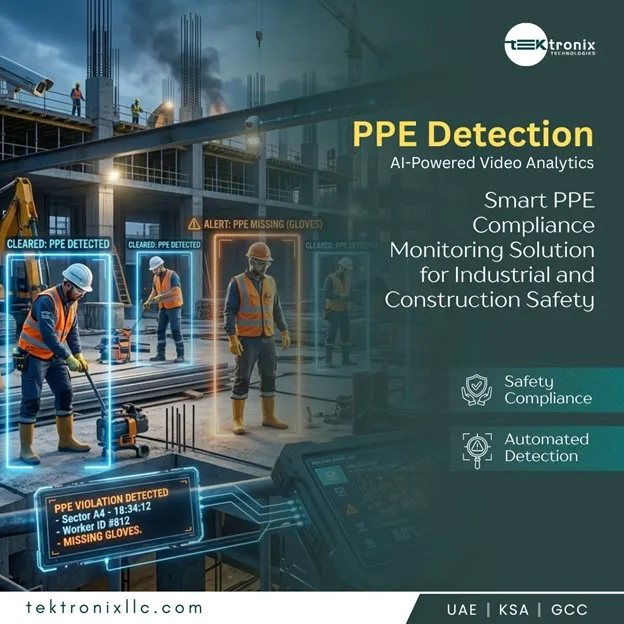
AI-Powered PPE Detection uses deep-learning computer vision to automatically identify whether workers are wearing required protective equipment — hard hats, high-visibility vests, safety goggles, gloves, harnesses, and respiratory masks — the moment they enter a monitored zone. Rather than storing raw footage for someone to review later, the system analyses each video frame instantly, cross-checks it against site-specific safety rules, and triggers an alert the second a violation is detected.
This capability sits within a broader category of AI-Powered Video Analytics, where machine-learning models are trained to recognize objects, behaviours, and patterns from live or recorded video streams. For PPE monitoring specifically, the models are fine-tuned on thousands of real-world site images so they can reliably distinguish compliant workers from non-compliant ones, even in low light, at odd camera angles, or amid heavy site dust — conditions common on UAE job sites.
How Video Analytics Software Powers PPE Compliance
At its core, modern Video Analytics Software combines edge-AI processing, cloud dashboards, and existing IP camera networks into a single monitoring layer. Edge devices analyse footage close to the camera for near-instant detection, while the cloud platform aggregates data across every site, zone, and shift into a unified compliance dashboard that safety managers can access from anywhere.
A typical PPE compliance workflow looks like this:
- Cameras capture live video feeds from entry points, high-risk zones, and general work areas.
- The AI engine scans each frame to detect workers and classify the PPE items they are wearing.
- Any missing or incorrectly worn equipment triggers an instant alert to the site supervisor's dashboard or mobile device.
- Every event is logged automatically, building a searchable compliance history for audits and insurance reporting.
Organizations evaluating this technology can review Tektronix's video analytics solutions in Dubai to see how existing camera infrastructure can be upgraded into a fully automated safety-monitoring layer without a full hardware overhaul.
Benefits of Video Analytics Solutions for UAE Businesses
Deploying comprehensive Video Analytics Solutions delivers measurable value well beyond regulatory compliance. Organizations across construction, oil and gas, logistics, retail, and facilities management are adopting this technology to strengthen safety culture while controlling operational costs.
- Fewer workplace incidents: instant alerts allow supervisors to correct non-compliance before an accident occurs.
- Lower insurance and liability exposure: automated compliance logs provide defensible evidence for claims and audits.
- Reduced manual oversight costs: fewer personnel are needed for routine PPE spot-checks and patrols.
- Faster regulatory reporting: HSE compliance reports are generated automatically instead of compiled by hand.
- Scalable across multiple sites: a single dashboard can monitor dozens of locations simultaneously.
For organizations comparing platforms, it is worth exploring dedicated video analytics software built for UAE job sites, since generic surveillance tools rarely offer the industry-specific detection models, Arabic-English reporting, and local support that regional deployments require.
Data Privacy and Responsible AI Use in Workforce Monitoring
As camera-based monitoring expands, organizations must balance safety gains with worker privacy and UAE data-protection expectations. Reputable platforms process video for compliance detection without permanently storing unnecessary biometric data, restrict dashboard access by role, and maintain clear audit trails showing who viewed which footage and when. Workforce monitoring initiatives tend to gain the most acceptance when management communicates transparently with employees about what is being monitored, why, and how the resulting data will and will not be used.
Responsible deployment also means avoiding automated disciplinary action based purely on a single flagged event. The most effective programs use AI detection to prompt coaching and immediate correction on site, reserving formal action for genuine repeat patterns — keeping the technology positioned as a safety enabler rather than a surveillance tool aimed at penalizing workers.



























Sign in to leave a comment.