Enterprise Video Compliance: What Businesses Need to Know Before Publishing Video at Scale

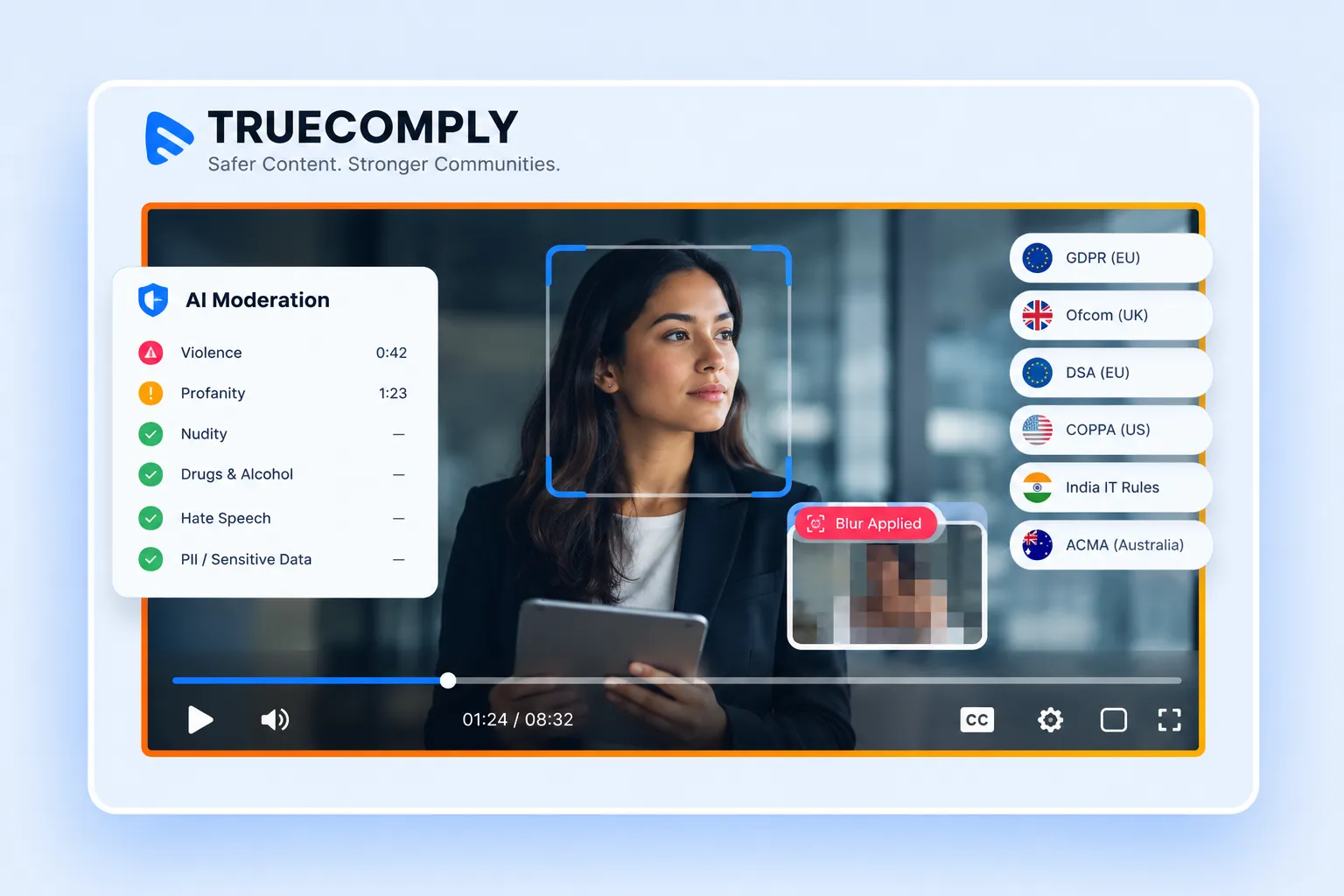
Video is no longer something businesses create only for marketing.
Companies use it for employee training, webinars, product demonstrations, customer education, internal communications, live events, and, in some cases, entire streaming services. As those video libraries grow, another problem starts to surface: how do you make sure all that content is safe and compliant before it reaches an audience?
That is where enterprise video compliance comes in.
For a small team with a handful of videos, checking content manually may be manageable. For an enterprise handling hundreds or thousands of hours of video across different countries, languages, and platforms, it becomes much harder.
A compliance process needs to account for what appears on screen, what is said in the audio, which market the content is being distributed in, and what the company's own content policies require.
What is enterprise video compliance?
Enterprise video compliance is the process of reviewing video and audio content to make sure it meets applicable regulations, company policies, safety requirements, and distribution standards.
That review can cover everything from explicit or violent material to profanity, hate speech, sensitive information, age-restricted content, and other categories an organization considers inappropriate or risky.
It can also involve requirements that are less obvious when looking at the video itself. Privacy, accessibility, copyright, regional regulations, content classification, and record-keeping can all become part of the compliance process.
For an enterprise, the real difficulty isn't knowing what should be checked. It is doing it consistently across a large volume of content.
Imagine a streaming business preparing 2,000 hours of programming for release in several markets. Asking a team to watch every minute, record every issue, send videos back for editing, and check them again after the edits would take a significant amount of time.
This is why many organizations are moving toward a combination of automated analysis and human review.
Why video compliance becomes difficult at enterprise scale
Video creates a different compliance challenge from text.
A document can be searched for specific words. A video may contain information in several forms at the same time.
Someone might say something inappropriate while the screen shows something completely different. A person's face, an address, a document, a product label, or another sensitive element could appear for only a few seconds.
There is also the question of context.
A news report showing violence is not necessarily treated the same way as entertainment content showing violence. A medical training video might contain material that would be inappropriate in a general-audience program but perfectly legitimate in its intended context.
This is one reason a simple “safe” or “unsafe” label isn't enough for many enterprise workflows.
A useful compliance system should help a reviewer answer:
- What was detected?
- Where does it appear in the video?
- How serious is it?
- Which policy applies?
- Does it actually require action?
- What should be done with the content?
- Who approved the final version?
That information is much more useful than a single automated score.
What does a typical enterprise video compliance process look like?
There isn't one workflow that works for every organization, but most large-scale video operations have a similar set of steps.
1. Video enters the workflow
The content may come from a video CMS, media library, production system, live-stream recording, API, or user upload.
At this stage, organizations can decide whether every video should be checked or whether only specific content types, regions, or channels require review.
2. The content is analyzed
Automated tools can scan the video and audio for categories defined by the organization.
Depending on the platform, this can include things such as:
- Nudity and sexual content
- Violence
- Profanity
- Hate speech
- Drugs and alcohol
- Tobacco and smoking
- Gambling
- Self-harm
- Obscene gestures
- Sensitive visual content
- Personally identifiable information
- Custom content categories
The important point is that automated analysis should surface potential issues, not automatically make every final compliance decision.
3. Reviewers investigate flagged moments
Instead of watching an entire 60-minute video, a reviewer can jump directly to the moments that need attention.
That makes a significant difference to a compliance team.
For example, if a system identifies potentially problematic content at 12:42 and 38:17, the reviewer can inspect those sections, consider the context, and decide what action is appropriate.
This human review step is particularly useful when the same piece of content can have different implications depending on its purpose or audience.
4. The content is fixed when necessary
Finding an issue is only half the job.
Sometimes the content can still be published after making a small change. Depending on the situation, that could mean blurring part of a frame, muting audio, removing a short section, adding a warning, or applying another restriction.
There is no reason to throw away an otherwise useful 90-minute video because of one problematic five-second section.
A good compliance workflow should therefore connect detection with remediation.
5. The decision is recorded
For businesses operating at scale, keeping a record of the review matters.
A useful report might show what was detected, when it was detected, which rule was applied, who reviewed it, and what action was taken.
This creates a history that can be useful when a compliance team needs to revisit a decision or demonstrate how content was reviewed.
Where does AI fit into enterprise video compliance?
AI is useful because of the sheer amount of content enterprises have to process.
It can go through video frames and audio much faster than a person can. Instead of asking reviewers to start every video from the beginning, an automated system can identify sections that deserve attention.
But there is an important distinction here.
AI-powered detection is not the same thing as compliance.
An AI model may identify a person smoking in a video. Whether that is actually a violation depends on the organization's policy, the context, the audience, and potentially the market where the video will be distributed.
The better approach is to use AI as the first layer of the process and allow people to handle decisions that require context.
This human-in-the-loop model is particularly useful for enterprises because it balances speed with accountability.
Different countries can mean different compliance requirements
A video that is acceptable in one market may require additional review in another.
That becomes particularly important for companies distributing OTT, broadcast, educational, or user-generated content internationally.
Depending on where the service operates and what type of content it distributes, an organization may need to consider regulatory frameworks and requirements associated with bodies and laws such as Ofcom in the UK, the Digital Services Act and AVMSD in the European Union, India's IT Rules, ACMA-related requirements in Australia, COPPA in the United States, and IMDA requirements in Singapore.
These regulations should not be treated as interchangeable checklists. Each applies in a particular legal and operational context.
For an enterprise operating across multiple markets, the compliance workflow therefore needs to be flexible enough to apply different rules to different content.
This is where regional moderation profiles can be useful. Instead of creating a completely separate process for every market, organizations can establish policies that correspond to the regions in which their content is distributed.
What should you look for in enterprise video compliance software?
Buying a compliance platform isn't simply about finding the system with the longest list of detection categories.
The more important question is whether it fits the way your organization actually handles video.
Detection across video and audio
A platform should be able to examine more than just the video frames. Spoken language and other audio signals can be equally important when looking for profanity, hate speech, or other policy violations.
Precise timestamps
A reviewer should be able to see exactly where an issue was detected.
This saves time and makes the review process much easier to manage.
Custom policies
Predefined categories are useful, but every business has its own rules.
A broadcaster, an e-learning platform, and a corporate training department may have completely different ideas about what needs to be flagged.
Custom moderation categories can help organizations reflect those differences.
Regional policies
If content is distributed internationally, the platform should make it possible to apply different compliance profiles based on the target market.
Human review
There should be a straightforward way for a reviewer to inspect a flagged section and make the final decision.
Automation should reduce repetitive work, not remove judgment where judgment is required.
Remediation
Look for tools that can do something with the findings.
Depending on the use case, that might include blurring, muting, beeping, removing a frame or section, or adding a content label.
Reporting and audit trails
A compliance process becomes much easier to manage when there is a clear record of what happened to every flagged asset.
API access
Large organizations rarely want another isolated dashboard.
They may already have a CMS, DAM, video platform, storage system, or internal publishing workflow. APIs allow compliance checks to become part of those existing processes.
Who needs enterprise video compliance?
The use cases extend well beyond traditional broadcasters.
OTT and streaming services can use compliance checks before publishing content to different markets.
Broadcasters and media companies can review programming before distribution and identify sections that require attention.
E-learning platforms may need to review both internally produced material and user-submitted content.
Large enterprises can apply consistent policies to training libraries, webinars, employee communications, and customer-facing videos.
UGC platforms face an even larger challenge because they may receive new content continuously from thousands or millions of users.
Live event businesses also have a growing need to review recordings after conferences, sports events, webinars, and other broadcasts.
The common factor is volume. Once an organization has enough content, manual review alone becomes difficult to sustain.
Enterprise video compliance is more than content moderation
It is easy to think of compliance as simply finding offensive or sensitive material in a video.
In practice, enterprise compliance can cover a much wider set of responsibilities.
Content moderation is one part of it. Other areas can include privacy, accessibility, security, copyright, age classification, regional regulations, internal content policies, and documentation.
That broader view changes how companies should evaluate compliance technology.
The question isn't just:
“Can this software detect inappropriate content?”
It is:
“Can this software become part of our video governance process?”
That is a much more useful question for an enterprise.
How Muvi TrueComply fits into the workflow
For organizations that manage large volumes of video, Muvi TrueComply provides an AI-powered compliance workflow for analyzing content, identifying potentially sensitive material, reviewing findings, and taking corrective action.
The platform supports visual and audio analysis, predefined moderation categories, custom categories, regional moderation profiles, and remediation options.
For example, a business can submit video content for analysis, review flagged moments, and apply actions such as blur, mute, beep, or removal where appropriate.
TrueComply also supports API-based workflows, which can be useful when compliance needs to be connected to an existing media or publishing infrastructure rather than handled as a separate manual process.
The bigger benefit is the workflow itself: content can be checked before it moves further down the publishing pipeline, rather than discovering compliance issues after distribution.
What does the future of enterprise video compliance look like?
Video libraries aren't getting smaller.
More businesses are producing video, more platforms are accepting user-generated content, and more organizations are distributing content internationally.
That makes a purely manual compliance process increasingly difficult to maintain.
At the same time, fully automated decisions aren't always appropriate. Context matters, and regulations can be complicated.
The practical middle ground is a workflow where machines handle the repetitive scanning, people review the cases that need judgment, and the organization keeps a clear record of the decisions.
For enterprises, that means video compliance becomes part of the normal content lifecycle:
Create → Analyze → Review → Remediate → Approve → Publish
That's a much more scalable approach than treating compliance as a final check before a video goes live.




Sign in to leave a comment.