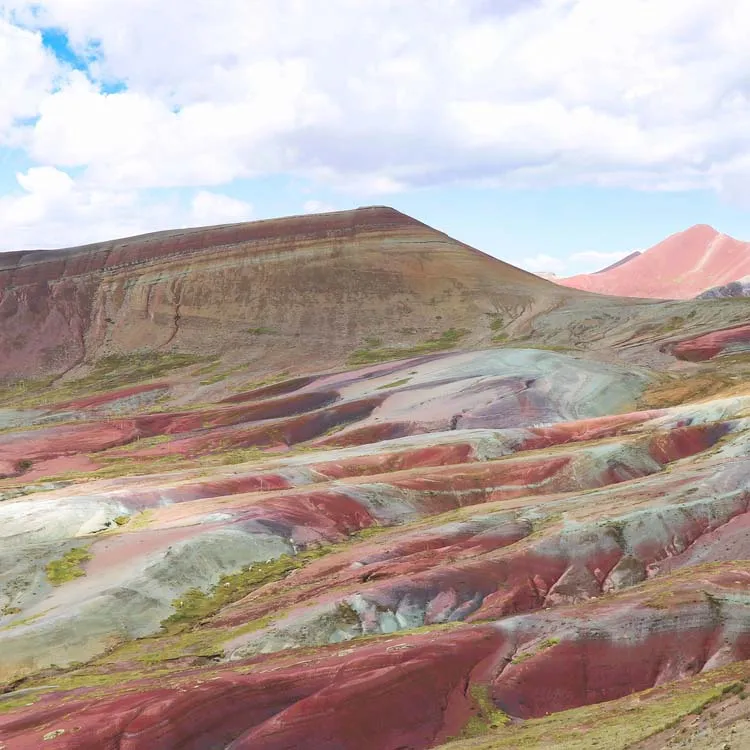

Rainbow Mountain’s colors are not painted onto the rock. They result from ancient sediments, mineral chemistry, tectonic uplift, erosion, weathering, and changing ice cover. To understand what causes Rainbow Mountain’s colors, it helps to look beneath the stripes and consider the natural processes that produced them.
Ancient Sediments Became Colorful Rock
Long before Vinicunca became a destination, layers of sediment accumulated in the region. Sand, mud, clay, and mineral-rich material settled in ancient environments, gradually becoming sedimentary rock. Different layers contained different mineral combinations, helping create the contrasting colors visible on the mountain.
The Andes then rose through powerful tectonic forces. As the Nazca Plate moved beneath the South American Plate, rocks across the region were uplifted and deformed. Layers that had formed in flatter settings were tilted and brought closer to the surface. Their arrangement is why the colors appear as stripes rather than scattered patches.
Minerals Create the Color
The familiar red and pink shades are associated with iron-bearing material. When iron-containing minerals react with oxygen and moisture, oxidation can produce reddish tones similar to rust. Other layers contain quartz-rich sandstone, carbonate-rich material, clays, and ferromagnesian minerals, contributing pale, white, green, brown, yellow, and ochre shades.
Not every color comes from one isolated mineral. Several minerals can occur within the same layer, while weathering changes how materials appear at the surface. Sunlight, moisture, cloud cover, and rainfall can make the same bands look stronger or softer from one visit to another.

How Ice Helped Reveal the Stripes
Rainbow Mountain’s modern appearance is also connected to changing ice cover. For years, snow and glacial ice covered portions of the colored rock, keeping some mineral bands hidden. As temperatures changed and ice retreated, more underlying rock became visible.
That recent exposure is important because it can make a geological feature seem newly created when it is actually extremely old. The minerals and sedimentary layers formed over geological timescales; what changed more recently was how much of them visitors could see.
Glacial retreat in the Andes is part of a broader environmental story. High-altitude glaciers respond to temperature and precipitation changes, and their retreat can expose rock previously protected by ice. At Rainbow Mountain, this has helped reveal the striped formations that attract visitors today.
Weathering Keeps Changing the Surface
Exposure does not stop once the ice disappears. Wind, rain, freezing temperatures, sunlight, and repeated wetting and drying continue to affect exposed rock. These forces gradually break down minerals and move loose sediment, while oxidation can alter mineral surfaces.
The colors are not permanently fixed. Their basic geological origin remains, but the surface can change over time. Rain may darken the bands temporarily, while dry, sunny conditions can make reds, yellows, and pinks appear more pronounced.
Why Preservation Matters
The same natural processes that revealed Rainbow Mountain can also wear it down. Foot traffic, loose sediment, rainfall, and erosion can affect exposed surfaces and paths. Because the colored layers formed over millions of years, damage caused today cannot simply be replaced on a human timescale.
Responsible visitation therefore matters. Staying on established routes, avoiding unnecessary contact with exposed rock, carrying waste away, and respecting local conservation guidance can reduce pressure on the site.
Seeing the stripes this way changes the experience: each band represents conditions that existed long before modern roads, trails, or tourism reached the Andes. The colors are evidence of Earth’s changing chemistry and climate.

Seeing the Science in Person
A Rainbow Mountain tour can make the geology easier to appreciate because the colored bands become more than a photograph when their origins are understood.
For travelers planning a day trip from Cusco, learning the geological story beforehand can add meaning to every viewpoint. A private tour can also provide time for a slower visit and more attention to natural details along the route.
Rainbow Mountain is a reminder that color can be a record of geological time. From ancient sediments and mineral reactions to tectonic uplift and retreating ice, each visible band reflects part of Earth’s history. To experience that story respectfully, consider planning your visit with Rainbow Mountain Expeditions. Contact them today.
About the Author
Sam Morales is a travel writer who focuses on natural landmarks, outdoor destinations, and practical travel education. His work connects geological facts with clear explanations that general readers can understand. He enjoys learning how climate, rock formation, and human activity shape memorable places.

























Sign in to leave a comment.