
The eReader Market at an Inflection Point: Strategic Trends and Commercial Opportunities
The global eReader market is moving through a period of measured expansion rather than explosive disruption. Revenue has grown from roughly $163 million in 2020 to about $215 million in 2025, with projections extending past $340 million by 2032. The implied compound annual growth rate across the 2026–2032 horizon sits near 7%, a trajectory that signals steady demand rather than speculative hype. This is not a category defined by rapid replacement cycles or flashy hardware launches; it is a mature, utility-driven segment where reading quality, battery endurance, content access, and total cost of ownership shape purchasing decisions. For executives and investors, the strategic question is no longer whether eReaders will matter, but where value will concentrate as the market matures, bifurcates, and responds to regulatory and supply chain pressures.
Behind the steady headline numbers, the category faces a set of structural challenges that will determine which players can defend margins and which will be squeezed by commoditization.
Key Challenges and Turning Points
First, the segment is navigating a tension between specialization and convergence. A pure reading device competes against tablets, smartphones, and multipurpose e-ink Android devices that blur the boundary between reading, note-taking, and light productivity. Differentiation must therefore come from display characteristics, reading software, content ecosystem access, or use-case focus rather than from raw hardware prestige alone. Second, supply chain and regulatory dynamics are adding cost and sourcing uncertainty. Trade policy actions involving critical minerals and related finished components have reached e-reader-relevant semiconductor and display supply paths, while tariff and import restrictions on processed minerals and derivatives took effect in early 2026. These pressures can influence bill-of-materials costs, lead-time planning, and regional sourcing strategies, especially for manufacturers that depend on tightly coordinated display and chip pipelines. Third, the display technology mix is shifting in ways that could alter both user expectations and unit economics. E-ink remains central, yet the emergence of color e-paper and broader experimentation with alternative display formats is expanding the design envelope. At the same time, production scaling for larger e-paper modules through strategic manufacturing partnerships indicates that the industry is investing in capacity and format diversification, which may reshape price points and product positioning over the next few years.
Together, these forces create a market that rewards clarity of positioning, disciplined cost planning, and ecosystem alignment more than brute-force feature expansion.
Key Drivers Shaping the eReader Market
Several interlocking forces are underpinning the category’s trajectory. None operates in isolation; each reinforces or constrains the others, which is why the most resilient strategies tend to address technology, demand, policy, and supply chain considerations simultaneously.
Worldwide eBook Sales Platform Market
Technology Innovation and Display Evolution
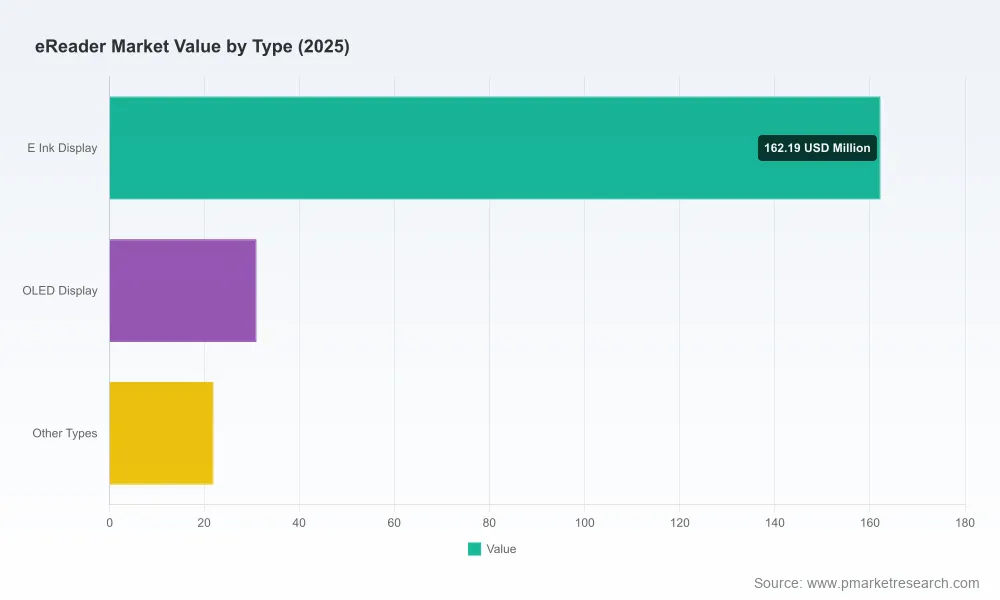
The most visible driver is the continued refinement of e-paper technology and surrounding subsystem design. The category has long been anchored by E Ink–style displays, and that segment remains the largest share of the market by device type. Yet the practical story is broader: improvements in refresh behavior, contrast, weight, and battery efficiency have steadily raised the baseline reading experience, while color e-paper options have opened new doors for textbooks, annotation-heavy workflows, and visually oriented content. On the hardware side, compact models, stylus-enabled note devices, and Android-capable e-readers illustrate a widening product architecture. This matters because the same device can now serve leisure reading, academic study, and professional annotation with different trade-offs in screen size, input methods, and software openness.
The displays are only part of the equation. Chip availability and cost also influence product planning. Global chip sales reached about 1.05 trillion units in 2025, with an average price near $0.74 per chip, indicating ample volume but also a pricing environment that rewards efficient component selection. For e-reader manufacturers, this suggests that disciplined silicon choices, display supplier relationships, and system-level optimization will remain meaningful levers for margin protection, especially as larger-format e-paper production lines come online and scale-up effects ripple through the supply base.
Policy and Regulatory Environment
Policy is becoming a more direct input into device economics. Investigations and trade actions concerning critical minerals and finished products, including semiconductors relevant to e-reader devices, have introduced new uncertainty into upstream planning. Executive orders on tariffs and import restrictions on processed critical minerals and derivatives took effect in early 2026 and can affect how components are sourced and priced. The immediate implication is not that the category will shrink, but that manufacturers and procurement teams must treat sourcing diversification, inventory timing, and regional compliance as strategic design inputs rather than back-office concerns. Companies that anticipate policy shifts and map their dependencies across displays, chips, and materials will be better positioned to maintain continuity and cost predictability.
Demand-Side Shifts in Consumption and Institutional Use
Demand is being shaped by both consumer preferences and institutional adoption patterns. On the consumer side, the appeal of low-distraction reading, long battery life, and eye-friendly displays remains strong, but users increasingly expect practical conveniences such as library integration, open format support, and better access to varied content ecosystems. On the institutional side, textbooks and educational use cases represent a substantial portion of market application demand, which makes durability, manageability, readability, and access economics especially important. Schools, universities, and content distributors are not only evaluating hardware; they are weighing entire workflows that include content licensing, device management, and long-term operating costs.
A second demand-side trend is the growing appreciation for flexibility. Open EPUB support, library connectivity, and Android-based customization options reflect a user base that values choice in content sources and software behavior. This pushes manufacturers to decide whether they want to compete primarily on a closed, tightly integrated reading experience or on openness, customization, and broader device versatility. The decision has implications forApp development, partnership strategy, and long-term brand positioning.
Supply Chain and Cost Structure Dynamics
Cost structure is being reshaped by both material-side pressures and manufacturing realignments. The joint venture formation between E Ink Holdings and AUO Display Plus for large-sized e-paper module production lines, with mass production beginning in the fourth quarter of 2025, signals an industry effort to strengthen capacity and improve the feasibility of larger displays at scale. Larger modules can enable new form factors and use cases, but they also require careful attention to yield, component costs, and product mix. Meanwhile, the regulatory environment described above can affect mineral inputs and semiconductor-related sourcing, which in turn influences final assembly economics. In this context, supply chain resilience becomes a competitive advantage: the ability to secure displays, manage chip procurement, and adapt to shifting trade conditions can differentiate one supplier’s roadmap from another’s.
Competitive Landscape and Winning Strategies
The market is not dominated by a single overwhelming leader. The combined market concentration of the top three participants sits near 25%, and the top five near 26%, indicating a moderately fragmented landscape where multiple players retain meaningful room to compete. That fragmentation matters strategically, because it means differentiation and ecosystem strength can outweigh scale alone in many sub-segments. The competitive field includes a mix of large platform-oriented players, niche device specialists, and hybrid hardware-software entrants.
Strategic Positioning and Differentiation
Amazon continues to be a dominant provider of the Kindle e-reader family, with recent Paperwhite and Scribe models emphasizing enhanced e-paper displays and added AI features. Its strategic strength lies in the combination of hardware, content reach, and software integration, which makes the Kindle ecosystem a strong reference point for integrated reading experiences. Rakuten Kobo offers a contrasting profile with models such as Clara, Libra Colour, and Elipsa, built around open EPUB support and library integrations. Kobo’s differentiation is rooted in format openness and institutional and library accessibility, which can be especially valuable in markets where content ecosystems are diverse or where public library usage is high. Barnes & Noble has been emphasizing an ad-free reading experience through Nook GlowLight and the newer Reading Tablet 8.7, a positioning that speaks to consumers seeking simplicity and focus.
Beyond the larger consumer-facing brands, a second tier of competitors competes on customization, productivity, and form-factor variety. Onyx International manufactures Boox Palma, Go series, and Note tablets with color e-paper and Android OS support, targeting users who want reading devices that can extend into broader app usage. PocketBook International produces Era Lite, InkPad, and Verse e-readers with an emphasis on long battery life and premium design, appealing to readers who prioritize endurance and build quality. ReMarkable develops an e-note with stylus support for digital writing and reading, narrowing its focus to annotation and note-centric workflows rather than general-purpose reading. Bigme supplies e-readers with open Android platforms for extended customization, and Ectaco provides model-specific variants oriented toward global market needs. This differentiated field shows that “eReader” is increasingly a family of related products rather than a single device template.
Recent Product Moves as Strategic Signals
Recent launches illustrate how companies are translating strategy into product. In May 2026, PocketBook International released a 7-inch Era Lite model with a built-in Libby app and long battery life, signaling a push toward broader accessibility and library-friendly reading. Also in May 2026, Onyx International announced the Poke 7 e-reader for upcoming release, underscoring continued interest in portable, Android-powered reading. In February 2026, Barnes & Noble launched a new NOOK Reading Tablet 8.7 with 64 GB storage and 16-hour battery life in collaboration with Lenovo, reflecting an emphasis on storage capacity, battery endurance, and partnership-based hardware execution. Each move reinforces a different strategic priority: library integration, Android portability, or ad-free reading experience with upgraded storage and endurance.
Document Readers Market
Evolution of the Market Structure
The competitive structure appears to be evolving along two parallel paths. One is consolidation around ecosystem strength, where the value of content access, software polish, and brand trust can create stickiness beyond hardware specifications. The other is differentiation through specialized use cases, such as annotation, color reading, open-platform flexibility, or institutional/library alignment. New entrants and expanding product lines are likely to keep the market diverse, but the most successful players will probably be those that can combine a clear user value proposition with disciplined supply chain planning and credible content or software access. The presence of multiple viable positions also means that partnerships, whether around content distribution, display supply, or device manufacturing, can be as important as internal hardware development.
Forward Outlook: Three Trends to Watch
Looking ahead three to five years, the eReader market is likely to be shaped by the interplay of display diversification, ecosystem competition, and supply-side risk management.
Trend 1: Broader Display Formats and Use-Case Expansion
Color e-paper, larger-format modules, and hybrid reading-plus-note devices are expanding the practical boundaries of the category. Over the next few years, this is likely to produce more products aimed at education, annotation, and visually richer reading experiences, rather than solely at black-and-white leisure reading. The commercial opportunity lies in matching display choice to use case: if larger or color displays can be produced efficiently and integrated into reliable device designs, manufacturers can open new segments without abandoning the core reading value proposition. The risk is that format expansion raises cost and complexity faster than demand justifies, especially if supply for new display types remains constrained or if users do not uniformly value the added features.
Trend 2: Ecosystem Access as a Competitive Moat
As hardware specifications become more comparable across mid-tier devices, content access, file-format flexibility, library connectivity, and software experience will increasingly differentiate brands. Winners are likely to be those that make it easy for readers to move between personal libraries, institutional access, and open formats without friction. For companies, this means that partnerships and platform decisions may matter as much as industrial design. The opportunity is to build a reading experience that feels complete rather than device-bound. The risk is over-indexing on hardware while underestimating the importance of content relationships,App usability, and support for diverse reading workflows.
Trend 3: Supply Chain and Policy Resilience as a Strategic Requirement
Because critical minerals, semiconductor-related inputs, and tariff or import constraints can affect device economics, resilience in sourcing and planning will become a more visible competitive factor. Manufacturers that diversify suppliers, plan for policy volatility, and align product roadmaps with realistic cost assumptions are more likely to sustain margins and launch timing reliability. The opportunity is to treat supply chain design as part of product strategy, not just operations. The risk is complacency: assuming stable input costs or single-source dependencies in a period when trade and materials policy is actively evolving.
What This Means for Decision Makers
The strategic takeaways differ by role, but they share a common theme: the eReader market rewards focus, execution discipline, and awareness of external pressures more than generic hardware competition.
PW Consulting Health Care Research Center
For Manufacturers and Device Brands
Define a clear device identity before expanding the feature set. A strong position can be built around readability, battery endurance, annotation, openness, library access, or color display utility, but the value proposition should be coherent and targeted. Prioritize display and chip choices that fit the intended use case, and avoid over-engineering for audiences that mainly want simplicity and reading comfort. Build supply chain flexibility into product planning, especially where critical mineral inputs, semiconductor sourcing, and display module availability intersect. Consider partnerships that strengthen content access, library integration, or platform openness if those align with the brand’s target reader.
For Investors
Look beyond top-line growth and evaluate ecosystem durability, content relationships, and supply chain exposure. The moderately fragmented concentration structure suggests room for differentiated players, but it also means that not every hardware iteration will translate into sustainable advantage. Assess whether a company’s roadmap depends on format transitions that are still scaling, whether its content access model is defensible, and whether its sourcing strategy is robust to policy and materials volatility. Vertical or capability-based consolidation may create value where content, software, and hardware can be aligned more tightly, but only if execution and user experience support the integration.
For Procurement and Sourcing Leaders
Treat component sourcing and compliance as part of product strategy. Map dependencies across displays, chips, and material inputs, and evaluate scenarios where trade actions or mineral restrictions could affect cost or availability. Where possible, plan for multiple sourcing paths and consider inventory and launch timing in light of policy-sensitive inputs. For larger-format or newer display technologies, align procurement planning with production ramp expectations so that design ambitions do not outpace supply readiness.
The broader commercial opportunity in eReaders lies in recognizing that the category is becoming more nuanced, not less. Devices are diverging by use case, display technology is expanding the design space, and policy and supply chain realities are becoming integral to product economics. For organizations that need a sharper view of segment dynamics, regional demand patterns, and detailed company-level comparisons, the underlying data set and extended analysis are available in the full PW Consulting report. The complete report provides deeper segmentation detail, company profiles, and tailored strategic guidance for manufacturers, investors, and procurement teams navigating this evolving market.
For detailed analysis of this topic, please visit the official page: eReader Market
Lacy Lee
Senior Marketing Manager
[email protected]
PW Consulting: www.pmarketresearch.com




























Sign in to leave a comment.