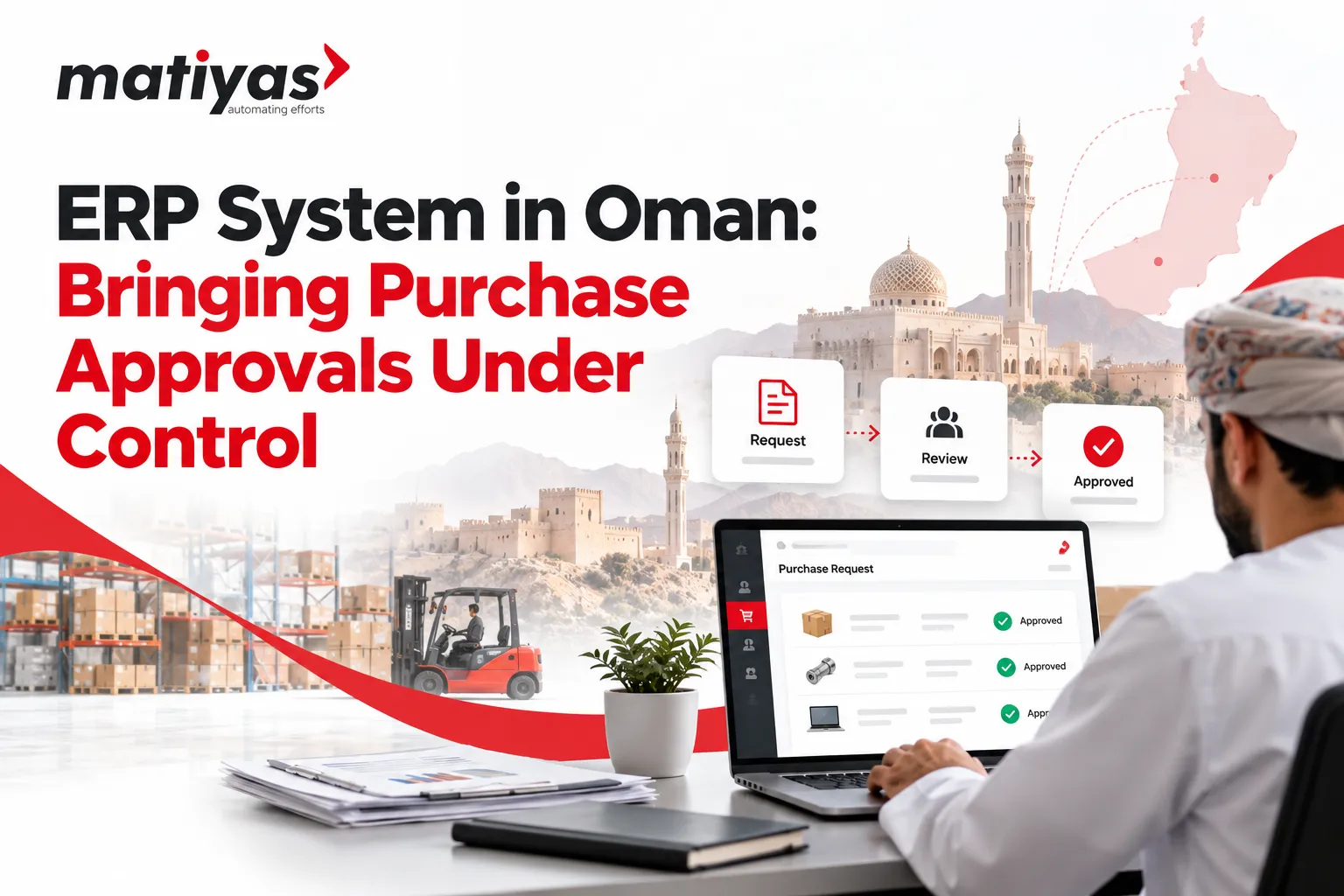

A purchase order can look straightforward: a department needs materials, a supplier provides a quotation, and the purchasing team places the order. The difficulty begins when nobody knows who should approve the expense, whether the budget is available, or whether the supplier has already received an informal commitment.
For businesses in Oman, these gaps can create unnecessary purchasing delays, unplanned spending and disagreements between procurement, finance and department managers. The problem becomes more complicated when a company operates multiple branches, warehouses, projects or business units.
An ERP system in Oman can help businesses establish a clear purchase approval process by connecting purchase requests, approval responsibilities, supplier information, budgets and accounting records within a coordinated system.
The objective is not to make every purchase wait for a director's signature. It is to ensure that the right person reviews the right transaction at the right stage, according to the company's purchasing policy.
1. Why Purchase Approvals Need More Than Emails and Signatures
Purchase approval is the control point between identifying a business need and committing company money.
In a loosely managed process, an employee may request equipment through email, receive informal permission through a messaging application and ask procurement to place an order before finance has reviewed the expense. Each person may believe the purchase is authorised, but the business may have no single, reliable record of the decision.
This creates three important problems.
Unclear spending authority. Employees may not know whether a department manager can approve routine supplies or whether a higher-value purchase requires senior management approval.
Disconnected purchasing records. The purchase request, supplier quotation, approval message and final purchase order may be stored in separate locations.
Limited financial visibility. Finance may discover a commitment only when the supplier's invoice arrives, making it harder to understand upcoming expenses and departmental spending.
These problems do not necessarily mean that employees are acting irresponsibly. Often, the approval process itself has never been properly defined.
A well-designed procurement workflow starts by establishing the rules and then uses ERP software to apply those rules consistently.
2. The Purchase Approval Challenges Oman Businesses Should Address
The appropriate controls depend on the company's size, industry and operating model. However, several practical scenarios deserve attention when reviewing procurement processes in Oman.
Purchases across multiple departments and branches
A trading company might purchase office supplies in Muscat, warehouse equipment for another location and replacement parts for its delivery vehicles. If each department follows a different approval method, management may struggle to compare expenditure or identify duplicate purchases.
An ERP-based workflow can use defined roles, departments, locations and approval rules to bring these requests into one process.
Urgent procurement without documented authorisation
Consider a maintenance team that needs a replacement component to avoid delaying a critical operation. A manager approves the purchase verbally, and the supplier receives the order immediately.
The operational decision may be reasonable, but the company still needs a record of who authorised the expense, why it was urgent and whether the purchase followed the approved exception process.
A practical ERP workflow should support documented urgent approvals without turning every emergency into an uncontrolled exception.
Supplier quotations and changing prices
A supplier may revise its quotation, delivery terms or item specifications after the original purchase request has been approved. If the purchasing team updates the order without renewed review, the final commitment may differ from the transaction management authorised.
Approval controls should therefore consider material changes to the supplier, quantity, price, scope or payment terms. The business must define which changes require reapproval rather than assuming that an earlier approval covers every subsequent revision.
Purchases that cross budget boundaries
A department may have enough budget for an individual item but exceed its spending allocation after several related purchases. Reviewing each transaction separately may not reveal the overall commitment.
Businesses should decide whether approval rules need to consider the purchase value, cumulative spending, budget availability, project allocation or a combination of these factors.
The key is to design controls around actual business risk rather than relying on a single approval threshold for every transaction.
3. How an ERP System Brings Purchase Approvals Under Control
An ERP system can connect purchasing activities with finance, inventory and management reporting. Instead of treating approval as an isolated email exchange, the company can define a documented sequence of actions.
A typical workflow might follow this structure:
1. Purchase request
Employee records the need, quantity, reason and required date.
2. Budget and policy review
Check the relevant department, project, budget and purchasing rules.
3. Authorised approval
Route the request to the manager or additional approver required by policy.
4. Purchase order
Create and issue the supplier order only after the required approvals.
5. Receipt, invoice and review
Compare the order, goods received and supplier invoice where applicable.
This sequence is a recommended business design, not a mandatory process for every purchase. A small stationery purchase may follow a shorter route, while specialised equipment, capital expenditure or project procurement may require additional checks.
The value of ERP lies in making those differences explicit and manageable.
Define approval limits and responsibilities
Companies should document which roles can request, review and approve purchases. Approval limits can be based on value, category, department, project or risk.
For example, a company might permit department managers to approve routine purchases within an authorised limit, while larger commitments require finance review and director approval. The amounts should be established by the company's own governance policy; there is no universal threshold suitable for every business in Oman.
Keep the approval decision attached to the transaction
An approval should identify the authorised person, decision, date and any relevant comments. Supporting quotations and business justifications should remain accessible alongside the purchase record.
This reduces dependence on searching old emails when finance needs to understand why an expense was approved.
Route exceptions to the right person
A purchase that exceeds a defined limit, uses an unapproved supplier or changes materially after approval may need additional review.
ERP workflow rules can route these cases for further action. The precise controls depend on the ERP configuration and the company's policies.
Prevent approval from becoming a formality
A workflow is not effective if employees can bypass it by issuing orders outside the system. Companies need to align purchasing permissions, supplier communication practices and staff responsibilities with the approval process.
For higher-risk transactions, technical controls may also be required to prevent unauthorised document submission or changes after approval.
4. ERP Modules That Support Procurement Control
Purchase approval is most effective when the relevant business functions share the same transaction information.
| ERP module | Role in purchase control |
|---|---|
| Purchasing | Records purchase requests, supplier quotations and purchase orders. |
| Workflow and permissions | Routes transactions to authorised reviewers and restricts actions by role. |
| Accounting and finance | Connects expenditure with accounts, cost centres and financial records. |
| Inventory management | Helps teams review available stock and record received materials. |
| Project management | Supports purchasing linked to projects, activities and project budgets when configured. |
| Reporting and dashboards | Helps management review pending approvals, purchasing commitments and exceptions. |
These modules should not operate as disconnected checklists. Their value comes from linking the purchasing decision to the financial and operational consequences of that decision.
For example, a warehouse manager requesting replacement stock should be able to provide a business reason, while procurement reviews supplier terms and finance considers the relevant expenditure. The approved order then becomes the reference for receiving goods and checking the supplier's invoice.
ERPNext's official documentation explains how configurable workflows support multiple approval levels and how buying settings help govern purchasing transactions. The exact controls available depend on the selected documents, configuration, permissions and any additional development required.
Frappe Documentation
+1
5. What Oman Businesses Should Consider in Their Procurement Setup
A successful ERP implementation should reflect the way the company actually buys goods and services, rather than forcing every department into an unnecessarily complicated workflow.
Purchase approvals for local and international suppliers
Oman-based businesses may purchase from domestic suppliers as well as overseas manufacturers, distributors and service providers. Their procurement processes may involve different currencies, shipping arrangements, delivery timelines and payment terms.
Approval rules should identify what management needs to review before a commitment is made. For an overseas purchase, that might include the quotation currency, payment terms, expected delivery date, freight costs and any relevant import documentation.
The ERP system should record the transaction details needed by purchasing and finance, with additional controls where the business requires them.
Tax and invoice considerations
Procurement controls should also support accurate accounting records. The Oman Tax Authority provides official VAT services and guidance, making it important for businesses to configure supplier and purchase records in line with their applicable tax treatment.
Tax Portal
+1
An approval does not, by itself, establish that a supplier invoice is correct or that a tax treatment is appropriate. Finance teams must still verify the relevant invoice details, tax treatment and supporting documentation.
Businesses should also check current local requirements when configuring ERP workflows, particularly where their activities involve imports, multiple legal entities or specialised tax treatments.
Project-based purchasing and operational expenditure
A construction-related business, industrial supplier or project contractor may need to connect purchases to a specific project, site or cost centre.
For example, a request for electrical components might be valid for one project but inappropriate for another if the relevant budget is already committed. Recording the project reference and purchase purpose helps management evaluate the request in context.
Where the business needs retention payments, subcontractor controls or specialised project-cost approval rules, those requirements should be assessed separately during implementation. They should not be assumed to be available automatically merely because a business has installed ERP software.
6. ERPNext and Odoo: Configuring the Right Approval Process
Businesses evaluating ERP solutions in Oman should assess whether the selected platform can support their approval hierarchy, purchasing documentation, reporting requirements and internal controls.
Two platforms that Matiyas Solutions works with are ERPNext and Odoo. The right choice depends on the company's requirements, existing systems, budget and implementation priorities.
ERPNext for structured purchase approvals
ERPNext supports configurable workflows with multiple approval stages, transition rules and conditions. These can be used to route relevant business documents through defined review and approval steps. Its buying settings also provide controls for parts of the purchasing transaction cycle.
Frappe Documentation
+1
A business might configure a workflow so that:
- A department employee creates a purchase request or draft order.
- The relevant manager reviews the business need.
- Finance or another authorised reviewer assesses transactions that meet defined conditions.
- An authorised approver makes the final decision.
- Procurement proceeds according to the approved process.
The workflow must be configured for the appropriate document and roles. Additional customisation may be necessary if the business needs advanced budget enforcement, complex approval delegation, specific exception rules or controls that go beyond standard configuration.
What about Odoo?
Odoo should be evaluated against the same operational requirements rather than selected based on general feature claims. During the evaluation, businesses should verify the relevant purchasing approval capabilities, user permissions, approval conditions, audit requirements and any additional applications or custom development needed.
The decision should come from a documented requirements assessment and practical testing—not from assuming that one platform will automatically reproduce the company's existing purchasing policy.
7. An Illustrative Example: A Purchase Order That Needs a Second Review
Consider a hypothetical distribution company operating in Muscat. Its procurement team buys packaging materials, warehouse supplies and replacement equipment.
The company discovers that purchase requests are approved through emails and messaging applications. When finance reviews the monthly expenses, it cannot easily distinguish between orders approved by department managers and those that required director-level approval.
The company decides to formalise its purchasing process.
Before ERP workflow controls
- Purchase requests arrive through different channels.
- Managers approve spending without a consistent record.
- Finance discovers some commitments only when invoices arrive.
- Revised quotations are not always sent back for review.
After the process is configured
- Employees record the purchase purpose and required details in the system.
- Approval rules determine which authorised roles must review each transaction.
- Supporting quotations and decisions remain linked to the purchasing record.
- Material changes trigger the review required by company policy.
- Managers can review pending approvals and purchasing commitments through available reports.
The company can then measure whether the new process is working by tracking approval turnaround time, the number of orders issued before authorisation, requests returned for missing information and purchases requiring reapproval.
These are proposed measurement criteria, not claimed results from an actual Matiyas customer. Their purpose is to help management assess whether the revised process improves control without creating unnecessary administrative delays.
8. How to Implement Purchase Approval Controls Without Slowing Operations
A common mistake is to introduce too many approval stages before understanding where the actual risks lie. This can cause employees to see the ERP system as an obstacle rather than a useful management tool.
A more practical implementation approach follows five steps.
Step 1: Map the existing purchasing process. Document how requests are raised, quotations are evaluated, approvals are given and orders are issued. Identify where informal approvals or duplicated records occur.
Step 2: Establish a clear approval matrix. Define approval limits, authorised roles, escalation rules and exceptions. Separate the person requesting a purchase from the person authorising it wherever appropriate and practical.
Step 3: Configure the workflow. Set up the relevant ERP documents, permissions, approval states and conditions. Determine how the process should handle rejected requests, revised quotations, absent approvers and urgent purchases.
Step 4: Test realistic purchasing scenarios. Test routine purchases, higher-value orders, missing quotations, changes after approval and attempts by unauthorised users to submit transactions. Confirm that the system behaves as intended.
Step 5: Train users and review performance. Explain the responsibilities of requesters, procurement staff, managers and finance. After deployment, monitor delays, exceptions and bypass attempts, then refine the workflow where justified.
The goal is controlled purchasing—not maximum paperwork.
9. How Matiyas Solutions Can Support Your Business
For companies seeking ERP software in Oman, purchase approval requirements should be discussed during the business-process assessment, before the system is configured.
Matiyas Solutions provides ERP implementation, configuration, customisation, integration, training and support services. Its Oman ERP offering covers purchasing alongside finance, inventory and other business functions.
ERP System & Solutions - Matiyas
+1
Depending on the company's requirements, the implementation process can include:
- Procurement workflow assessment: Review existing purchase requests, approval limits and authorisation responsibilities.
- ERP configuration: Define suitable workflow stages, user roles and approval conditions.
- Purchasing and finance integration: Connect approved orders with relevant financial and inventory processes.
- Custom reporting: Help managers review pending requests, purchasing commitments and approval exceptions.
- Testing and training: Validate the configured process and train employees to follow it consistently.
The scope should be agreed before implementation so that standard functionality, configuration and any additional custom development are clearly distinguished.
Businesses can explore Matiyas Solutions' ERP software and solutions in Oman to discuss their procurement requirements.
10. Conclusion: Make Every Purchase Approval Accountable
Purchase approval control is not simply about deciding who signs a purchase order. It is about establishing a reliable connection between a business need, an authorised spending decision, a supplier commitment and the resulting financial record.
For businesses in Oman, an appropriately configured ERP system can make this process easier to manage by recording approvals, defining responsibilities, documenting exceptions and connecting purchasing with finance and inventory.
The most effective approach begins with a clear purchasing policy. Approval limits must reflect the company's actual structure, and the system must be tested to ensure that unauthorised transactions cannot bypass the intended controls.
With a well-planned ERP implementation, management can gain better visibility into purchasing decisions while allowing routine procurement to move forward without unnecessary delays.



















Sign in to leave a comment.