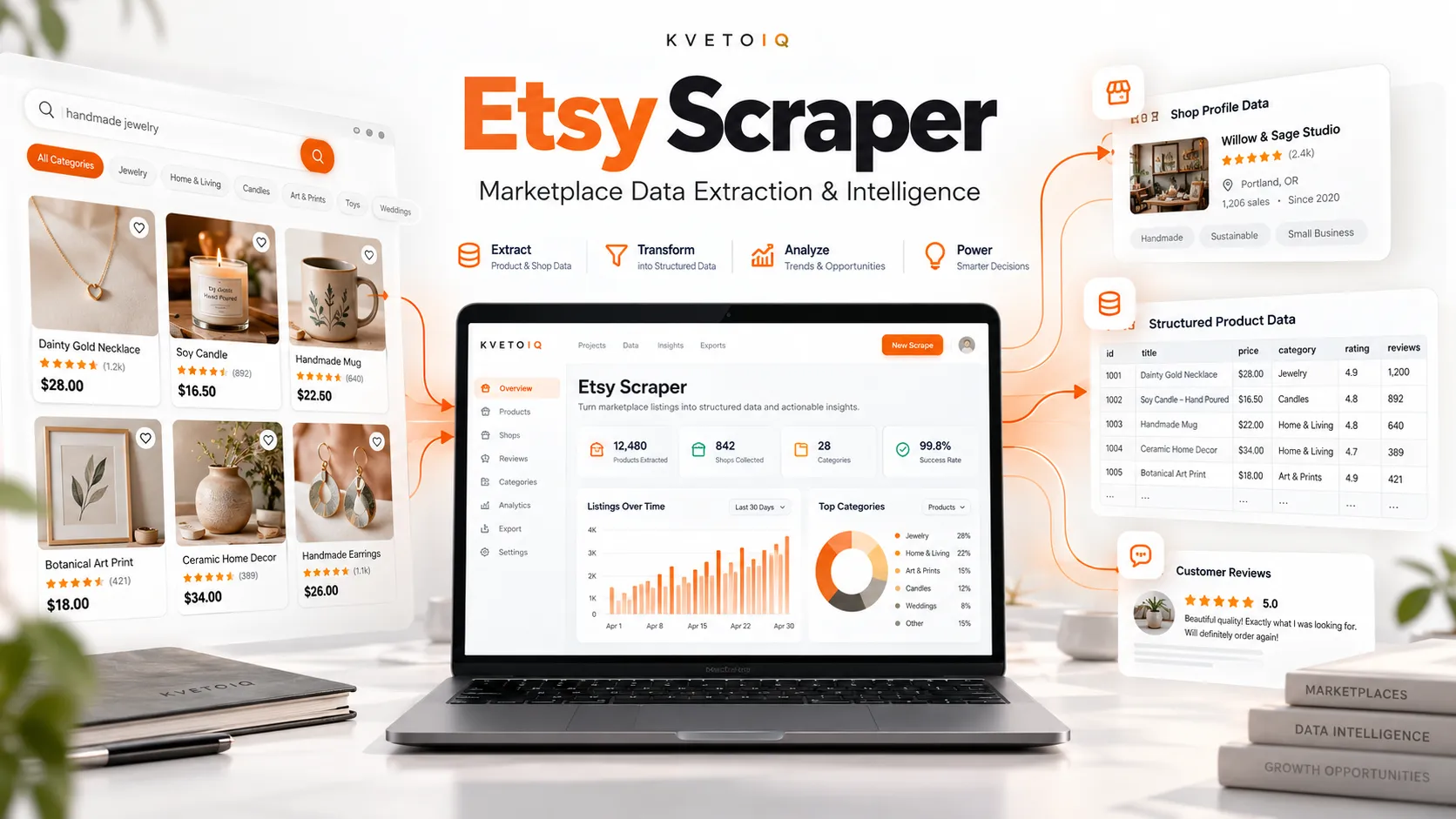

Etsy contains a large amount of useful marketplace information across product listings, shops, pricing, reviews, categories, and search results.
For ecommerce brands, research teams, retailers, and data analysts, these signals can help answer practical questions about competitors and changing market conditions.
The challenge is scale.
Manually reviewing a few Etsy listings is simple. Monitoring hundreds or thousands of products, sellers, or search results repeatedly is not.
An Etsy scraper can help turn eligible marketplace information into structured data that businesses can analyze more consistently.
1. Product Pricing and Promotions
Pricing is one of the clearest marketplace signals businesses can monitor.
A structured dataset may include:
- Current product price
- Sale price
- Discounts
- Currency
- Variation-level pricing
- Shipping costs
- Observation date
A one-time check shows the current market.
Recurring collection shows how that market changes.
Businesses can use historical observations to understand when competitors launch promotions, increase prices, or reposition products into different price ranges.
2. Product and Assortment Changes
Marketplace sellers constantly add, remove, and update listings.
Tracking those changes can help companies understand how competitors are adjusting their assortments.
Useful signals may include:
- New products
- Removed listings
- Categories
- Materials
- Product tags
- Variations
- Personalization options
- Product attributes
This can support product discovery, assortment research, and competitive benchmarking.
3. Etsy Shop and Seller Activity
Individual shops can provide valuable competitive signals.
Businesses may analyze publicly available information such as:
- Shop name
- Ratings
- Review volume
- Active listings
- Assortment breadth
- Listing activity
Repeated monitoring can help identify sellers that are expanding quickly or increasing their activity within a particular niche.
4. Customer Reviews
Reviews provide another perspective that pricing and product data cannot.
Structured public review information can help research teams identify recurring themes around:
- Product quality
- Customer complaints
- Materials
- Packaging
- Delivery
- Personalization
- Frequently praised features
Instead of manually reading individual reviews, businesses can analyze larger collections of feedback and identify common patterns.
5. Marketplace Search Visibility
Etsy search results can also be monitored for selected keywords.
For example, a company may collect:
- Search keyword
- Listing position
- Product
- Shop
- Category
- Listing URL
- Observation timestamp
This makes it possible to study which products and sellers consistently appear for commercially important searches.
When the same queries are tracked over time, businesses can also identify changes in marketplace visibility.
6. Product and Category Trends
Marketplace data can help research teams study broader product trends.
They may look at:
- Product styles
- Popular tags
- Materials
- Category growth
- Pricing bands
- New product themes
- Listing growth
These signals should not be treated as automatic proof of future demand.
Instead, they provide additional evidence that businesses can combine with sales data, customer research, and other market intelligence.
What Does a Reliable Etsy Data Workflow Need?
Collecting data is only the first stage.
For business use, the information may also need:
Normalization
Different values need to follow consistent formats.
Validation
Required fields, prices, URLs, and other values should be checked.
Deduplication
Repeated records should not distort analysis.
Timestamping
Teams need to know when each marketplace observation was collected.
Historical storage
Previous observations should be retained when change detection matters.
Structured delivery
Data may need to be delivered through CSV, Excel, JSON, APIs, databases, or cloud storage.
These steps are what turn basic scraping output into usable ecommerce intelligence.
Managed Etsy Scraping vs. DIY Collection
Browser extensions and scripts can be useful for small experiments.
However, recurring data requirements introduce additional work:
- Maintaining collection workflows
- Scheduling updates
- Monitoring source changes
- Normalizing records
- Running quality checks
- Preserving historical data
- Delivering data to downstream teams
Businesses that do not want to maintain this infrastructure internally can use a managed Etsy scraper for recurring data collection and delivery.
KVETOIQ provides managed Etsy data scraping services for ecommerce research, pricing intelligence, seller benchmarking, product monitoring, and custom marketplace datasets.
Explore Etsy Data Scraping Services:
https://kvetoiq.com/etsy-data-scraping-services/
Final Thoughts
The business value of Etsy data does not come from scraping as many pages as possible.
It comes from answering specific questions.
A good marketplace data project starts by defining:
What do we need to know?
Then the data collection process can be designed around the products, sellers, searches, fields, and refresh frequency needed to answer that question.
With the right collection and quality controls, Etsy marketplace data can support better pricing research, competitive analysis, product discovery, seller benchmarking, and ecommerce intelligence.






















Sign in to leave a comment.