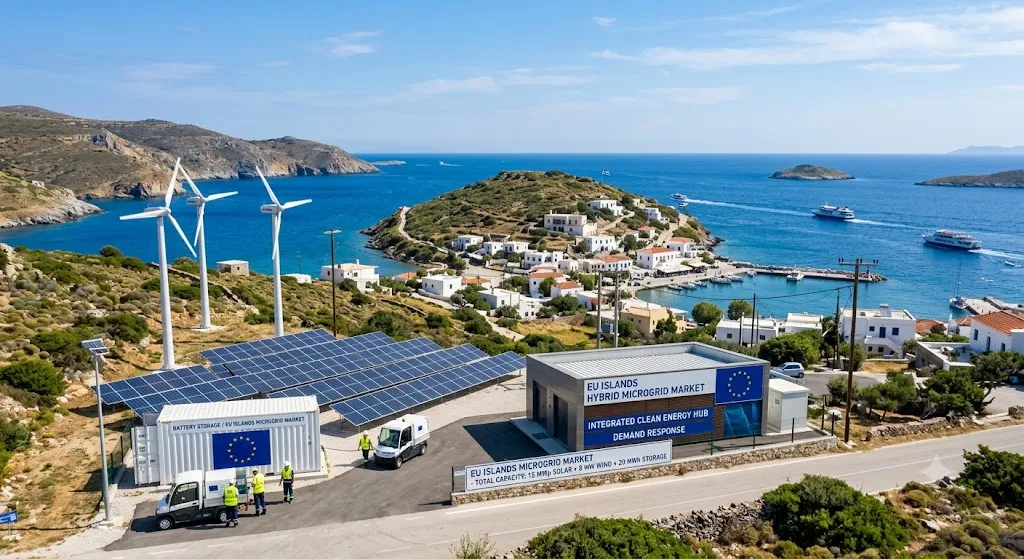


EU Islands Hybrid Microgrids: Market Size and Investment Opportunities
Europe’s island communities are examining new approaches to electricity supply as renewable energy, storage, and electrification reshape local demand. Traditional island systems often rely heavily on imported fuels and centralized generators. Those arrangements can provide dependable electricity, but they may expose consumers to volatile fuel costs, transportation risks, and high operating expenses. Hybrid microgrids offer another model built around local flexibility.
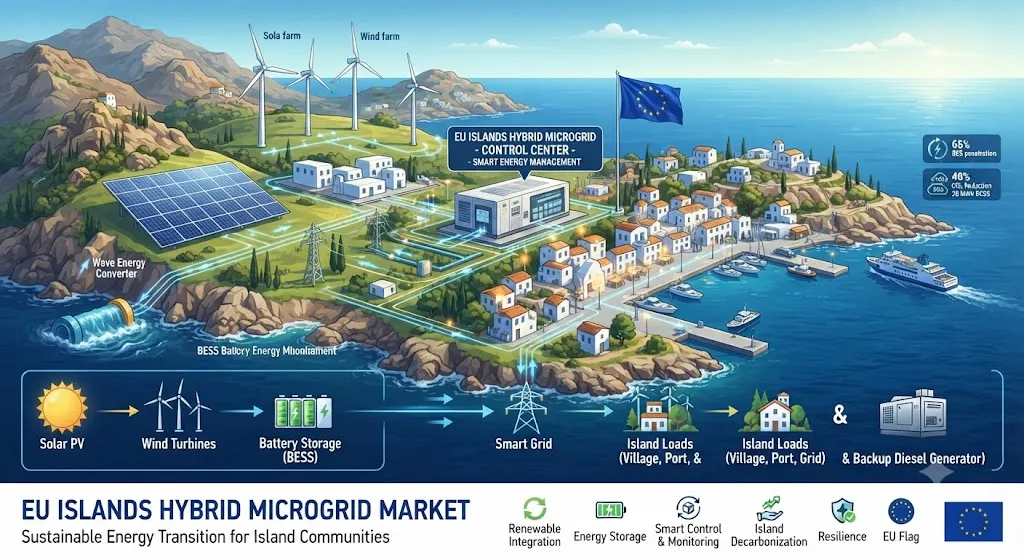
The concept is straightforward but powerful. Renewable generators provide low-carbon electricity, batteries store excess production, intelligent controls coordinate assets, and dispatchable generation remains available when needed. Instead of replacing every conventional asset immediately, a microgrid can gradually increase renewable utilization while retaining resilience. This staged approach can be attractive for islands where reliability requirements are particularly strict.
Solar power is an important component. Rooftops, commercial sites, public facilities, and selected ground-mounted areas can provide distributed generation close to consumption. Wind power can complement solar by producing electricity during different periods. Combining resources reduces dependence on one generation profile and can improve overall renewable availability across the day and year.
Storage determines how effectively renewable electricity can be used. Batteries can capture midday solar output and release it during evening demand. They can provide rapid frequency response and help stabilize small grids after sudden changes in generation or load. Storage can reduce the need to start backup generators frequently, improving efficiency and potentially lowering maintenance requirements.
The EU Islands Hybrid Microgrid Market Size depends on more than installed renewable capacity. Stakeholders need to examine project scale, battery duration, demand growth, generator replacement cycles, grid infrastructure, and technology costs. Market sizing can also vary depending on whether projects serving tourism facilities, industrial sites, communities, or entire island networks are included.
Demand-side flexibility is becoming increasingly relevant. Electric vehicle charging can be scheduled when renewable output is high. Water treatment and desalination systems may have some operational flexibility, while commercial buildings can adjust heating, cooling, and refrigeration within practical limits. Coordinating these loads can reduce peaks and improve the value of renewable generation without requiring equivalent increases in generation capacity.
Infrastructure constraints remain important. Island grids may have limited substations, narrow distribution networks, or aging equipment. Adding generation without reinforcing these systems can create congestion or voltage challenges. Developers therefore need coordinated planning for distribution upgrades, protection systems, transformers, communications, and control infrastructure. Modernization should be treated as part of the microgrid investment rather than an afterthought.
Financing structures can influence project scale and timing. Public grants, European programs, municipal investment, energy communities, and private developers may all contribute to deployment. Revenue can come from electricity sales, avoided fuel consumption, flexibility services, capacity support, and resilience benefits. Clear contractual arrangements are essential when multiple parties own generation, storage, and network assets.
Environmental and social considerations also affect project development. Islands may have sensitive ecosystems, limited land, historic landscapes, and strong tourism interests. Equipment placement should therefore balance technical performance with visual, ecological, and community considerations. Recycling plans for solar modules, batteries, and electronic equipment can further support responsible development over the full asset lifecycle.
Digital control will increasingly connect the entire system. Forecasting platforms can anticipate renewable output and demand, while optimization software can determine when batteries should charge, discharge, or reserve capacity. Remote monitoring can help operators manage dispersed assets and identify abnormal performance. Cybersecurity will become equally important as more devices communicate through connected control networks.
The long-term opportunity is a flexible local electricity system capable of combining multiple resources under changing conditions. European islands can use hybrid microgrids to reduce fuel dependence, support electrification, improve resilience, and increase renewable utilization. Success will depend on accurate planning, appropriate technology selection, bankable financing, modern grid infrastructure, and strong operational capabilities. These factors together will shape future investment across island energy systems.





















Sign in to leave a comment.