
EU Islands Hybrid Microgrid Market Report: Battery Storage and Smart Controls Reshape Island Energy
Battery storage and intelligent energy management are changing how isolated electricity networks balance renewable generation and demand. European islands provide a compelling environment for these technologies because conventional power supplies can be expensive, renewable resources vary throughout the day, and maintaining reliable electricity is essential for residents, businesses, and public services.
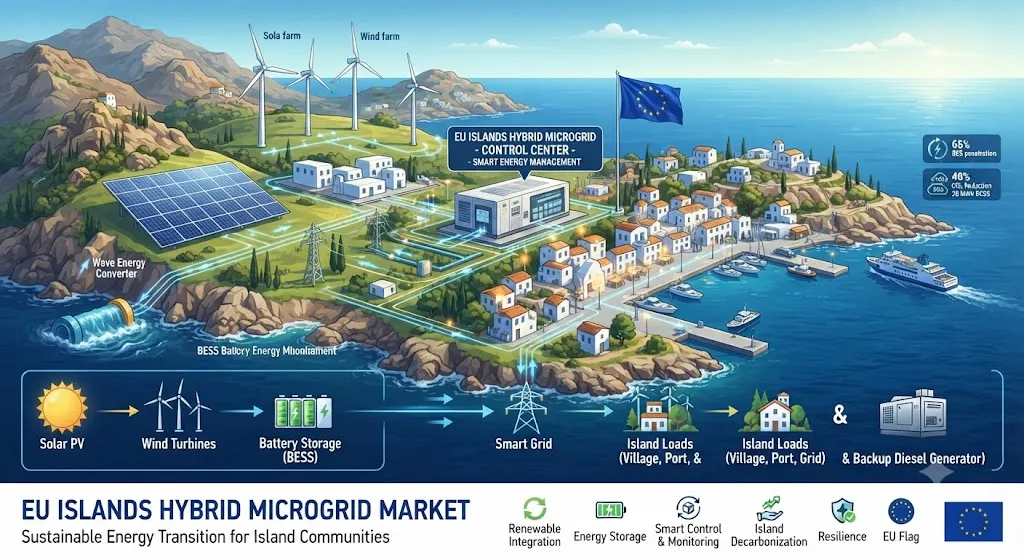
A hybrid microgrid combines distributed generation, storage, and controllable resources within a coordinated electrical system. Solar panels can generate electricity during daylight hours, wind turbines can contribute when conditions are favorable, and batteries can shift available electricity toward periods of higher demand. Conventional generators remain useful when renewable resources and stored energy cannot independently satisfy consumption.
The EU Islands Hybrid Microgrid Market Report provides a relevant framework for understanding the technologies, commercial opportunities, and infrastructure requirements associated with these systems. Their success depends on more than equipment installation: operators must coordinate multiple assets under changing weather, demand, and network conditions.
Why Battery Storage Matters
Renewable generation rarely matches electricity demand perfectly. Solar output decreases after sunset, while wind production changes according to atmospheric conditions. Batteries help bridge these mismatches by storing surplus electricity and delivering it when generation falls short.
Storage can also provide rapid responses to changes in frequency and power balance. In smaller electricity networks, disturbances may have a proportionally greater impact than they would on large interconnected systems. Fast-response storage therefore contributes to operational stability when properly integrated with other grid assets.
Battery selection requires consideration of power capacity, energy capacity, operating temperature, cycle life, safety provisions, and expected charging patterns. A system designed for brief frequency support may require a different configuration from one intended to supply evening demand for several hours.
The Role of Intelligent Energy Management
Energy management systems coordinate the microgrid's resources according to operational priorities. Software can forecast renewable production, anticipate consumption, monitor battery state of charge, and determine the appropriate dispatch of available generators.
For example, a controller may charge batteries when solar output exceeds demand, reserve energy for anticipated evening peaks, and reduce generator operation when renewable supply is sufficient. These decisions become more effective when informed by weather forecasts, historical demand, and equipment operating constraints.
Advanced analytics can support predictive maintenance by identifying abnormal temperature readings, declining battery performance, or irregular generator behavior. Early intervention can reduce equipment downtime and help operators plan service activities more efficiently.
Cybersecurity must be incorporated into system architecture. Connected controllers, remote monitoring platforms, and communications equipment introduce potential vulnerabilities that require appropriate access controls, software updates, network segmentation, and incident response procedures.
Integrating Multiple Renewable Resources
Solar and wind can complement each other where local weather patterns support diversified production. However, their relative contribution varies by island, season, and location. Resource assessments should therefore precede decisions about generation capacity.
Existing diesel generators can provide dependable backup while renewable capacity expands. Their role may gradually change from continuous electricity production toward reserve capacity and operation during periods of prolonged renewable shortages.
Additional flexibility may come from demand response. Water pumping, desalination, electric vehicle charging, and selected industrial activities can sometimes be scheduled around renewable availability. Coordinating these loads with generation and storage can reduce peak demand and improve asset utilization without compromising essential services.
Commercial Opportunities for Technology Providers
Storage manufacturers, inverter suppliers, microgrid software developers, engineering contractors, and specialist maintenance companies can all benefit from project development. Recurring service opportunities include performance monitoring, battery diagnostics, software optimization, equipment upgrades, and operational training.
Project developers increasingly need solutions that integrate equipment from different suppliers. Interoperability, standardized interfaces, and clear responsibility for system performance can therefore become important competitive differentiators.
Investors should assess total lifecycle costs rather than focusing only on battery purchase prices. Replacement requirements, degradation, efficiency, maintenance, financing, and end-of-life management all influence long-term returns.
Outlook for European Island Systems
Future microgrids are likely to become more digitally coordinated as renewable penetration increases and additional electricity demand becomes flexible. Electric mobility, distributed generation, and electrified heating may create opportunities for better demand management, provided that infrastructure is appropriately designed.
Nevertheless, technology adoption must remain site-specific. Battery storage cannot automatically eliminate the need for backup generation, particularly during extended periods of low renewable output. Reliability planning should account for exceptional weather, equipment failures, and realistic reserve requirements.
For European island communities, the combination of storage, renewable generation, and intelligent controls offers a practical pathway toward more resilient electricity supply. Providers that deliver integrated, maintainable, and economically justified systems can help transform island energy infrastructure while supporting broader decarbonization objectives.























Sign in to leave a comment.