

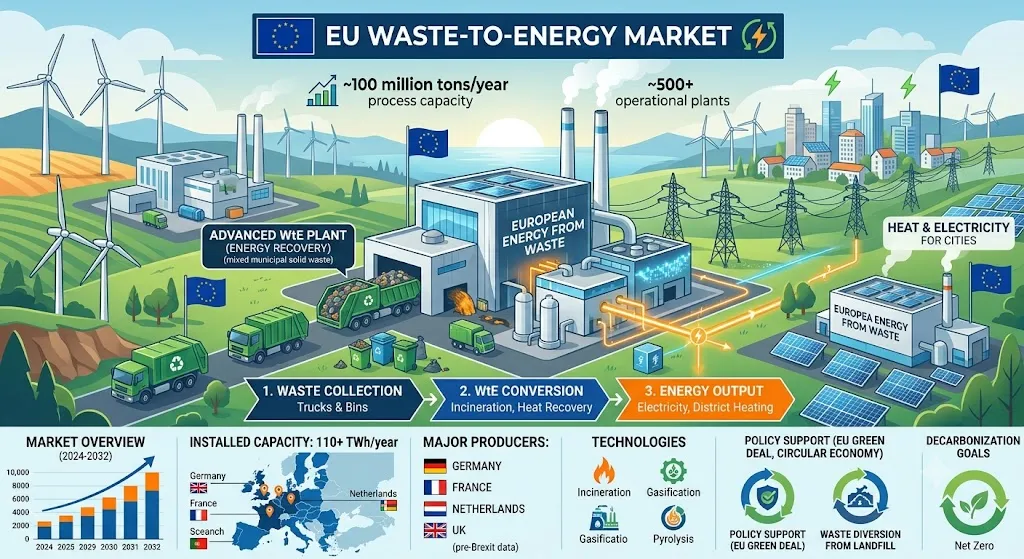
Understanding the Economic Value Behind European Waste Infrastructure
European municipalities face a difficult balancing act. They must reduce landfill dependence, improve recycling outcomes, and maintain dependable services for waste that cannot reasonably be reused or recovered as materials. Energy recovery can contribute to that system when facilities treat genuine residual streams and capture useful heat or electricity. Yet commercial success depends on much more than the volume entering a plant. Developers must understand environmental obligations, local energy demand, public expectations, and the contracts that connect every participant.
The central opportunity concerns market valuation. Decision makers increasingly distinguish facilities that simply process waste from assets that provide dependable public services and measurable energy value. Strong projects connect waste collection arrangements with realistic operating assumptions. They also acknowledge that separate collection and recycling improvements can change both the quantity and composition of remaining material. These changes influence combustion conditions, equipment wear, emissions controls, and ultimately the economics of continuous operation.
A closer look at EU Waste-to-Energy Market Size shows why revenue diversification deserves attention. Municipal customers want predictable treatment costs, while energy buyers expect reliable delivery and transparent pricing. Investors need evidence that these objectives can coexist throughout an asset's operating life. Contract structures therefore matter as much as machinery. Clear responsibilities for outages, quality variation, maintenance, and delivery shortfalls can prevent small technical problems from becoming expensive disputes.
Economics Beyond the Plant Gate
Waste treatment fees are only one part of a potential revenue model. Electricity exports, useful heat, recovered metals, and selected service agreements can improve financial resilience where suitable infrastructure exists. Nevertheless, each revenue stream carries distinct risks. Heat sales depend on network readiness and seasonal demand. Electricity receipts depend on market arrangements. Materials recovery requires dependable outlets and quality control. Financial models should stress these lines separately rather than assuming they move together.
Technology and Environmental Performance
Modern facilities rely on disciplined combustion management, emissions treatment, residue handling, and equipment maintenance. Sensors and analytical software can identify operating anomalies before they cause lengthy shutdowns. Heat exchangers and network connections may increase useful energy output without expanding waste throughput. Carbon capture is another area of investigation, although its costs, transport needs, and permanent storage arrangements must be evaluated case by case. Technology claims deserve independent verification under realistic operating conditions.
Regional Opportunities and Constraints
European markets are not interchangeable. Some cities already operate mature district heating systems and can improve existing plants. Other regions need better sorting infrastructure before deciding whether additional thermal capacity is appropriate. Local rules, financing costs, population density, and available industrial heat customers influence the preferred solution. A development strategy that succeeds in one country may fail elsewhere if permits, waste contracts, or energy connections are weaker.
Strategic Outlook
For companies assessing infrastructure financing, the strongest approach begins with evidence rather than ambitious capacity forecasts. Operators should measure actual plant availability, delivered energy, residue costs, and environmental performance. Buyers should test contract durability and understand which counterparty bears each material risk. Public authorities should ensure that energy recovery complements waste prevention and recycling instead of competing with them. A credible long term strategy rewards efficiency, accountability, and adaptability.
The next phase will favor organizations that connect engineering expertise with commercial discipline. That means involving waste suppliers, network operators, regulators, lenders, and local residents early enough to identify constraints before construction. It also means evaluating alternatives fairly, including biological treatment for suitable organic material. Well designed projects can support dependable municipal services, but only when their scale and technology match the residual waste genuinely available.
























Sign in to leave a comment.