

Understanding the EU Waste-to-Energy Market Size and Infrastructure Demand
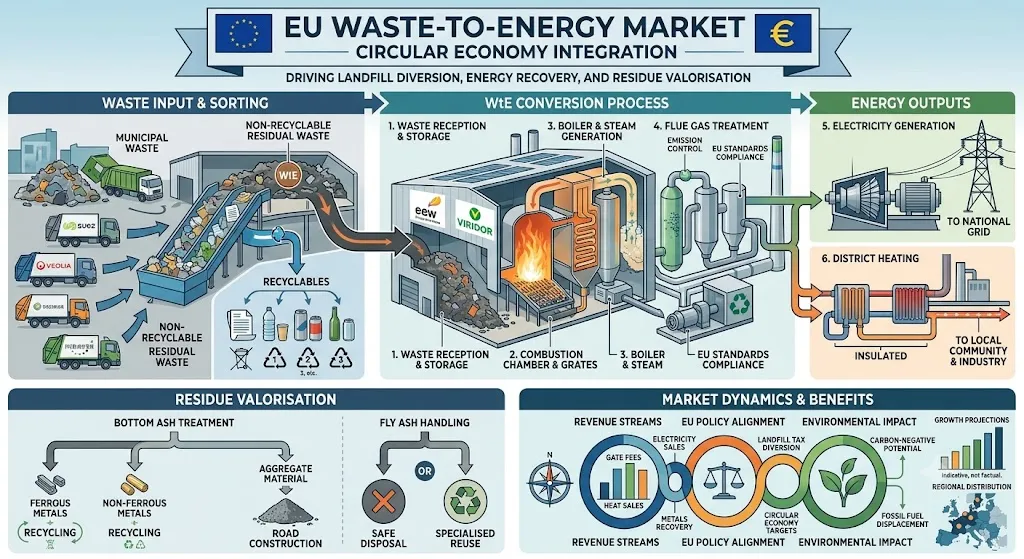
Waste-to-energy projects are becoming increasingly connected to the broader concept of resource efficiency. The objective is no longer simply to reduce the volume of residual waste through combustion. Modern facilities can recover energy, extract metals from ash, support district heating, and potentially connect with future carbon-management infrastructure. This broader perspective is influencing project design and creating new opportunities for technology companies and infrastructure operators across Europe.
The first step is understanding the waste hierarchy. Prevention, reuse, and recycling remain higher priorities than energy recovery. Waste-to-energy therefore has a role primarily for residual materials that cannot reasonably be prevented or recycled. Efficient collection and sorting systems are essential because they determine what material reaches the thermal facility. Better upstream separation can increase recycling while giving the plant a more consistent residual feedstock.
Energy integration can substantially influence project value. Electricity generation is relatively straightforward, but recovered heat can provide additional efficiency where demand is available. District heating networks offer one pathway, particularly in cities with cold climates and established heat infrastructure. Industrial users can provide another, especially when steam or high-temperature heat is required.
Plant technology continues to evolve. Combustion systems can be optimized through automated controls, while advanced flue-gas treatment supports compliance with strict emissions limits. Heat exchangers, turbines, generators, and auxiliary systems can be configured to maximize energy recovery under local conditions. Digital monitoring allows operators to track performance and identify equipment issues before they become major failures.
Material recovery is also gaining importance. Ferrous and non-ferrous metals can often be recovered from bottom ash using mechanical and magnetic separation systems. Further processing may improve the quality of mineral fractions, although applications depend on regulatory requirements and local markets. These steps can reduce disposal volumes and increase the amount of value extracted from residual waste.
Economic performance is influenced by several revenue and cost categories. Gate fees provide payment for waste treatment, while electricity and heat sales create energy-related income. Capital expenditure can be substantial because plants require complex furnaces, boilers, turbines, emissions-control equipment, and supporting infrastructure. Financing costs, maintenance requirements, residue handling, staffing, insurance, and compliance expenses also affect long-term economics.
Policy changes can alter these calculations. Higher recycling targets may reduce residual waste volumes, while landfill restrictions can strengthen demand for alternative treatment. Carbon pricing and emissions policy can influence operating costs and investment priorities. Incentives for heat decarbonization or carbon capture may create new value streams. Investors therefore need to monitor waste and energy policy together rather than evaluating either market in isolation.
Future facilities may increasingly incorporate carbon capture. Capturing emissions from mixed waste is technically complex because the carbon originates from both fossil and biogenic sources. However, biogenic content creates the possibility of negative-emissions outcomes under appropriate accounting and storage conditions. The pathway requires reliable capture equipment, additional energy, transport infrastructure, storage access, and supportive commercial frameworks.
Market participants are also exploring new business models. Municipal authorities may use long-term concessions or public-private partnerships, while utilities can integrate plants into wider power and heating portfolios. Engineering firms and technology providers can supply equipment and services across the asset life cycle. Operators with experience in optimization, compliance, and residue management can differentiate themselves as project requirements become more demanding.
The EU Waste-to-Energy Market Size is influenced by the intersection of waste generation, treatment capacity, energy demand, regulation, and infrastructure investment. Understanding these connections is essential for companies assessing expansion opportunities. Future growth will not simply depend on building more combustion capacity. It will depend on replacing aging assets, improving resource recovery, integrating useful energy, and developing facilities that remain compatible with Europe's evolving circular-economy objectives.
























Sign in to leave a comment.