Evacuation Chair Buying Guide: Types, Features and Applications

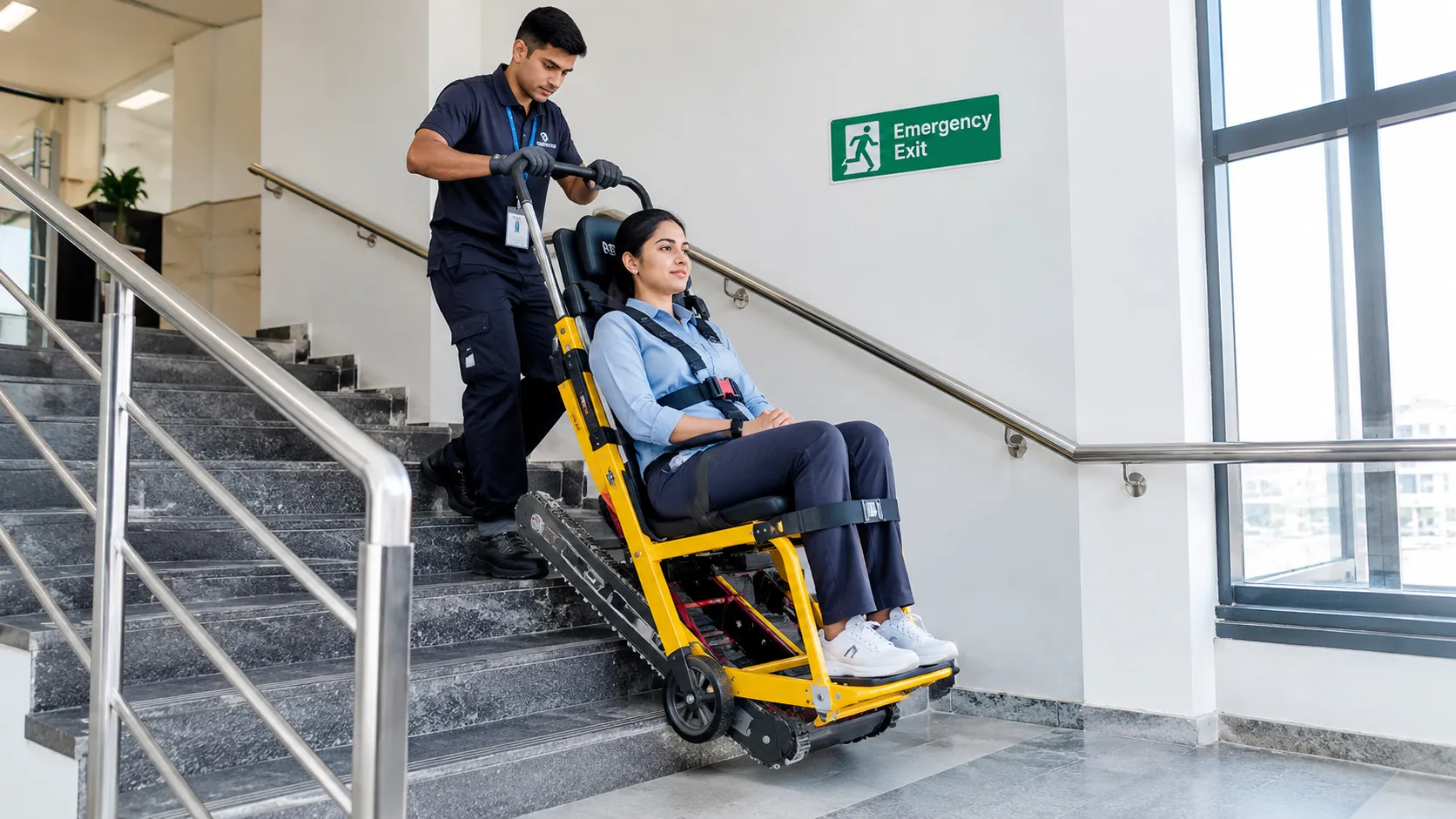
An evacuation chair can help move a person with limited mobility downstairs when a lift is unavailable during an emergency.
It is particularly useful in buildings where not everyone can leave through the stairs without assistance.
Hospitals, offices, hotels, schools and residential buildings all need to consider this type of equipment. However, choosing an evacuation chair is not simply a matter of finding the cheapest model or the one with the highest weight capacity.
The right choice depends on the people who may need assistance, the building's staircases, the number of trained operators and how the equipment will be stored and maintained.
This evacuation chair buying guide explains the main types, important features, common applications and questions buyers should ask before making a purchase.
What Is an Evacuation Chair?
An evacuation chair is a wheeled or track-equipped device designed to help transport a seated person over stairs during an emergency. Depending on the design, it may also be used to move someone across flat surfaces.
Many models include a seat, backrest, safety belts, wheels and a stair-descent mechanism.
Some use tracks that support controlled movement downstairs, while others rely on lifting handles or powered assistance.
The main purpose is to support evacuation when a person cannot safely use the stairs independently. It is not a replacement for a wheelchair, stretcher or trained emergency response team.
An evacuation chair should also not be treated as a device that makes every staircase safe. Its suitability depends on the model, the user, the operator and the building.
Types of Evacuation Chairs
The main differences between evacuation chairs involve how they move, how much effort the operator must use and whether they are designed for regular transport as well as emergencies.
1. Manual Track-Based Evacuation Chairs
Manual track-based chairs are among the most common designs. They use a track or rail system to support controlled movement downstairs.
Some models are designed for one trained operator, while others require two people. The manufacturer determines the permitted operating method, so buyers should not assume that every manual chair can be used by one person.
2. Heavy-Duty Evacuation Chairs
Heavy-duty evacuation chairs are designed for users who exceed the capacity of standard models or for facilities that require a more robust construction.
They may have reinforced frames, wider seats or stronger restraint systems. However, a higher weight rating does not automatically mean that the chair is easier to operate.
The combined weight of the user and equipment, the staircase design and the number of operators must all be considered.
These chairs may be suitable for hospitals, care facilities and buildings where a wider range of user needs must be supported.
3. Powered Evacuation Chairs
Powered evacuation chairs use a motor and battery to assist movement on stairs. Some designs can support both upward and downward travel.
They may reduce the physical effort required from operators, which can be useful in certain healthcare or residential settings. However, they introduce additional requirements, including battery charging, maintenance and a suitable operating procedure.
A powered chair should not be selected only because it appears easier to use. Buyers should check its operating instructions, battery requirements, emergency use limitations and whether staff can operate it confidently.
4. Two-Operator Carry Chairs
Some evacuation chairs use lifting handles rather than a track system. These designs require operators to carry or lift the occupant over stairs.
They may be useful in settings, but they require sufficient physical strength, coordination and training. The building's evacuation plan should specify how many operators are needed.
A carry chair should not be assumed to be a suitable substitute for a track-based model simply because both are described as evacuation chairs.
5. Multi-Purpose Transport Chairs
Some evacuation chairs can be used on flat surfaces for routine patient or passenger transport and then configured for stair movement.
This may be useful in hospitals, clinics and care facilities where equipment is used regularly. However, a multi-purpose chair should still be assessed for its emergency function, not only its everyday transport features.
Key Features to Check Before Buying
Before buying an evacuation chair, check these key features:
- Weight capacity: Check the maximum load, including the user and equipment.
- Stair compatibility: Make sure it fits your stairs, turns and landings.
- Safety restraints: Choose secure belts or harnesses that are easy to use.
- Operator needs: Check how many trained people are needed to operate it.
- Chair weight: Choose a model staff can safely move and handle.
- Wheels or tracks: Check which design works best on your stairs.
- Storage: Keep the chair clearly marked and easy to access.
- Folded size: Check the storage dimensions if space is limited.
- Maintenance: Review inspection, servicing and replacement-part needs.
- Training and support: Look for clear instructions, training and after-sales support.
Where Are Evacuation Chairs Needed?
Evacuation chairs may be considered in a range of settings.
- Hospitals and healthcare facilities: These buildings may need to move patients or visitors who cannot use stairs independently. The chair must be appropriate for the user's condition and the facility's emergency procedures.
- Offices and commercial buildings: Staff or visitors with limited mobility may need assistance during an evacuation. The building should identify suitable equipment, trained operators and evacuation routes.
- Schools and colleges: An evacuation plan may need to account for students, staff or visitors who require assistance. Equipment selection should reflect the building and the people who may use it.
- Hotels and residential buildings: A chair may support evacuation planning where guests or residents cannot safely use stairs without help.
The need for an evacuation chair depends on the building's risk assessment and emergency arrangements. It should not be assumed that one chair is enough for every building.
Conclusion
An evacuation chair buying guide should help buyers understand that there is no single model suitable for every building.
Manual track-based chairs suits buildings that need downward evacuation without battery dependence. Powered chairs may be useful where assisted movement is important, while heavy-duty and multi-purpose designs can address different user or facility requirements.
The best choice depends on the staircase, occupant needs, operator requirements, storage arrangements and maintenance plan.
Before purchasing, buyers should compare specifications, confirm compatibility with the building and arrange proper training. The goal is not simply to own an evacuation chair, but to have equipment that can be used safely and effectively when an emergency occurs.



Sign in to leave a comment.