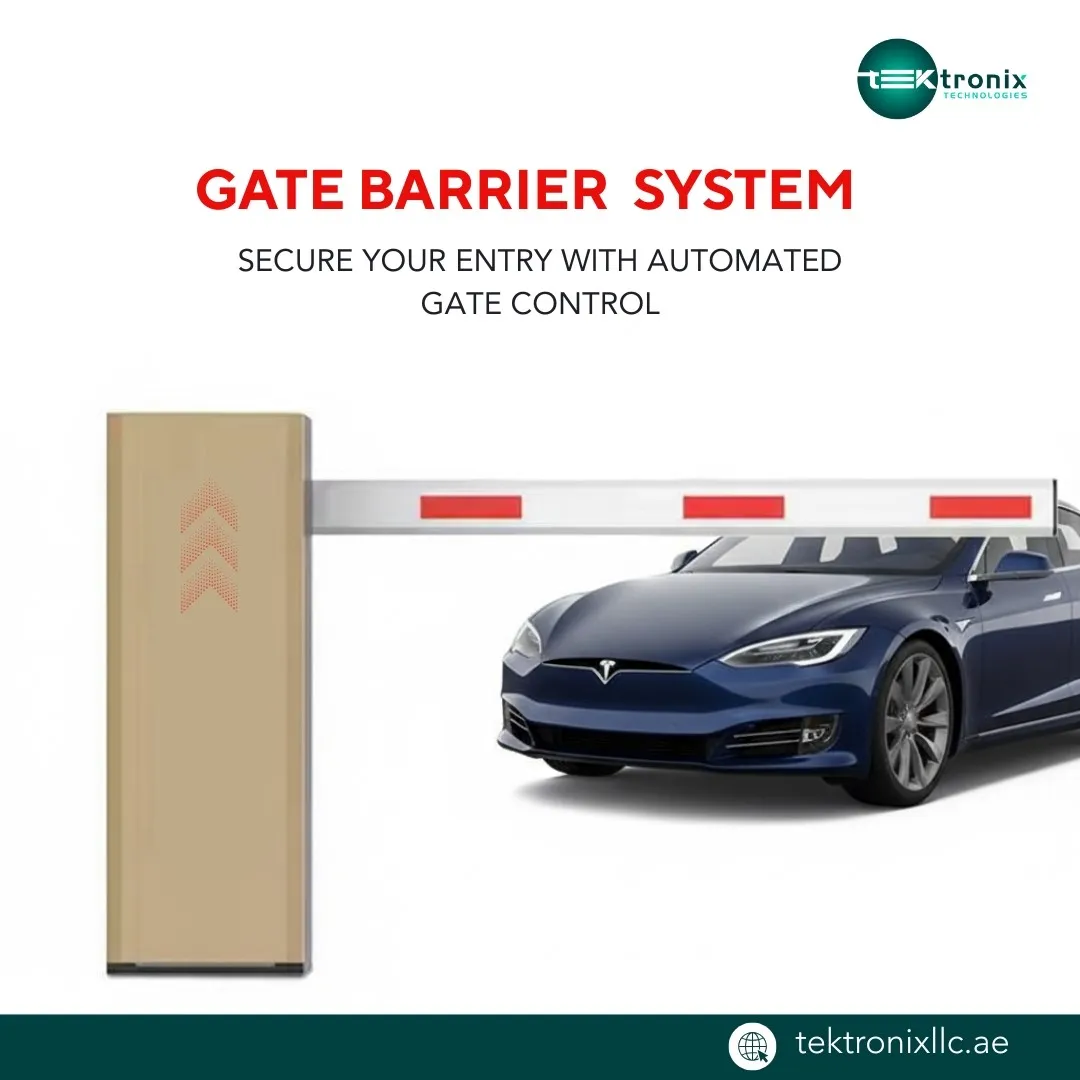

A Gate Barrier System is no longer the end goal of UAE vehicle access management — it is the starting point for a fully connected security and operational ecosystem, where every barrier lane, every credential reader, and every camera contributes real-time intelligence to a unified management platform. Across the UAE's evolving built environment, the expectation of building owners, facility managers, and regulatory authorities is that vehicular access infrastructure generates actionable data, integrates with broader security platforms, and delivers measurable efficiency returns alongside its core security function. 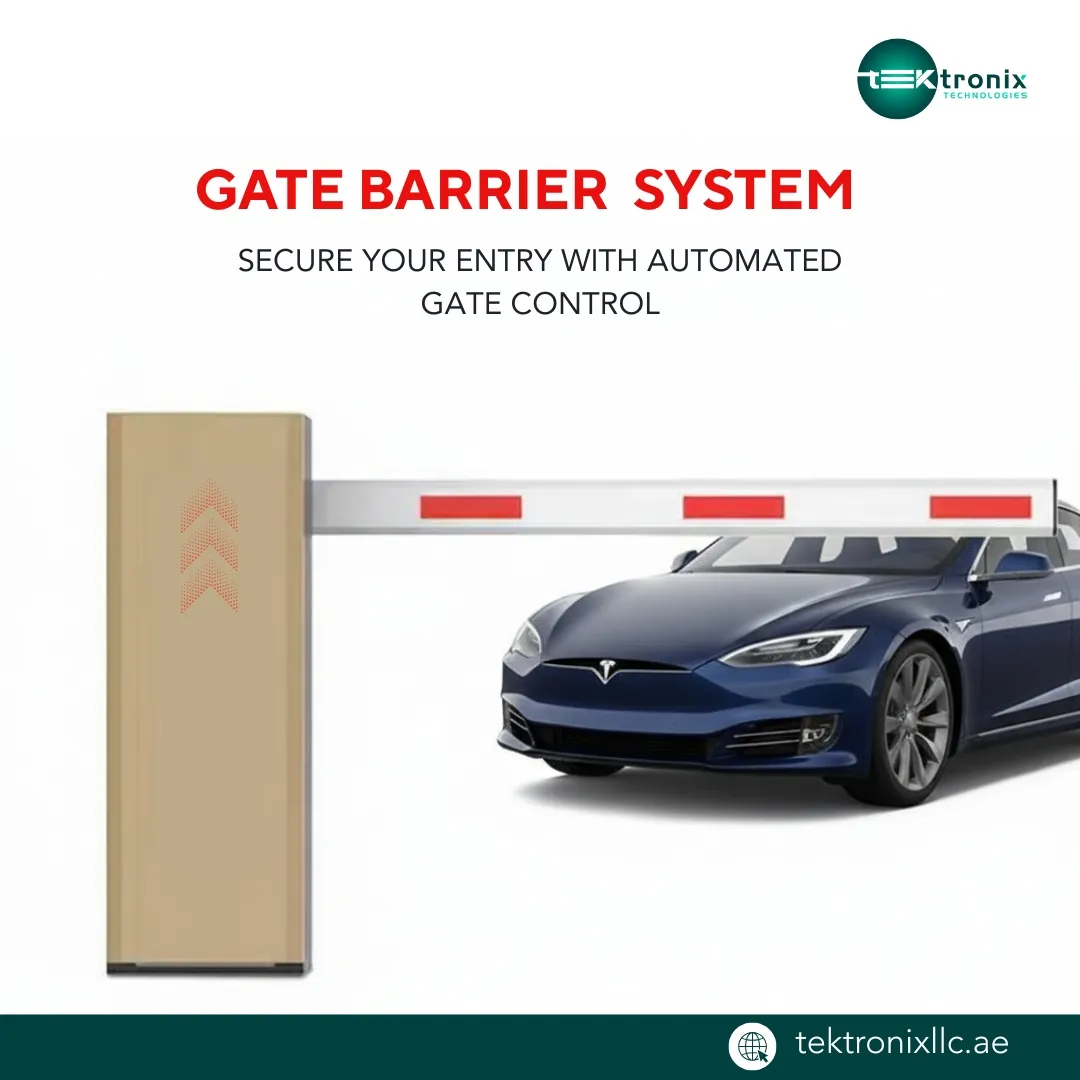
Tektronix LLC has spent more than two decades delivering physical security infrastructure across the Gulf, with UAE project references spanning residential communities, commercial campuses, logistics parks, and government facilities. This guide walks through what a genuinely connected barrier deployment looks like today, and what facility managers should weigh when specifying one.
From Standalone Barrier to Connected Security Node
The conceptual shift defining modern deployment is the move from treating Gate Barriers as standalone access points — a gate that simply opens and closes — to treating each one as a connected intelligence node within a networked vehicular security ecosystem. A standalone barrier records nothing, communicates with nothing, and responds only to the immediate credential it receives. A connected node, by contrast, contributes every vehicle entry and exit event to a centralised database, queries a live access policy server before every decision, pushes alarm events to a security dashboard in real time, and feeds vehicle movement data into logistics and compliance reporting systems the operator depends on.
This is what UAE authorities and enterprise operators are now consistently specifying. Free zone tenant security obligations increasingly require documented vehicle access records retrievable on demand, and corporate occupiers leasing space in Grade A commercial developments increasingly require connected, API-accessible barrier infrastructure as a condition of lease. A well-specified Security Gate Barrier Systems deployment is built from the ground up to meet this connected standard as the baseline, not as an optional upgrade.
Boom Barrier System: The Foundational Hardware
The Boom Barrier System is the foundational vehicular access hardware around which connected UAE barrier ecosystems are built — a motorised boom arm available in light-commercial, standard-commercial, and heavy-duty duty-cycle configurations. What differentiates a connected boom barrier from a basic one is not the mechanical arm but the intelligence behind it: a controller board with onboard event logging, network connectivity for cloud platform integration, configurable relay outputs for CCTV and building management integration, and an encrypted, tamper-monitored protocol for credential reader connectivity.
Related to this category, an automatic gate barrier configuration removes the need for a staffed lane entirely, processing registered vehicles automatically against a live credential database rather than requiring a security guard to visually verify and manually raise each barrier.
Toll Gate Barriers for Unstaffed Revenue and Permit Management
UAE mixed-use residential-commercial developments, private road concessions, and multi-occupancy business parks requiring paid or permit-based access deploy Toll Gate Barriers that operate continuously without staffing — processing resident permits, visitor day passes, and commercial vehicle access in fully automated workflows. Integration with payment terminals, transponder readers, and cloud-based revenue management platforms consolidates income reporting, permit renewal, and access event auditing for property operators managing multiple sites from one dashboard.
Parking Gate Barrier Deployments for High-Occupancy Developments
High-occupancy mixed-use towers, hotel complexes, and hospital campuses deploy a Parking Gate Barrier as the first physical layer of a multi-tiered car park management architecture — controlling vehicle entry and exit while feeding real-time occupancy data to the platform driving space availability signage, pre-booking integration, and EV charging zone allocation.
Connecting these barriers to number-plate recognition cameras, ticketing kiosks for unregistered visitors, and validation terminals at retail and hospitality outlets lets a single system apply zone-specific access permissions automatically — directing patient vehicles to designated drop-off areas at a hospital campus, for example, without manual traffic marshalling.
Automatic Road Barrier Systems for Schedule-Responsive Campus Traffic
Within UAE smart campus environments — university developments, healthcare city complexes, and government institution campuses — internal road network management requires programmable, schedule-responsive traffic control that adapts to the facility's daily rhythm. An Automatic Road Barrier enables exactly this: barrier lanes on internal roads open and close on configurable schedules aligned with lecture start times, shift changes, and planned delivery windows, without security team intervention. Remote schedule changes and emergency override commands — opening every internal barrier for an evacuation, for instance — can be pushed from any networked device.
RFID Barrier System: Stop-Free Throughput at High-Frequency Lanes
The practical enabler of stop-free vehicle throughput at UAE high-frequency entry points is the RFID Barrier System, integrating long-range UHF readers into boom barrier lane configurations. Windscreen-mounted tags enrolled against the vehicle credential database allow a barrier to identify an approaching vehicle and begin its lift cycle before the vehicle reaches the boom arm, eliminating the dwell time that stopped credential presentation creates.
Closely related, Automated Boom Gate Access combines this hands-free identification with automatic policy checking, so a registered vehicle simply approaches and passes through without the driver interacting with any hardware at all — a meaningful improvement for peak-hour exit queues at residential communities and corporate campuses alike.
Vehicle Access Control: The Platform That Unifies Every Lane
At the architectural layer above individual barrier hardware, Vehicle Access Control is the platform that unifies every barrier lane, credential reader, and camera input into a single policy-governed system. A central management server maintains a real-time vehicle credential database, updated automatically from HR systems, logistics platforms, and visitor management kiosks, and applies configurable access policies at each lane — registered staff vehicles granted entry at designated lanes during working hours, pre-authorised deliveries cleared automatically against a delivery schedule, visitor vehicles processed through a pre-registration workflow, and anything that doesn't match a valid policy triggering a control room alert.
The data this architecture generates — complete vehicle movement histories by registration, contractor compliance records, delivery schedule adherence — turns vehicle access control into a business intelligence asset as much as a security function.
Smart Integration: How the Ecosystem Delivers More Than the Sum of Its Parts
The transformative impact of a connected barrier platform is realised through integration with systems beyond the security domain. Delivery vehicle pre-clearance via API integration with supplier management systems clears scheduled deliveries automatically at the gate, flagging no-shows and late arrivals for logistics review. Barrier entry and exit data can feed real-time occupancy into smart mobility apps, supporting urban traffic management objectives. Vehicle occupancy data can inform car park lighting, ventilation, and EV charging load management as part of a facility's broader efficiency programme.
Barrier access events correlated with CCTV, intruder alarm, and access control events in a unified security console enable comprehensive post-incident vehicle movement reconstruction, while barrier hardware health telemetry — cycle counts, motor temperature, fault codes — fed directly to a facility's maintenance system supports predictive scheduling and reduces unplanned downtime at critical entry points.
Heavy-Duty Applications: Logistics, Free Zones, and 24/7 Operations
UAE logistics and manufacturing sectors demand vehicular access hardware engineered for operational intensities that standard commercial barriers cannot sustain. Heavy-duty boom barrier variants provide long arm reach for container truck lanes, high daily duty-cycle ratings for round-the-clock logistics gate operation, and coastal-grade construction that resists salt air and desert dust across a multi-year operational lifecycle. For free zone logistics operators, these barriers are the mechanism through which significant cargo volumes are controlled daily, making hardware reliability a direct operational risk variable that specifiers take seriously rather than a secondary consideration.
Gate Barrier System UAE: Deployment Across the Federation
A Gate Barrier System UAE-wide capability needs to serve the full geographic span of the federation's barrier market — from Abu Dhabi's industrial zones and smart residential communities, to Sharjah's growing commercial real estate sector, Ras Al Khaimah's expanding free zones, and Fujairah's port-adjacent logistics developments. Applying a single, consistent delivery framework across every project ensures the documentation quality, authority submission standard, and post-commissioning support model are identical whether the project is a single residential community gate or a large multi-lane logistics hub.
Gate Barrier System Dubai: A Complex Regulatory and Commercial Environment
A Gate Barrier System Dubai deployment operates within one of the region's most complex regulatory environments. Security licensing requirements, municipality road permit conditions for civil works, road authority permissions, and electronic security standards for government-affiliated buildings all shape project delivery timelines and documentation. Established relationships across these authority departments, built over years of licensed project delivery in the emirate, enable efficient permit processing and authority submission management for barrier projects spanning Dubai's residential, commercial, logistics, and government sectors.
Why UAE Operators Choose Tektronix for Smart Barrier Deployments
Tektronix LLC is a SIRA-licensed security systems integrator with active project references across Dubai's residential, commercial, logistics, and government sectors, and authorised supply and integration partnerships that provide manufacturer-certified hardware, UAE-stocked spare parts, and factory warranty coverage on every supplied barrier. UHF RFID integration expertise supports hands-free vehicle identification for logistics, residential community, and corporate campus throughput optimisation.
Every project is delivered under an ISO 9001-compliant methodology with full authority submission management, civil works coordination, acceptance testing, and as-built documentation, alongside PDPL-compliant vehicle access data handling with configurable retention periods for systems capturing registration and driver identity information.
Conclusion
Vehicle access transformation in the UAE is not about replacing a gate — it is about deploying a system that generates intelligence, integrates with the facility's wider ecosystem, and delivers measurable security and operational returns from day one. Whether the requirement is a high-cycle boom barrier connected to a cloud platform, unstaffed toll barriers integrated with a resident portal, smart parking barriers feeding real-time occupancy to a mobile app, a site-wide vehicle access control architecture unifying every lane under one policy engine, a schedule-responsive road barrier for a smart campus, or a hands-free RFID system eliminating throughput bottlenecks, every element needs to work together under one accountable, compliant deployment. Facility operators who specify against this full picture, rather than a single gate in isolation, consistently end up with infrastructure that pays for itself well beyond its security function.
FAQS
1. How does a connected gate barrier system generate a return on investment?
A connected system generates returns across several dimensions: reduced security staffing costs at gate lanes, documented vehicle access records that support insurance claims and regulatory compliance, vehicle movement analytics that inform capacity and staffing decisions, and a smoother, queue-free experience for registered vehicles that supports resident and tenant satisfaction.
2. What connectivity options are available for remote barrier monitoring at UAE sites?
Sites with existing network infrastructure typically connect barrier controllers via Ethernet to a secure web-accessible management platform, while remote sites without permanent infrastructure use cellular data connections instead. Dual-path connectivity with a cellular failover is often specified for mission-critical sites where monitoring continuity during an internet outage matters.
3. How does RFID access work for households or fleets with multiple vehicles?
Each vehicle receives its own RFID tag, enrolled separately in the access control database under the relevant household or fleet account, with no practical limit on the number of tags per account. Every vehicle's movement is logged individually rather than as a single consolidated record, supporting accurate per-vehicle reporting for parking enforcement or incident investigation.
4. Can gate barrier systems at logistics facilities support customs documentation requirements?
Yes — a properly configured platform can capture and log the vehicle identity data fields customs and free zone authorities typically require, including registration plate, vehicle type, driver identity, and entry and exit timestamps, exportable in formats compatible with authority compliance reporting.
5. What is a sensible approach for upgrading an existing manual barrier to a smart connected system?
A phased approach works well: first replace basic controllers with network-connected units tied to a cloud management platform for remote monitoring and event logging; then add credential intelligence through LPR cameras or RFID readers and a vehicle database; and finally connect the platform to CCTV, visitor management, and building management systems via API. This lets an operator validate returns at each stage before committing to the next investment.
https://tektronixllc.ae/gate-barrier-system/





























Sign in to leave a comment.