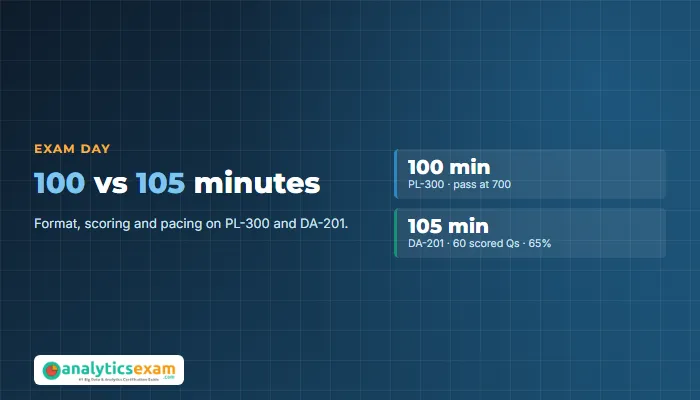

Walking into either exam blind is the biggest unforced error candidates make. PL-300 and Tableau DA-201 run on different clocks, different question formats, and different scoring systems, and knowing the format ahead of time changes how you pace yourself.
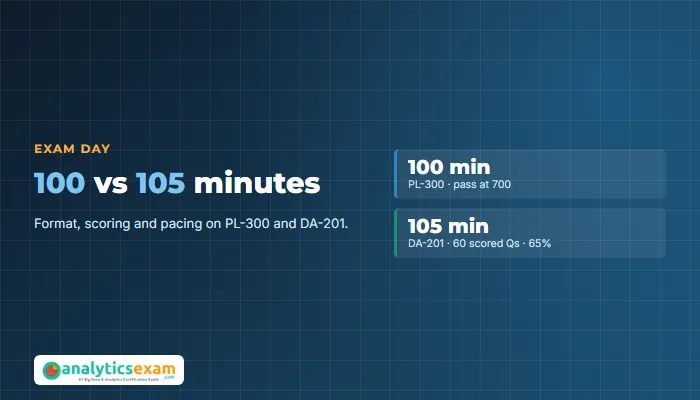
The clock
DA-201 gives you 105 minutes. PL-300 gives you 100. Five minutes doesn't sound like much, but across a proctored exam it changes how much time you can afford to sit with a question that isn't clicking.
The questions
DA-201's format is fixed and known ahead of time: 60 multiple-choice or multiple-select questions, plus up to five additional unscored questions. You won't know which questions are unscored, so treat every question the same. PL-300 is less predictable — Microsoft describes it as proctored and notes it may include interactive components, not just multiple choice, so some items can ask for more than picking an answer.
The scoring
DA-201 uses a straightforward percentage: you need 65% to pass. PL-300 uses Microsoft's 1–1000 scale, and you need a score of 700 or higher. The two numbers aren't directly comparable to each other since they're measured on different scales entirely — don't try to convert one into the other while you're studying.

Where you can take it
DA-201 offers a choice: a proctored test center or an online proctored session, whichever fits your schedule better. PL-300 is also proctored. Either way, expect standard proctoring rules — ID checks, a monitored workspace, and no outside materials.
Retakes if it doesn't go your way
Neither exam locks you out permanently after a miss. DA-201's retake costs US$100. PL-300 lets you retake 24 hours after a first attempt, with longer waits kicking in for subsequent retakes. Plan your study schedule assuming you might need a second attempt, not hoping you won't.
One more difference: what you're expected to know walking in
DA-201 has no listed prerequisites, so nothing stops you from registering the same day you decide to sit it. PL-300 assumes you're already comfortable with Power Query and DAX before you book a seat — that's not formally enforced, but the exam format is built on that assumption. Walking in without that groundwork changes how the 100 minutes feel, regardless of how well you know the question style itself.
Neither exam requires a specific course beforehand, so "prerequisite" here means practical readiness, not paperwork either company actually checks at registration.
What exam day actually feels like
Numbers only tell you so much about pacing and nerves. One candidate's account of exam day is worth reading if you want a sense of what the DA-201 experience is actually like beyond the format sheet — the kind of detail a syllabus page won't give you.
Format shouldn't be the deciding factor, but it should inform your prep
If interactive, hands-on questions make you nervous, that's a reason to spend extra time inside the actual tool before your PL-300 date, not a reason to avoid the exam. If you'd rather have a fixed, known question count, DA-201's format is more predictable going in. Our breakdown of DAX filter context versus Tableau LOD covers what each calculation engine actually asks of you, which matters more long-term than either exam's format.
Frequently Asked Questions
How long is the PL-300 exam compared to Analytics-DA-201?
PL-300 runs 100 minutes. Analytics-DA-201 runs 105 minutes. The five-minute difference matters more than it sounds like once you're sitting with a question that isn't clicking.
Are PL-300 and Analytics-DA-201 scored the same way?
No. DA-201 uses a straightforward percentage, and you need 65% to pass. PL-300 uses Microsoft's 1–1000 scale, and you need a score of 700 or higher — the two aren't directly comparable to each other.
Can Analytics-DA-201 be taken online, or only at a test center?
Both options are available. DA-201 can be taken proctored at a test center or in an online proctored session, whichever fits your schedule.
What's the retake wait time if I fail PL-300?
PL-300 retakes open 24 hours after a first attempt, with longer waiting periods built in for any attempts after that.
Know the clock, know the question style, and exam day stops being the scary part.



























Sign in to leave a comment.