
Introduction
Technology rarely sits still, and few innovations have moved as quickly from novelty to necessity as augmented reality. What once felt like a gimmick reserved for gaming apps has quietly become a working tool across classrooms, hospitals, retail stores, and factory floors. The benefits of augmented reality are no longer theoretical; they show up in the way a surgeon rehearses a procedure, the way a shopper previews furniture in a living room, or the way a technician fixes machinery without flipping through a manual. This shift matters because it changes how people interact with information itself. Instead of reading instructions, users now see them layered directly onto the physical world. This article looks at why the benefits of augmented reality are drawing attention from businesses, educators, and everyday consumers, and why the technology is becoming a genuine part of daily life rather than a passing trend.
What Makes Augmented Reality Different
Augmented reality blends digital elements with the physical environment in real time, using a phone camera, headset, or smart glasses. Unlike virtual reality, which replaces the real world entirely, augmented reality adds a layer on top of it. This distinction is central to understanding the benefits of augmented reality, because it keeps users grounded in their actual surroundings while giving them extra context, guidance, or entertainment. A person can walk through a store, point a phone at a shelf, and instantly see product reviews or pricing comparisons without leaving the aisle. That immediacy is what separates this technology from earlier digital tools, and it is a major reason adoption keeps climbing across industries that never seemed like obvious candidates for immersive tech.
Benefits of Augmented Reality in Business
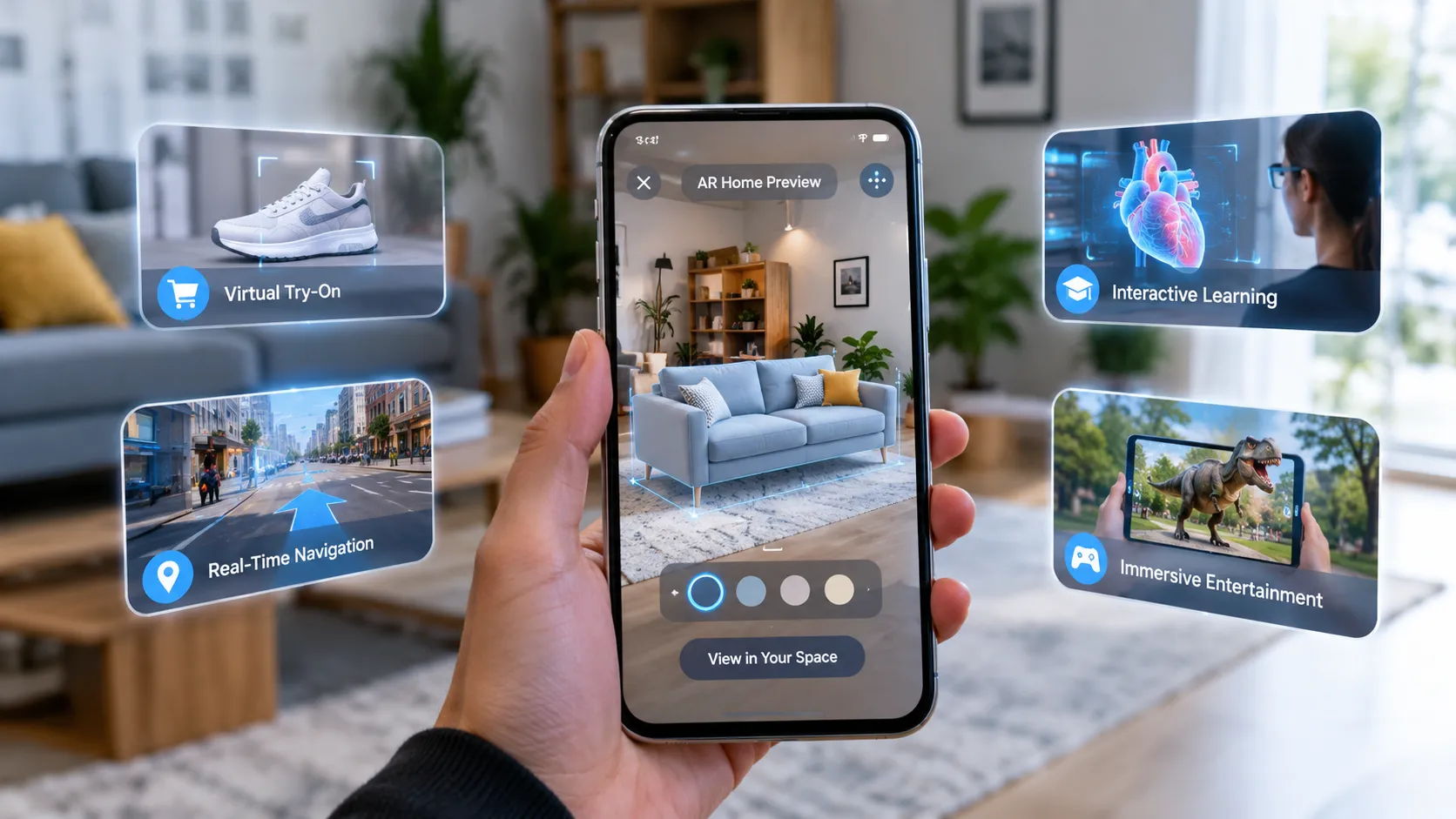
Retailers were among the first to recognize the commercial value of this technology, and the benefits of augmented reality for business are now well documented. Furniture brands let customers visualize a couch in their own living room before buying it, which reduces returns and builds buyer confidence. Beauty companies allow shoppers to try on makeup shades virtually, cutting down on wasted samples and in-store friction. Beyond retail, manufacturing teams use augmented overlays to guide assembly line workers through complex tasks, lowering error rates and training time. Marketing teams have also found that augmented campaigns generate stronger engagement than static ads, since people are naturally drawn to interactive experiences. For companies looking to differentiate themselves, the benefits of augmented reality translate directly into measurable gains such as higher conversion rates, fewer product returns, and stronger customer loyalty.
Benefits of Augmented Reality in Education
Classrooms have historically relied on textbooks and diagrams to explain complex subjects, but static images only go so far when teaching anatomy, astronomy, or engineering concepts. This is where the benefits of augmented reality become especially clear. Students can examine a three-dimensional model of the human heart, rotate it, and see how blood flows through each chamber, rather than staring at a flat illustration. History lessons become more memorable when learners can view a reconstructed ancient city overlaid on their own classroom floor. Teachers report that students retain information longer when it is presented through interactive, spatial learning rather than passive reading. For distance education in particular, augmented tools help bridge the gap between remote instruction and hands-on experience, giving students a sense of presence even when the instructor is miles away.
Benefits of Augmented Reality in Healthcare
Medical training and patient care have both been reshaped by immersive technology. Surgeons now rehearse delicate procedures using augmented overlays that map a patient's anatomy in precise detail before ever making an incision. Nursing students practice locating veins or administering injections on simulated patients, building confidence without any real-world risk. The benefits of augmented reality extend to patient communication as well, since doctors can use visual overlays to explain a diagnosis or treatment plan in a way that plain language sometimes cannot capture. Physical therapists use motion-tracking overlays to correct a patient's form during rehabilitation exercises, which speeds up recovery and reduces the chance of re-injury. As hospitals continue adopting these tools, the technology is proving that better visualization often leads to better outcomes.
Benefits of Augmented Reality in Everyday Life
Away from hospitals and classrooms, ordinary consumers are experiencing the benefits of augmented reality in smaller but meaningful ways. Navigation apps now overlay walking directions directly onto a live camera view, making it easier to find a destination in an unfamiliar city. Home improvement apps let users measure a room or preview a paint color before committing to a purchase. Even social media filters, often dismissed as pure entertainment, rely on the same underlying technology that powers more serious applications. Gaming remains one of the most visible showcases, turning neighborhoods and parks into interactive playgrounds. What ties these examples together is convenience: augmented tools remove guesswork and let people make decisions with more confidence, whether they are hanging a picture frame or choosing a paint swatch.
Challenges Worth Considering
No technology arrives without trade-offs, and augmented reality is no exception. Privacy concerns are real, since many applications require camera access and location data to function properly. Battery consumption on mobile devices remains a practical limitation, and not every user has access to the hardware needed for a smooth experience. Developers also face the ongoing challenge of designing interfaces that feel natural rather than cluttered, since poorly designed overlays can overwhelm users instead of helping them. These are not reasons to dismiss the technology, but they are worth acknowledging honestly, since responsible adoption depends on solving these issues rather than ignoring them.
Conclusion
The momentum behind augmented reality is not slowing down, and the reasons are easy to see once the practical applications are laid out. From retail and manufacturing to classrooms and operating rooms, the benefits of augmented reality are reshaping how people learn, shop, work, and heal. What makes this technology compelling is not novelty for its own sake, but the simple fact that it solves real problems by making information easier to understand and act on. As devices become lighter, more affordable, and more capable, the everyday presence of augmented tools will likely grow even further, turning what once felt futuristic into something as ordinary as checking a phone.


























Sign in to leave a comment.