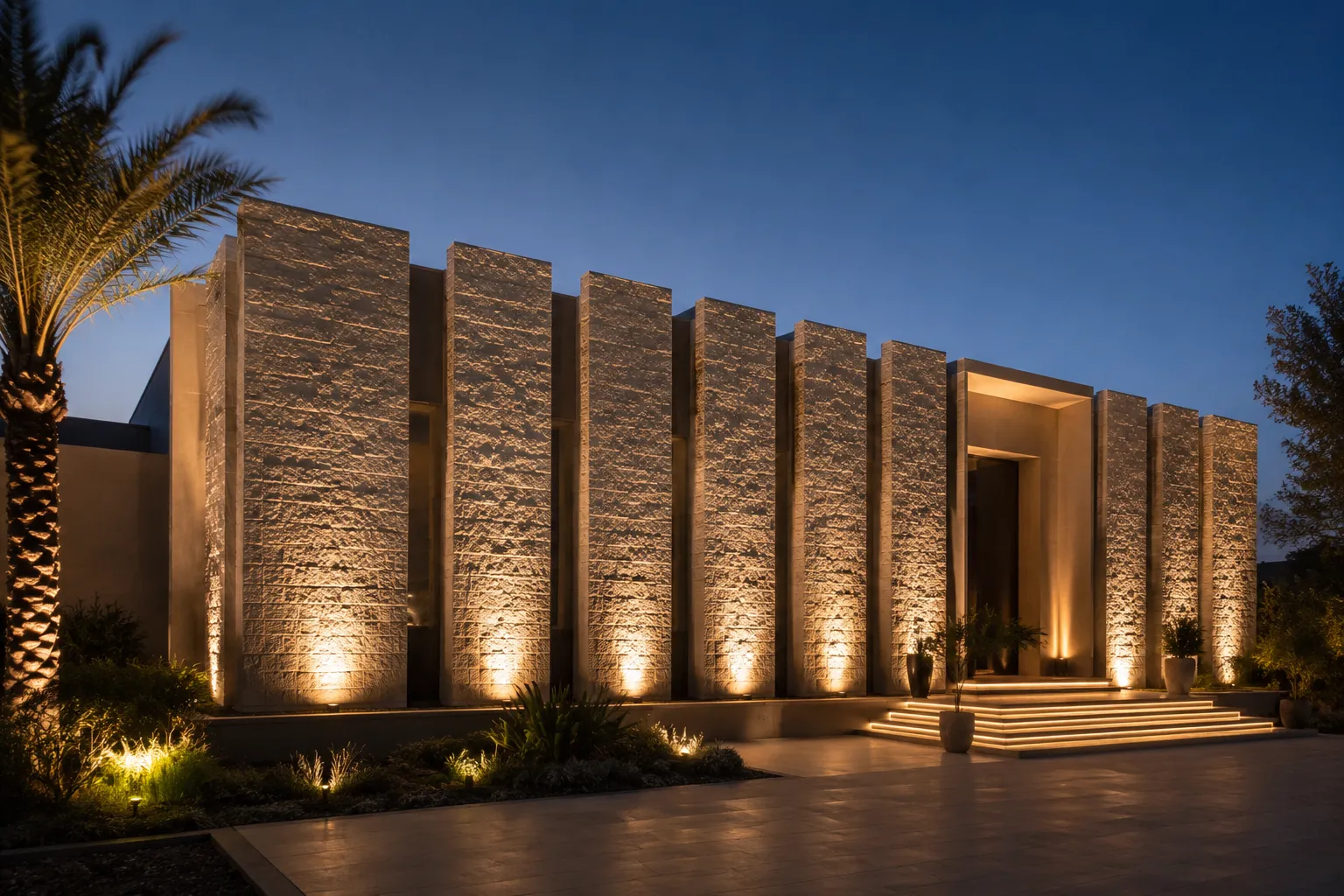

Luzion Lighting believes that architecture should remain expressive after sunset. When daylight disappears, carefully designed illumination can reveal details, proportions and textures that might otherwise fade into the background.
A thoughtful facade lighting design does not simply cover a building with light. It decides what should be seen, what should remain subtle and how the entire façade should be experienced from different viewpoints.

When Does Lighting Become Part of Architecture?
Lighting becomes architectural when it is considered alongside the building rather than added after construction.
The position of a window, the rhythm of columns, the depth of a recess and the texture of a material can all influence the lighting strategy.
This approach to architectural facade lighting can create a visual relationship between the structure and its surroundings, particularly for buildings that remain active after sunset.
Hotels, retail destinations, corporate offices, villas and landmark developments can all benefit from an exterior lighting concept developed around their individual architectural language.
How Does Light Create a Visual Hierarchy?
Not every part of a façade needs the same level of illumination.
A designer can establish hierarchy by allowing certain elements to receive stronger or more focused light while other areas remain quieter. This creates a natural visual journey across the building.
For example, a project may emphasise:
- A principal entrance
- A distinctive architectural frame
- Vertical columns
- Decorative stonework
- Roofline geometry
- Selected windows or balconies
- A central architectural feature
This selective approach can make building facade lighting appear more refined than uniform high-output illumination.
Can Materials Influence the Lighting Experience?
The surface being illuminated is just as important as the luminaire producing the light.
A rough stone wall can reveal dramatic shadows when illuminated from a close position. A smooth plaster surface may require a more controlled distribution. Glass can introduce reflections, while metal may create highlights that need to be carefully managed.
For this reason, professional facade lighting solutions should be developed with the façade's material palette in mind.
What Makes Modern LED Facade Lighting Flexible?
Modern LED facade lighting gives architects and lighting designers greater freedom in fixture size, optical distribution, colour temperature and control.
Compact luminaires can be integrated into architectural details where traditional fixtures may have been visually intrusive.
Depending on the application, a project can incorporate:
- Wall washers
- Linear LED profiles
- Architectural spotlights
- Uplighters
- Grazing fixtures
- Inground luminaires
- RGBW systems
Luzion's Facade Lights collection can support different architectural applications where precise exterior illumination is required.
Why Is the Viewing Distance Important?
A façade is rarely viewed from one fixed position.
A person walking toward a hotel entrance experiences the building differently from someone viewing it from a nearby road. A high-rise may also be visible from considerable distances.
Therefore, exterior lighting design should consider both close-range architectural details and the overall silhouette of the building.
Beam angle, intensity and fixture spacing can be adjusted according to these viewing conditions.
How Can Lighting Support a Building's Character?
Lighting can contribute to the personality of a property.
A luxury residence may call for discreet and warm illumination. A contemporary office building may benefit from crisp linear elements. A hospitality project might combine architectural lighting with softer entrance and landscape illumination.
For hospitality developments, Hotel Lighting Design can help create a coordinated lighting experience across guest-facing spaces.
The important principle is consistency: the lighting should feel like part of the architecture's identity.
What About Dynamic Facade Lighting?
Some buildings require more than static white illumination.
RGB and RGBW systems can introduce colour-changing scenes for selected commercial, entertainment and landmark applications. With suitable controls, lighting scenes can be programmed for events, festivals or special occasions.
However, dynamic lighting works best when it has a clear purpose. Movement and colour should complement the building's geometry rather than obscure it.
How Can Designers Check the Result Before Installation?
A façade may look very different in a computer model compared with an actual installation, which makes early technical planning valuable.
Photometric calculations and digital lighting simulations can help examine fixture positions, beam distribution and illumination levels before products are installed.
Luzion's DIALux Design Services can support projects requiring detailed lighting calculations and technical planning.
For projects requiring a broader lighting strategy, Lighting Design Services can connect architectural intent with technical execution.
What Should Be Considered for Long-Term Outdoor Performance?
An attractive façade is only successful if its lighting system continues to perform reliably.
Outdoor projects may expose luminaires to heat, dust, moisture, rain, humidity and corrosive conditions. The installation location and environmental conditions should therefore influence product selection.
Important considerations include IP protection, thermal management, material quality, mounting method, electrical coordination and maintenance accessibility.
These factors become particularly important for large buildings where replacing or servicing fixtures can require specialist access equipment.
Can Facade Lighting Work With Landscape Lighting?
The building and its surroundings are part of the same nighttime environment.
If a brightly illuminated façade is surrounded by completely dark landscape areas, the visual transition may feel disconnected. Coordinating architectural illumination with pathways, trees, gardens and outdoor gathering spaces can create a more balanced composition.
Explore Landscape Lighting when the project requires architectural and outdoor lighting to work together.
What Is the Real Purpose of Facade Lighting?
The purpose of facade lighting design is ultimately to make architecture readable and memorable after dark.
It can reveal details that daylight no longer provides, establish a property's identity and create a more engaging experience for people approaching or viewing the building.
The strongest designs are rarely about using more light. They are about using the right light in the right place.
For architects, developers, lighting designers, MEP consultants and contractors, Luzion Lighting provides architectural LED lighting, façade illumination and technical design support for projects across international markets.
Explore Facade Lighting Design to discover how a carefully considered lighting strategy can give architecture a distinctive presence long after the sun has set.
Luzion Lighting combines architectural understanding, precision LED technology and project-focused expertise to create sophisticated facade lighting solutions where light becomes an integral part of the building itself.






















Sign in to leave a comment.