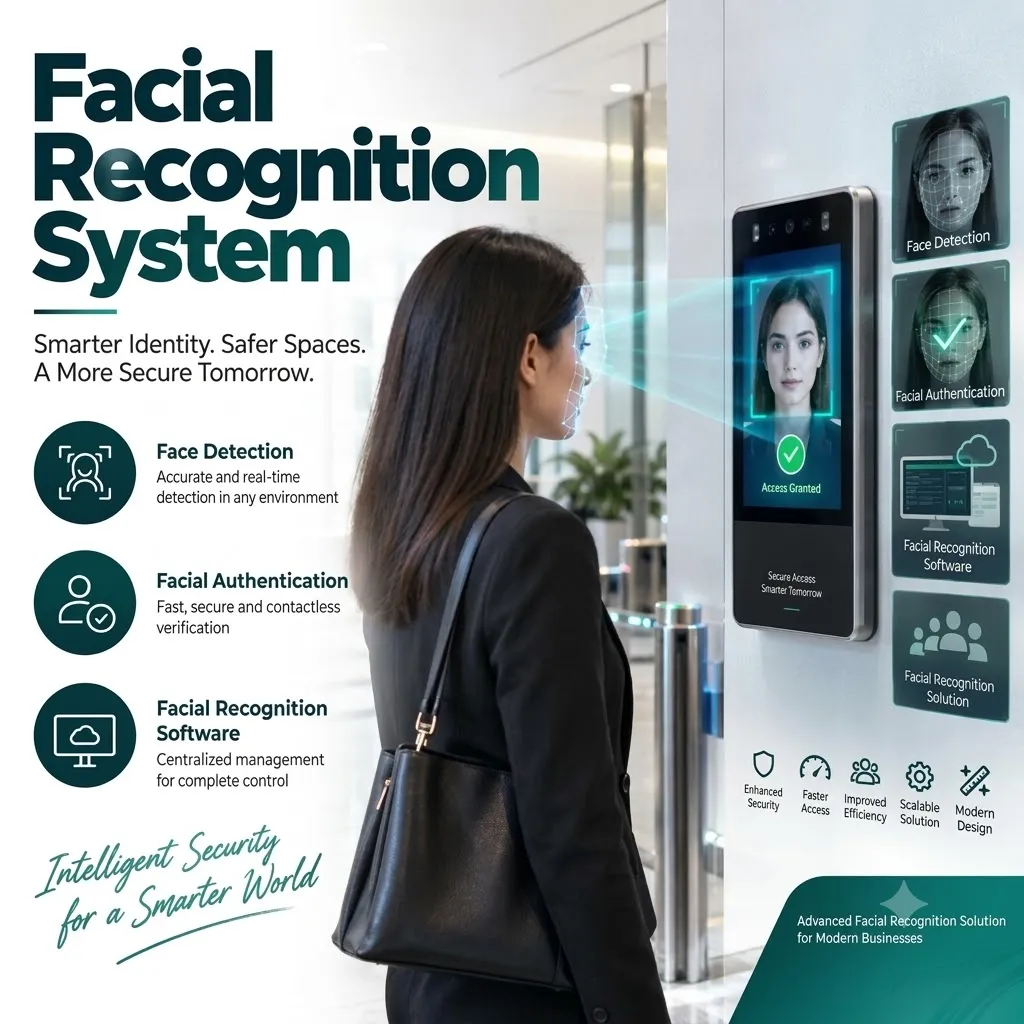

Facial Recognition System technology is redefining how Saudi Arabia protects its cities, workplaces, and public spaces, replacing manual checkpoints with instant, contactless identity verification. As the Kingdom accelerates its Vision 2030 smart-city agenda, government entities, enterprises, and critical infrastructure operators are turning to camera-based biometric platforms that recognise a person the moment they appear on screen. This guide explains how the technology works, where it is being deployed across Saudi Arabia, and what to look for when choosing a solution.

The Rising Need for Smart Security in Saudi Arabia's Cities and Enterprises
Rapid urban growth, giga-projects such as NEOM and the Red Sea developments, and record-breaking Hajj and Umrah crowds have pushed traditional security models to their limits. Manual ID checks, physical access cards, and human-monitored CCTV cannot scale to the pace at which Saudi Arabia's population centres, airports, stadiums, and corporate campuses are expanding. Security leaders are now prioritising systems that can verify identity in real time, flag unauthorised individuals automatically, and reduce dependence on large manual security teams. This shift is being driven jointly by government modernisation programmes tied to Vision 2030 and by private-sector demand for frictionless, touchless entry experiences in offices, retail, hospitality, and banking environments across the Kingdom.
What Is a Facial Recognition System and How Does It Work?
A Facial Recognition System uses computer vision and deep learning to map the unique geometric features of a person's face — the distance between the eyes, the shape of the jawline, the contour of the nose — and convert them into a mathematical template. This template is then compared against a stored database or a live watchlist to confirm or reject a match within a fraction of a second. Unlike traditional badge or PIN-based systems, the technology requires no physical contact and works even when a person is moving, partially obscured, or wearing accessories such as glasses or a face mask, thanks to modern deep-learning models trained on diverse regional facial datasets.
Face Detection: The First Step in Intelligent Surveillance
Face Detection is the foundational process that occurs before any identity match can happen — it is the system's ability to locate a human face within a video frame, distinguishing it from background objects, shadows, or other movement. Once a face is detected, the platform isolates the region of interest, corrects for angle and lighting, and passes a cleaned image forward for deeper analysis. High-performing detection engines can spot multiple faces simultaneously across a crowded frame, such as a mall entrance or transport hub, and continue tracking each one as it moves through the camera's field of view, which is essential for busy Saudi environments like airports and shopping centres.
Facial Identification vs Facial Authentication: Understanding the Difference
These two terms are often used interchangeably but serve distinct security purposes. Facial Identification answers the question "who is this person?" by comparing a captured face against an entire database to find a match — commonly used in watchlist screening, missing-person searches, or crowd monitoring at large public events. Facial Authentication, by contrast, answers a narrower question — "is this person who they claim to be?" — by comparing a live face against a single pre-registered profile, typically used for building access, time and attendance, or device login. Understanding which function a facility actually needs is the first step in designing an effective deployment, since identification and authentication place very different demands on database size, processing speed, and privacy governance.
Facial Recognition Access Control for Modern Facilities
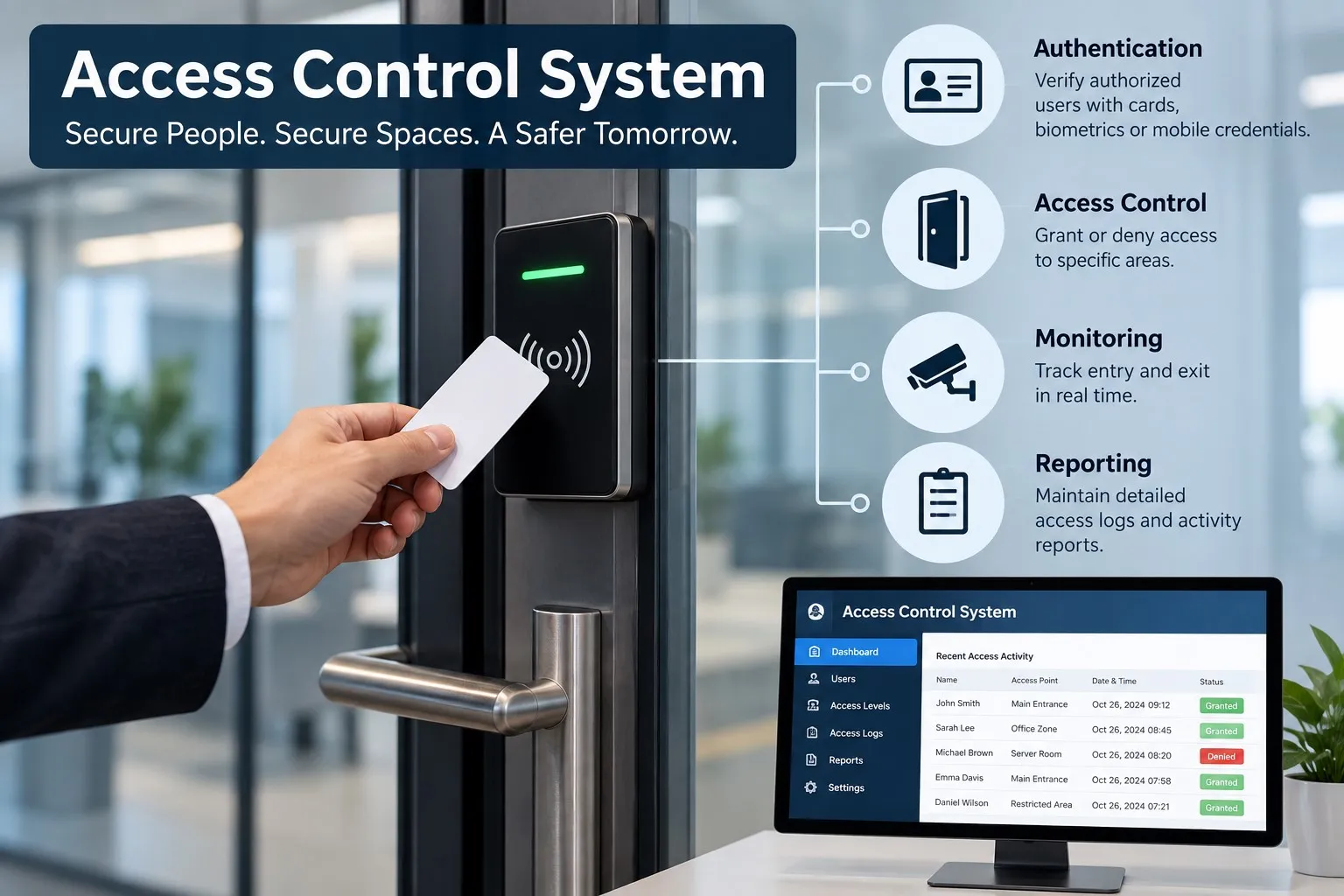
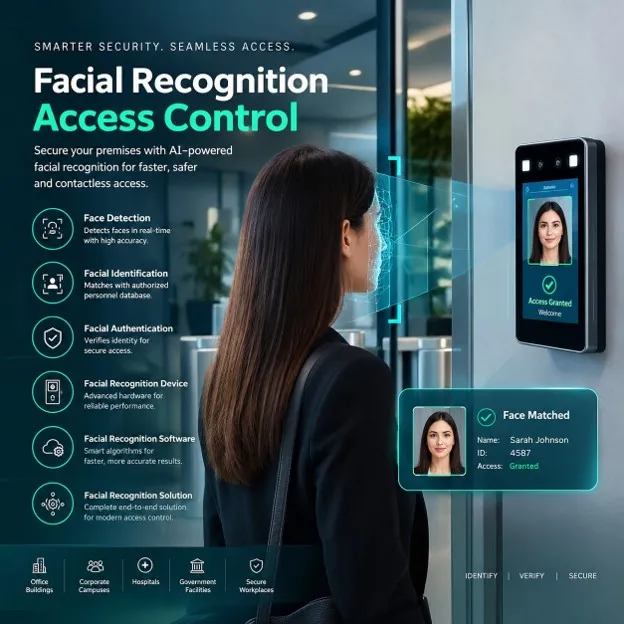
Facial Recognition Access Control is rapidly replacing keycards and PIN pads at office towers, data centres, factories, and residential compounds across Saudi Arabia. Employees and residents simply walk up to a reader, and the system authenticates them in under a second, unlocking doors, turnstiles, or lifts without any physical contact. This approach eliminates the security risks associated with lost, shared, or cloned access cards, while also generating a precise, tamper-proof log of who entered which zone and when. For organisations managing multiple buildings or shift-based workforces, this level of automated, auditable control significantly reduces both administrative overhead and unauthorised-access risk.
Choosing the Right Facial Recognition Device for Your Environment
Hardware selection has a major impact on real-world accuracy. A Facial Recognition Device installed at an outdoor gate must handle direct sunlight, dust, and temperature extremes common across the Saudi climate, while a device mounted at an indoor reception desk can rely on more controlled lighting and shorter capture distances. Key specifications to evaluate include infrared and visible-light dual sensors for accuracy in low light or complete darkness, on-device anti-spoofing capability to block photo or video replay attacks, and edge-processing power that allows the device to make decisions locally without depending on a constant network connection. Matching device specification to installation environment is one of the most overlooked steps in a successful rollout.
Facial Recognition Software: The Intelligence Behind the Camera
Facial Recognition Software is the platform layer that manages enrolment, matching logic, watchlists, reporting, and integration with other security systems such as visitor management, HR databases, or building management platforms. Modern software suites offer centralised dashboards where security teams can manage thousands of enrolled faces across multiple sites, configure alert rules for VIPs or blacklisted individuals, and export detailed audit trails for compliance reporting. Cloud-based deployment options allow multi-branch organisations — such as banks or retail chains operating across Riyadh, Jeddah, and Dammam — to manage every location from a single console, while on-premise options remain popular for government and high-security facilities with strict data-residency requirements.
Facial Recognition Solution Use Cases Across Saudi Industries
A well-designed Facial Recognition Solution adapts to the specific risk profile of each sector. Banks use it to authenticate high-value transactions and prevent identity fraud at branches. Airports and transport hubs use it for e-gate passenger processing and watchlist screening. Hospitals use it to secure restricted wards and control staff-only areas. Retail and hospitality operators use it to recognise VIP guests and flag known shoplifters. Educational institutions use it for contactless student and staff attendance. Across all of these, the underlying technology is the same, but enrolment policy, database size, and privacy safeguards are tailored to the sector's specific regulatory and operational needs. Organisations evaluating a proven facial recognition platform built for Saudi enterprises can review real product capabilities and deployment options before selecting a vendor.
Facial Recognition System KSA — National Adoption and Vision 2030
Facial Recognition System KSA deployments are expanding in step with the Kingdom's broader digital transformation agenda under the Saudi Data and Artificial Intelligence Authority (SDAIA) and Vision 2030. National initiatives spanning smart airports, giga-projects such as NEOM, and large-scale Hajj and Umrah crowd-management programmes are increasingly built around biometric verification as a core layer of public safety infrastructure. Government entities are combining facial recognition with existing digital identity frameworks to streamline everything from border processing to public-event access, positioning the Kingdom among the more advanced adopters of biometric security technology in the wider Middle East region.
Facial Recognition System Riyadh — Smart City Leadership
As the nation's capital and its fastest-growing business hub, Facial Recognition System Riyadh deployments are concentrated in high-rise commercial towers, government ministries, luxury residential compounds, and the city's expanding metro and transit network. Riyadh's status as host to major international events and its rapid growth as a global business destination have made frictionless, high-assurance security a priority for both public authorities and private developers. Facility owners in the city increasingly specify biometric access control at the design stage of new developments, rather than retrofitting it later, reflecting a broader shift toward treating smart security as core infrastructure rather than an optional add-on.
Standards, Privacy, and Compliance in Biometric Security
Because facial data is highly sensitive, any deployment in Saudi Arabia must be designed around the Kingdom's Personal Data Protection Law (PDPL), which governs how biometric information is collected, stored, and processed. Responsible vendors build consent workflows, data-minimisation practices, and encrypted storage into the platform from the outset, rather than treating privacy as an afterthought. Enterprises should also confirm that enrolled facial templates — the mathematical representations used for matching — cannot be reverse-engineered into a usable photograph, and that retention periods, access permissions, and audit logging meet both PDPL requirements and any sector-specific regulations, such as those governing banking or healthcare data.
The Technology Stack Behind Modern Facial Recognition Deployments
A dependable deployment typically combines several layers: high-resolution cameras or dedicated biometric readers for capture, an edge or on-premise server for real-time matching, a centralised software platform for management and reporting, and integration middleware that connects the system to access-control hardware, visitor-management tools, or law-enforcement watchlists where legally applicable. Liveness detection — verifying that the face presented is a live person rather than a photo, video, or mask — is now considered a baseline requirement rather than an advanced feature, given the rise of increasingly sophisticated spoofing attempts. Together, these layers allow a facility to move from simple camera monitoring to an intelligent, self-verifying security ecosystem.
Why Choose an Experienced Facial Recognition Partner in Saudi Arabia
Biometric security is a high-stakes deployment, so vendor credibility matters as much as the technology itself. Look for a provider with a documented history of deployments across Saudi government, banking, and enterprise clients, engineers who understand both computer-vision accuracy tuning and PDPL compliance obligations, and transparent published accuracy benchmarks rather than unverified marketing claims. Providers offering a complete facial recognition product line for Saudi security projects bring practical, region-specific experience — including familiarity with local regulatory documentation, Arabic-language interfaces, and Gulf climate hardware tolerances — that generic international vendors often lack. Before signing any contract, request references from comparable regional projects, ask for a live accuracy demonstration under real site conditions, and confirm the vendor's data-handling practices meet your organisation's compliance standards.
Conclusion
Facial Recognition System technology has moved from futuristic concept to everyday infrastructure across Saudi Arabia's offices, airports, and smart cities. From accurate Face Detection and reliable Facial Identification to seamless Facial Authentication and Facial Recognition Access Control, the technology now underpins how organisations verify identity at scale. Whether deployed through a rugged Facial Recognition Device at a factory gate, enterprise-grade Facial Recognition Software managing thousands of profiles, or a citywide Facial Recognition System Riyadh initiative, the right Facial Recognition Solution delivers both security and convenience. As Facial Recognition System KSA adoption expands under Vision 2030, organisations that invest now gain a lasting advantage in safety, efficiency, and compliance.































Sign in to leave a comment.