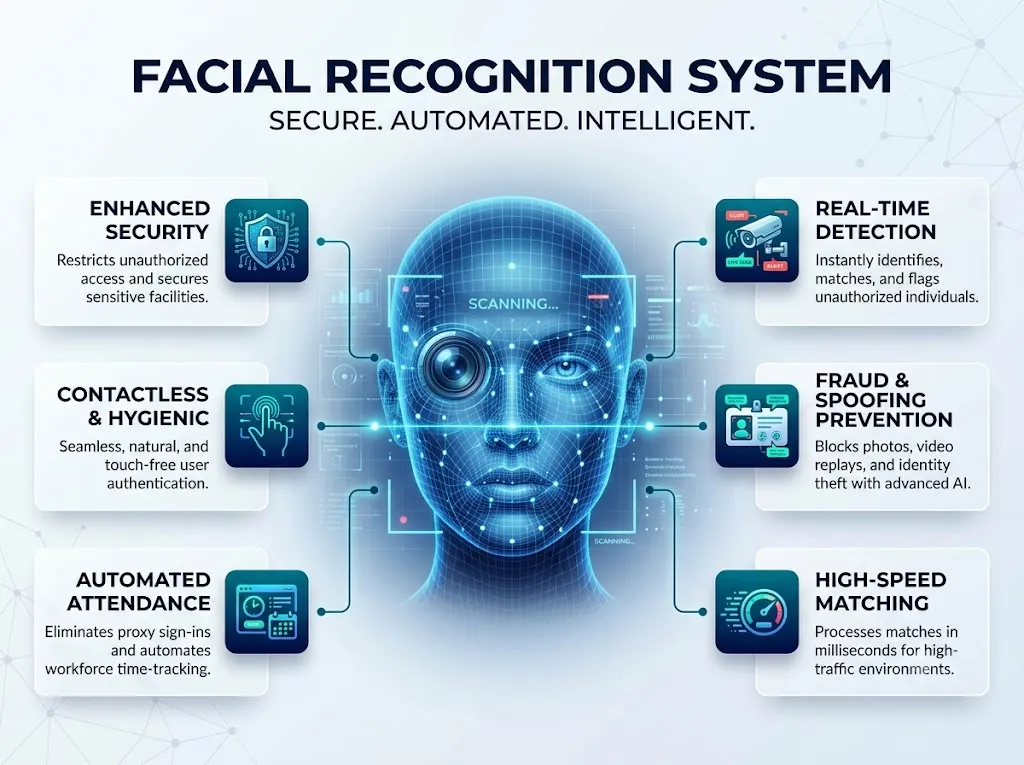

Facial recognition technology has become an important part of modern security, access control, and business automation. In the United Arab Emirates, where organizations increasingly focus on advanced security, smart buildings, and digital transformation, a Facial Recognition System can provide businesses with a faster and more intelligent way to identify and authenticate individuals.
From corporate offices and residential buildings to retail stores, hotels, educational institutions, and industrial facilities, facial recognition can help improve security while creating a convenient, contactless experience. Modern solutions combine cameras, artificial intelligence (AI), biometric algorithms, and specialized software to analyze facial features and compare them with authorized profiles.
This article explains what a Facial Recognition System is, how it works, its main types, benefits, important features, and why businesses in Dubai and across the UAE are adopting this technology.
What Is a Facial Recognition System?
A Facial Recognition System is a biometric security technology that identifies or verifies a person by analyzing their facial characteristics. Unlike traditional access methods such as passwords, ID cards, PINs, or keys, facial recognition uses a person's unique facial features for authentication.
The system generally works through a camera that captures an individual's face. Specialized Facial Recognition Software then processes the image, identifies important facial characteristics, and creates a mathematical representation known as a facial template. This template can be compared against authorized records to determine whether the person should be granted access or identified.
The technology can be used for:
- Access control
- Employee attendance
- Visitor management
- Security monitoring
- Identity verification
- Smart building management
- Restricted-area protection
- Customer experience applications
For UAE businesses, the technology can be particularly useful in environments where organizations need reliable security combined with fast and convenient access.
How Does Facial Recognition Technology Work?
A modern facial recognition solution typically involves several stages:
1. Face Detection
A camera captures an image or video and detects whether a human face is present.
2. Face Analysis
The system analyzes facial characteristics such as the distance between the eyes, shape of the nose, jawline, and other distinguishing features.
3. Feature Extraction
Artificial intelligence algorithms convert the facial characteristics into a digital representation that can be compared with stored profiles.
4. Face Matching
The system compares the captured facial template against a database of authorized individuals.
5. Authentication or Identification
If the captured face meets the configured matching criteria, the system can authenticate the person, trigger an access-control action, or generate an alert depending on the application.
This automated process can happen within seconds, making facial recognition suitable for locations where both security and operational efficiency are important.
Types of Facial Recognition Solutions
Businesses can deploy facial recognition in different forms depending on their requirements.
Facial Recognition System
A complete Facial Recognition System combines cameras, software, databases, networking, and access-control components. It can be designed for offices, commercial properties, warehouses, hotels, residential communities, and other facilities.
A complete system can provide centralized monitoring and management, allowing authorized administrators to control users and security policies from a single platform.
Facial Recognition Software
Facial Recognition Software is the intelligence layer responsible for analyzing facial images and performing matching or verification. It can integrate with existing CCTV cameras, access-control systems, attendance platforms, and security management solutions.
Software-based solutions are useful for organizations that already have suitable surveillance infrastructure and want to add intelligent facial recognition capabilities.
Facial Recognition Device
A Facial Recognition Device is a dedicated terminal equipped with a camera and processing capabilities. These devices are commonly installed at entrances, gates, turnstiles, offices, and restricted areas.
Depending on the model, a facial recognition terminal may also support features such as card authentication, PIN entry, temperature-related functions, visitor management, or integration with door controllers.
Benefits of Facial Recognition Systems for UAE Businesses
Enhanced Security
One of the biggest advantages of facial recognition is improved identity verification. Instead of relying entirely on access cards or passwords, organizations can use biometric authentication to verify that the person requesting access matches an authorized profile.
This can help reduce risks associated with lost, stolen, or shared credentials.
Contactless Access
Facial recognition provides a convenient, touch-free authentication experience. Employees and authorized visitors can access designated areas without physically touching a card reader or keypad.
This makes the technology particularly suitable for modern offices, smart buildings, hotels, and high-traffic facilities.
Faster Entry and Exit
Traditional access-control methods can cause delays when employees need to present cards or enter PINs. Facial recognition can streamline the process by automatically recognizing an authorized person.
Faster authentication can help reduce queues at entrances and improve the overall user experience.
Better Employee Attendance Management
Businesses can integrate facial recognition with attendance systems to automate employee check-in and check-out.
This can reduce manual attendance processes and help HR teams maintain more accurate attendance records.
Improved Visitor Management
Organizations can use facial recognition alongside visitor-management systems to make visitor authentication more efficient. Authorized visitor profiles can be managed digitally according to organizational policies.
Integration With CCTV
Modern facial recognition technology can work alongside video surveillance infrastructure. This allows organizations to combine conventional CCTV monitoring with AI-powered identification capabilities.
Security teams can potentially respond more quickly to events that require attention.
Reduced Dependence on Physical Credentials
Cards, keys, and access badges can be lost, damaged, or shared. Facial recognition provides a biometric alternative that can reduce reliance on physical credentials.
Centralized Management
Large UAE organizations may have multiple offices, branches, entrances, or facilities. A centralized management platform can make it easier to manage users, permissions, devices, and security events.
Why Facial Recognition Is Important in Dubai and the UAE
The UAE is recognized for its investment in smart-city infrastructure, advanced technology, automation, and digital services. Businesses operating in Dubai, Abu Dhabi, Sharjah, and other emirates are increasingly looking for technologies that can improve both security and operational efficiency.
A Facial Recognition System in UAE can support organizations in creating smarter access-control environments while reducing manual processes.
For example, a corporate office in Dubai may use facial recognition for employee access and attendance. A hotel may use it as part of a broader identity and visitor-management solution. A warehouse or industrial facility can deploy it to control access to restricted zones.
The key advantage is flexibility: facial recognition can be configured for different business environments and integrated with existing security infrastructure.
Key Features to Look for in a Facial Recognition System
Before purchasing a solution, UAE businesses should evaluate several important features.
High Recognition Accuracy
Choose technology capable of reliable facial matching under realistic operating conditions.
Fast Authentication
Quick recognition is important for busy entrances, employee access points, and high-traffic facilities.
AI-Based Processing
Advanced AI algorithms can improve the system's ability to analyze facial characteristics and handle different conditions.
Anti-Spoofing Technology
A strong system should include liveness detection or anti-spoofing capabilities to help distinguish a genuine person from photographs, videos, or other presentation attacks.
Access-Control Integration
The system should integrate with doors, turnstiles, gates, barriers, and other security equipment where required.
Scalability
Organizations should consider whether the solution can support additional users, devices, locations, and future expansion.
Reporting and Monitoring
Administrators may need dashboards, access logs, attendance records, alerts, and reporting capabilities.
Data Security and Privacy
Businesses should carefully consider how biometric information is collected, stored, processed, protected, and retained. Deployment should comply with applicable UAE laws, regulations, contractual requirements, and organizational privacy policies.
Applications of Facial Recognition Systems
Facial recognition technology can be used across many industries in the UAE.
Corporate Offices: Employee access, attendance, restricted-area security, and visitor management.
Hotels: Guest-facing authentication and controlled access applications where appropriate.
Retail: Security and operational applications, subject to applicable privacy and legal requirements.
Healthcare Facilities: Controlled access to authorized areas and staff authentication.
Educational Institutions: Access management and attendance applications.
Industrial Facilities: Restricted-area access and workforce management.
Residential Communities: Gate and building access for authorized residents.
Warehouses and Logistics: Secure access to sensitive operational areas.
Choosing the Right Facial Recognition Solution in UAE
Selecting the right system requires more than comparing camera specifications. Businesses should first identify their security objectives and operational requirements.
Consider the number of users, number of access points, indoor or outdoor installation, lighting conditions, integration requirements, network infrastructure, data-storage approach, and future scalability.
It is also important to select a professional security technology provider that can assist with system design, installation, configuration, integration, maintenance, and technical support.
A properly designed solution can deliver significantly better results than a system selected solely on price.
Conclusion
A Facial Recognition System provides businesses with an intelligent approach to identity verification, access control, attendance, and security management. By combining cameras, AI, biometric algorithms, and specialized Facial Recognition Software, organizations can create faster and more convenient authentication processes.
For businesses in Dubai and across the UAE, facial recognition can support the broader move toward smart buildings, automation, and advanced security infrastructure. However, organizations should select systems based on accuracy, anti-spoofing capabilities, integration, scalability, cybersecurity, and applicable privacy requirements.
With the right technology and professional implementation, facial recognition in UAE can become an important component of a modern, secure, and efficient business environment.
Frequently Asked Questions (FAQs)
1. What is a Facial Recognition System?
A Facial Recognition System is a biometric technology that identifies or verifies individuals by analyzing and comparing their facial characteristics. It can be used for access control, attendance, visitor management, and security applications.
2. What are the main benefits of facial recognition for businesses in Dubai?
The major benefits include enhanced security, contactless authentication, faster access, automated attendance, reduced dependence on access cards, improved visitor management, and integration with existing security systems.
3. What is the difference between facial recognition software and a facial recognition device?
Facial Recognition Software provides the algorithms and processing needed to analyze and match faces, while a Facial Recognition Device is a physical terminal that typically includes a camera and processing hardware. Both can work together as part of a complete facial recognition solution.
4. Is facial recognition suitable for UAE businesses?
Yes, facial recognition can be used across many UAE business environments, including offices, hotels, warehouses, residential communities, educational facilities, and industrial sites. Organizations should ensure that their deployment complies with applicable UAE laws and privacy requirements.
5. How do I choose the best facial recognition system?
Consider recognition performance, speed, liveness detection, environmental conditions, access-control integration, scalability, reporting, cybersecurity, data protection, installation requirements, and after-sales technical support before selecting a solution.
































Sign in to leave a comment.