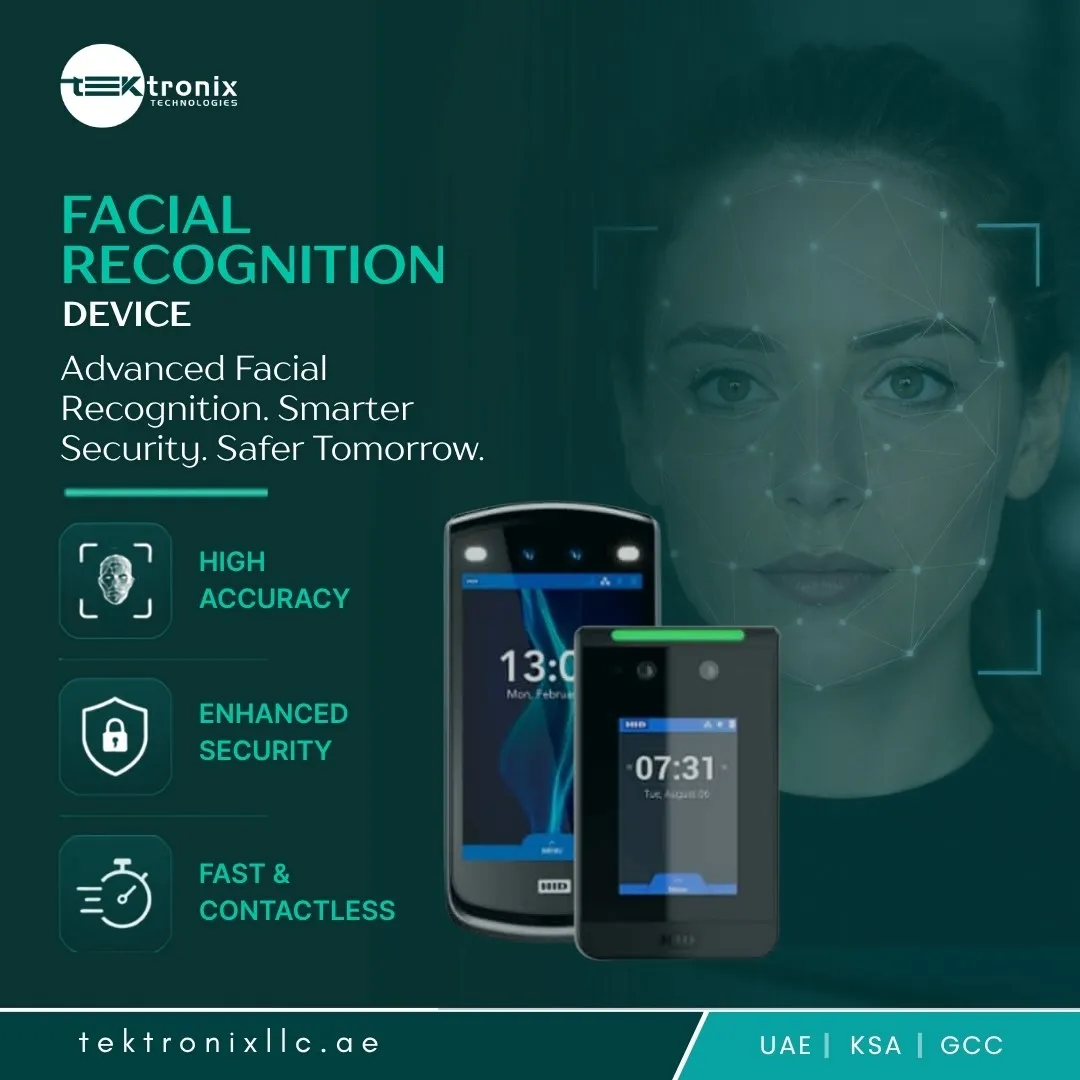

UAE aviation security stands at the front line of national border protection, and no technology has reshaped that front line more decisively than Facial Recognition. Airports across Dubai, Abu Dhabi, and Sharjah move millions of passengers, staff, and contractors through checkpoints every year, and card-based access control alone can no longer deliver the identity assurance that modern aviation security demands. A Facial Recognition System built for this environment must satisfy International Civil Aviation Organization (ICAO) Document 9303 machine-readable travel document standards, the UAE General Directorate of Residency and Foreigners Affairs (GDRFA) biometric immigration requirements, and the physical security mandates issued by the UAE General Civil Aviation Authority (GCAA) for airside and restricted-zone access. Tektronix LLC, a SIRA-licensed security integrator with more than 500 deployments across the UAE and the wider GCC, engineers Facial Recognition Solution architecture for every identity boundary inside a UAE airport — from the terminal perimeter to the aircraft gate. 
The Identity Verification Challenge Facing UAE Airports
UAE airports operate at a scale that makes manual document checks and card-only access control structurally inadequate. Dubai International Airport alone processes more than 86 million passengers a year across three terminals, translating into thousands of identity verification transactions every hour across immigration counters, boarding gates, and secure-zone entry points running in parallel. A single identity failure — an impersonator slipping through a boarding gate, an unauthorised individual entering a restricted airside zone, or a shared access card used by the wrong employee — can trigger airspace security incidents, flight diversions, and law-enforcement escalations that cost far more than the biometric infrastructure that would have prevented them in the first place.
A Facial Recognition System deployed in this environment has to operate across two separate identity domains at once. The passenger-facing domain confirms that the traveller standing at the checkpoint is the same person named on the travel document and cleared to proceed. The staff-facing domain manages the more than 100,000 airline, ground-handling, retail, and maintenance employees whose daily movement through airside, restricted, and sensitive areas must be verified and logged individually, every time. Both domains demand sub-second verification, near-perfect accuracy across an extraordinarily diverse travelling population, and live integration with GDRFA immigration databases, airline departure control systems, and GCAA-mandated audit trails.
How Facial Recognition Works Across the Airport Security Journey
Face Detection at the Checkpoint
Face Detection is the first and most technically demanding step in any airport biometric workflow, because terminal environments present the widest range of visual conditions found in any public-access setting. Ambient light swings from sun-flooded departure halls to dim security screening lanes within metres. Passengers arrive from more than 200 nationalities with correspondingly diverse facial characteristics. Sunglasses, medical masks, headwear, and scarves create partial occlusions that a system must distinguish from full occlusions requiring a manual verification pathway. Peak-hour departure rushes routinely place several faces inside a single camera frame at once. Tektronix LLC specifies wide dynamic range (WDR) cameras paired with near-infrared (NIR) illumination at every UAE airport biometric checkpoint, so Face Detection image quality stays consistent regardless of the lighting conditions immediately around the camera.
Facial Identification for Passengers and Staff
Facial Identification operates in one-to-many mode: the live facial scan is compared against a database of enrolled identities to determine who the traveller is, without requiring a travel document or access card to be presented first. On the passenger side, the identification database draws on pre-enrolled biometric templates from the GDRFA national biometric identity programme and from airline-managed biometric boarding programmes, enabling token-less boarding where the passenger's face is the only credential needed from check-in through to the gate. GPU-accelerated on-device matching returns a result in under 300 milliseconds even against databases containing millions of enrolled templates — fast enough to keep queues moving when 300 or more passengers must board within a 30-minute window.
Facial Authentication for Airside and Restricted Zones
Facial Authentication governs staff movement into airside areas, secure perimeter zones, operations centres, and aircraft parking stands, where GCAA rules require every entry event to be biometrically verified, timestamped, and logged against the individual's current authorisation. Authentication checks the matched identity against the person's Airside Pass category under the airport operator's colour-coded pass system, any time-of-day restrictions that limit certain contractors to daytime shifts, zone-specific competency certifications such as airside vehicle driving authority or dangerous-goods handling clearance, and any active security directive that suspends access. If an Airside Pass has been suspended following a security incident or a lapsed certification, the biometric gate denies entry even when the individual presents a physically valid card — because the live policy check in the access management platform overrides the credential itself.
Facial Recognition Device and Facial Recognition Software UAE Airports Require
Choosing the Right Facial Recognition Device
The Facial Recognition Device specification for a UAE airport is more demanding than for almost any other commercial or public installation. Passenger gates at immigration halls and boarding areas need hardware capable of processing one traveller every 3 to 5 seconds at peak load — roughly 12 to 20 people per minute per lane — without falling short of the biometric accuracy required under ICAO Annex 9 facilitation standards and GDRFA matching thresholds. Tektronix LLC specifies HID Amico, Suprema BioStation 3, and purpose-built airport biometric gate hardware with dual-camera configurations: a wide-angle lens for early Face Detection as the traveller approaches, and a high-resolution telephoto lens for precise biometric template capture, so throughput never depends on a passenger stopping at a fixed point in the lane.
Facial Recognition Software UAE Airports Depend On
A Facial Recognition Software platform built for UAE airport deployment has to integrate with three upstream identity systems at the same time: the GDRFA National Biometric Identity System for residents and Emirates ID holders, airline departure control systems such as Amadeus Altéa, SITA WorldTracer, and Sabre for biometric boarding enrolment, and the airport operator's airside access management platform for staff credentialing. Tektronix LLC deploys biometric management software with SOAP and REST API connectivity into all three systems simultaneously, so a single match at the boarding gate validates the passenger's identity, confirms boarding eligibility in the departure control system, and generates a GCAA-compliant audit record in one transaction. Template storage runs on AES-256 encryption with on-premises key management, satisfying UAE PDPL biometric data sovereignty requirements for every Facial Recognition Software UAE licence application.
The Tektronix LLC Facial Recognition Solution Across Every Security Domain
Tektronix LLC's Facial Recognition Solution is built to cover every identity boundary that exists inside a UAE airport, not just the immigration hall or the boarding gate:
• Terminal Perimeter Access: Biometric verification at terminal staff entry points distinguishes the thousands of employees who legitimately enter the building each day from anyone attempting to bypass public screening. HR-system integration automatically provisions access for new hires and revokes it the moment someone leaves, so retained physical cards can no longer be used to re-enter.
• Immigration and Border Control: Biometric e-gates at UAE arrival halls, deployed to GDRFA programme specifications, combine automated passport chip reading with live facial matching against the GDRFA database, allowing Emirates ID holders to clear immigration in under 15 seconds without officer interaction.
• Security Screening Lanes: Staff screening lanes use biometric verification to confirm the person presenting for screening is the actual Airside Pass holder on record, closing off pass-lending between colleagues — a vulnerability manual document checks routinely miss during high-throughput shifts.
• Boarding Gates: Biometric boarding systems confirm passenger identity at the final airside checkpoint before boarding, giving security teams a last chance to intercept a traveller whose status changed after check-in, such as a watchlist match or a departure prohibition order.
• Airside Vehicle and Equipment Access: Biometric terminals at vehicle staging areas and equipment stores confirm that the operator holds a current driving authority and dangerous-goods certification before releasing keys or equipment, satisfying GCAA aircraft operations area (AOA) access requirements.
Facial Recognition System UAE Coverage
Facial Recognition System UAE
Facial Recognition System UAE deployments from Tektronix LLC span the national airport network — from the mega-hub airports serving Dubai and Abu Dhabi to the regional airports at Fujairah, Al Ain, and Ras Al Khaimah that keep the country's aviation network connected. Consistent system specification and post-commissioning support across every UAE airport are backed by national engineering infrastructure and established GCAA coordination, with every deployment designed to satisfy GCAA Security Programme requirements and integrate with the Federal Authority for Identity and Citizenship (ICA) national biometric identity infrastructure.
Facial Recognition System Dubai
Facial Recognition System Dubai airport projects are coordinated with Dubai Airports Company (DACO) infrastructure standards, Dubai Police General Headquarters aviation security requirements, and Dubai Civil Aviation Authority oversight. Tektronix LLC's SIRA licensure and working relationships with DACO and Dubai Police Aviation Security qualify the team for biometric access control and passenger facilitation projects at Dubai International Airport (DXB) and Al Maktoum International Airport (DWC), where both GCAA compliance and Dubai-specific security programme requirements must be satisfied together.
Facial Recognition System Abu Dhabi
Facial Recognition System Abu Dhabi engagements are coordinated with Abu Dhabi Airports Company (ADAC) infrastructure requirements, Abu Dhabi Police aviation security standards, and ICA biometric database integration specifications. Abu Dhabi International Airport's ongoing Terminal A expansion — among the largest airport terminal development programmes in the world — includes biometric self-service passenger processing, automated border control e-gates, and airside biometric access control, making it one of the most complex Facial Recognition System Abu Dhabi deployment programmes currently under way. Tektronix LLC's Abu Dhabi engineering team works directly with ADAC project management and the ICA biometric integration team on every Abu Dhabi airport biometric project.
Facial Recognition System Sharjah
Facial Recognition System Sharjah deployments serve Sharjah International Airport's growing cargo and passenger traffic, coordinated with Sharjah Airport Authority infrastructure requirements and Sharjah Police aviation security standards. As Sharjah expands its role in UAE regional connectivity and logistics, Facial Recognition System Sharjah projects extend the same GDRFA-aligned passenger facilitation and GCAA-compliant staff access control found at the larger hub airports, giving Sharjah's terminal operators and cargo handling facilities the same biometric assurance level used at Dubai and Abu Dhabi without a separate compliance framework to manage.
Why Tektronix LLC for UAE Airport Biometric Security
Tektronix LLC holds active SIRA licensure and certified integration partnerships with HID Global, Suprema, ZKTeco, Hikvision, Axis Communications, Genetec, and Lenel, covering the full biometric hardware and access management software spectrum a UAE airport deployment requires. The engineering team carries formal training in ICAO Document 9303 biometric standards, GCAA security programme access control requirements, airline departure control system integration, and UAE PDPL biometric data governance, backed by a UAE and GCC project portfolio of more than 500 access control and biometric installations across aviation, government, critical infrastructure, and commercial environments.
Airport security directors and facility managers evaluating a Facial Recognition System UAE programme, a Facial Recognition System Dubai project at DXB or DWC, a Facial Recognition System Abu Dhabi deployment at Terminal A, or a Facial Recognition System Sharjah installation are invited to review our facial recognition solutions for UAE airport security and engage the SIRA-licensed engineering team for a site assessment and system design proposal.
Conclusion
UAE aviation security requires a Facial Recognition System that performs at aviation-grade accuracy and sub-second throughput across every identity boundary, from the terminal perimeter to the boarding gate. Delivered through a Facial Recognition Access Control framework that unifies passenger facilitation and staff access management, anchored by Face Detection tuned for UAE terminal conditions, scaled through Facial Identification across millions of enrolled identities, governed by Facial Authentication that enforces GCAA-mandated policy at every airside entry point, and built on purpose-specified Facial Recognition Device hardware and Facial Recognition Software UAE platforms integrated with GDRFA, airline departure control, and airport access management systems, Tektronix LLC's Facial Recognition Solution sets the biometric security benchmark for UAE aviation. Whether the requirement is a Facial Recognition System UAE national programme, a Facial Recognition System Dubai project, a Facial Recognition System Abu Dhabi deployment, or a Facial Recognition System Sharjah installation, the certified engineering team at Tektronix LLC delivers.
Elevate your airport's biometric security — explore our facial recognition solutions for UAE airport security and passenger facilitation and schedule a security assessment today.
Measuring the Impact of a Facial Recognition Solution
Airport operators evaluating a Facial Recognition Solution need more than a hardware specification sheet; they need evidence that the platform improves both security posture and passenger experience at the same time. Tektronix LLC benchmarks every UAE deployment against three measurable outcomes: reduction in average checkpoint dwell time once Facial Identification replaces manual document review, elimination of pass-sharing incidents once Facial Authentication is enforced at every airside gate, and improvement in audit completeness once every access event — successful or denied — is logged automatically instead of relying on manual guard logs. Airports that have moved from card-only access to a fully integrated Facial Recognition System typically report double-digit reductions in average boarding gate processing time, alongside a marked drop in security incident investigation time because every biometric event carries a timestamped, tamper-resistant record.
Return on investment for a Facial Recognition System UAE deployment is rarely driven by a single use case. The same biometric enrolment that speeds up passenger boarding also strengthens staff access control, and the same access management platform that logs airside entries for GCAA compliance also feeds the data an airport security operations centre needs for pattern analysis and threat detection. Tektronix LLC designs its Facial Recognition Solution architecture so that a single enrolment and a single software platform serve every one of these use cases simultaneously, rather than requiring the airport operator to maintain separate biometric systems for passengers, staff, and vehicles.
Implementation Roadmap for a UAE Airport Facial Recognition Deployment
Site Assessment and Regulatory Mapping
Every UAE airport biometric project begins with a site assessment that maps existing infrastructure against GCAA Security Programme requirements, GDRFA immigration workflow specifications, and the airport operator's own access management policies. This stage identifies which checkpoints need new Facial Recognition Device hardware, which can be upgraded through a software layer alone, and which upstream systems — GDRFA, the airline departure control system, or the airside access platform — require new API integration work.
Phased Hardware and Software Rollout
Tektronix LLC sequences UAE airport Facial Recognition System rollouts by risk priority rather than by convenience of installation. Airside perimeter and restricted-zone Facial Authentication points are typically commissioned first, since these carry the highest security consequence per incident, followed by staff screening lanes, and then passenger-facing Facial Identification at immigration and boarding gates. Each phase is validated independently against ICAO 9303 and GDRFA matching accuracy thresholds before the next phase begins, so the airport never operates with an unverified biometric checkpoint in its live security perimeter.
Commissioning, Training, and Ongoing Support
Commissioning includes on-site false match rate and false non-match rate testing under live terminal lighting conditions, integration testing against the GDRFA database and airline departure control systems, and staff training for airport security personnel who manage exception handling when Facial Authentication returns a denial. Tektronix LLC's post-commissioning support covers firmware updates for every Facial Recognition Device on-site, software platform patching, and periodic re-validation of matching accuracy as passenger volumes and enrolled database size grow — ensuring the Facial Recognition Software UAE platform keeps performing at aviation-grade accuracy years after go-live, not just on commissioning day.
Frequently Asked Questions
Q1. How does a Facial Recognition System at UAE airports satisfy ICAO biometric standards?
A Facial Recognition System deployed at UAE airports for passenger processing must satisfy ICAO Document 9303 Part 9 specifications for biometric data in machine-readable travel documents, including the facial image format standard (ISO/IEC 19794-5), biometric matching algorithm performance thresholds, and chip data integrity verification for e-passport processing. Tektronix LLC specifies biometric gate hardware and software platforms certified compliant with ICAO 9303 Part 9 that have passed ICAO-aligned performance evaluation for false match rate (FMR) and false non-match rate (FNMR) — typically FMR below 0.1% and FNMR below 1% for frontal facial image matching under controlled terminal lighting.
Q2. How does Facial Identification enable token-less biometric boarding at UAE airport gates?
Facial Identification enables token-less boarding by pre-enrolling the passenger's facial biometric template at check-in, either captured live at a kiosk or retrieved from an existing airline biometric boarding programme or the GDRFA national biometric identity system. The enrolled template links to the passenger's boarding record in the airline's departure control system. At the gate, the passenger approaches without presenting a boarding pass, the camera performs Face Detection and Facial Identification against the enrolled template, and on a match the gate validates the boarding record and releases the barrier — completing the entire transaction in under 3 seconds without any document handling.
Q3. How does Facial Authentication manage a suspended Airside Pass at UAE airports?
Facial Authentication queries the airport operator's access management platform in real time for every access attempt, checking the matched identity's current Airside Pass status, zone authorisation, and any active security directives at the moment of the attempt rather than at last synchronisation. When a pass is suspended after a security incident, a failed background re-check, or a driving-authority expiry, the next authentication attempt at any airside gate is denied regardless of the physical card presented, because the decision rests on the biometric match plus the live policy check, not the card alone. The denial is logged with a timestamp and pushed as a security alert to the airside pass office.
Q4. What Facial Recognition Device specifications apply to UAE airport immigration e-gates?
UAE immigration e-gate Facial Recognition Device specifications follow GDRFA programme requirements and ICAO 9303 Part 10 standards for automated border control. Key requirements include a dual-camera configuration (an approach camera for initial Face Detection and a high-resolution capture camera for template extraction), ISO/IEC 30107-3 Level 2 PAD-certified liveness detection to block presentation attacks, sub-300-millisecond matching against the GDRFA biometric database, an integrated e-passport chip reader, and throughput of one passenger every 8 to 15 seconds for resident e-gates and every 12 to 20 seconds for visitor e-gates. Tektronix LLC coordinates device specification with the GDRFA programme office for all UAE immigration biometric projects.
Q5. How does Tektronix LLC ensure Facial Recognition Software UAE deployments meet PDPL biometric data governance?
Facial Recognition Software deployments at UAE airports are configured to satisfy PDPL biometric data governance, including on-premises AES-256 encrypted template storage within UAE jurisdiction, role-based access limited to authorised airport operator and GDRFA personnel, defined template retention periods aligned with GDRFA and airline data lifecycle policies, automated deletion triggered by passport expiry or employment termination, and a data protection impact assessment (DPIA) framework covering every biometric processing activity. Tektronix LLC provides the full PDPL compliance documentation package, including the DPIA, data processing agreements, and technical control specifications required for a UAE airport's biometric system licence application to the UAE Data Office.
Q6. What makes a Facial Recognition System Sharjah project different from a Dubai or Abu Dhabi deployment?
A Facial Recognition System Sharjah project follows the same GDRFA-aligned passenger facilitation and GCAA-compliant staff authentication architecture used at Dubai and Abu Dhabi, but it is coordinated with Sharjah Airport Authority infrastructure standards and Sharjah Police aviation security requirements rather than DACO or ADAC. Because Sharjah handles a significant share of UAE regional cargo traffic alongside passenger operations, its biometric access control design places additional weight on staff and vehicle authentication for cargo handling zones, while passenger-facing Facial Identification at check-in and boarding mirrors the standard used across the national network.
https://tektronixllc.ae/facial-recognition-dubai/





























Sign in to leave a comment.