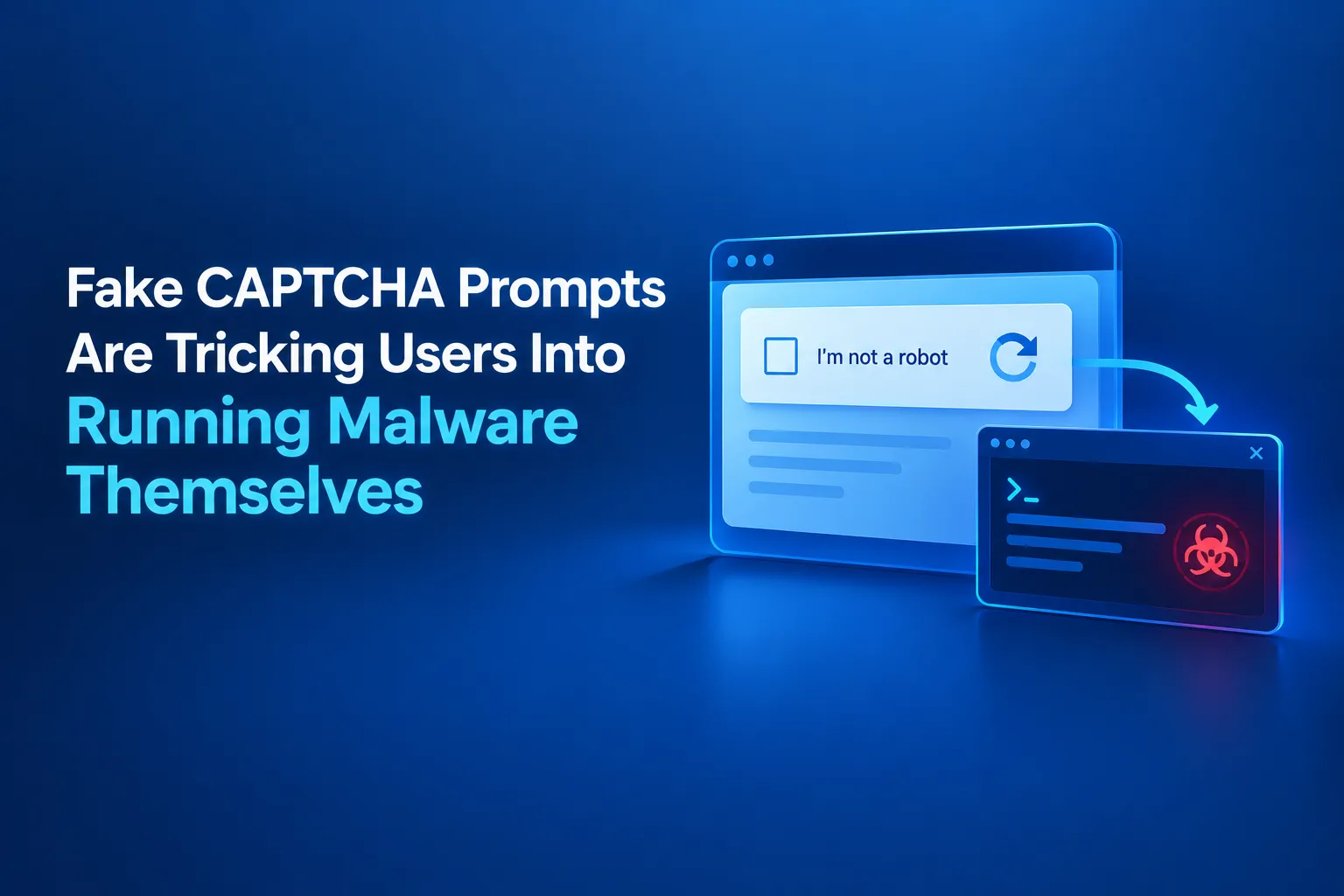

A visitor lands on what looks like an ordinary website and gets the kind of prompt millions of people see every day: "Verify you are human." They click the box. Except this time, instead of a simple checkmark, a message appears asking them to press a few keys to complete the verification, open the Run dialog, paste something, hit enter. It feels tedious but harmless, exactly like every other CAPTCHA friction point the internet has trained people to click through without thinking. Except what they just pasted and executed wasn't a verification token. It was a command that silently installed malware on their own machine, and they did it themselves, no exploit required.

This technique, often called ClickFix, has spread fast precisely because it sidesteps almost every technical defense built to stop attacks. There's no malicious attachment to scan, no exploit kit targeting a software vulnerability, no phishing link redirecting anywhere suspicious. The entire attack depends on convincing a real person to manually copy a command and run it themselves, using tools that are already installed and already trusted on every Windows machine. A unified cybersecurity platform becomes critical here because the compromise doesn't begin with a file landing on disk, it begins with a command a human being was tricked into executing willingly, which means the only realistic way to catch it is watching what that command does next, not what delivered it.
That's exactly where real threat detection earns its value in this scenario. Antivirus tools built to catch malicious downloads have nothing to flag, because nothing was downloaded in the traditional sense. What actually matters is behavioral visibility into the command line itself, catching a Power Shell process launched from a Run dialog with an unusual argument string, or a script pulling a payload from a remote server moments after a user closed a browser tab that had nothing to do with either action.
Why This Trick Works So Well
Security awareness training has spent years teaching people to distrust email attachments and suspicious links, and that training has genuinely helped. But it hasn't prepared anyone to distrust a CAPTCHA, because CAPTCHAs exist specifically to prove legitimacy. Attackers exploit that exact expectation, dressing up a malicious command as a routine, slightly annoying verification step that feels like proof the site is being careful, not proof it's compromised.
The Sites Behind the Prompt
These fake verification pages typically appear on compromised legitimate websites or through malicious ad placements, the same distribution channels that power other silent delivery methods. A visitor doesn't need to seek out anything unusual, they just need to land on a page that's already been tampered with, often one they've visited safely before, which is part of what makes this so hard for the average user to suspect at the moment. It's a similar gap to the one explored in Shadow IT Is a Blind Spot for Threat Detection, where the danger comes from something no one flagged as unusual in the first place, not from something that ever looked obviously wrong.
What Happens After the Click
Once the pasted command runs, the outcomes vary but tend to follow a familiar arc. Some deliver info stealer malware designed to harvest saved browser credentials, session cookies, and cryptocurrency wallet data within seconds of execution. Others establish a lightweight backdoor for persistent access, laying groundwork for a more targeted intrusion later. Either path typically ends the same way stolen access always does, fueling further compromise well beyond the original device.
Reducing the Exposure
Restricting which users can run scripting tools like PowerShell without elevated approval closes off much of what this attack depends on to succeed. Browser and endpoint monitoring that flags a Run dialog being used to launch a scripting interpreter, a sequence that almost never happens organically, catches the technique at the exact moment it becomes dangerous. And because the entire premise relies on a user trusting an unfamiliar instruction, updated awareness training that specifically covers this pattern, not just old attachment and link warnings, closes the human gap the technique was built to exploit.
Conclusion
ClickFix attacks succeed by turning a routine, expected moment of friction into the delivery mechanism itself, counting on the fact that nobody thinks to be suspicious of a CAPTCHA. Stopping it means recognizing that the most dangerous instructions aren't always hidden in a suspicious file, sometimes they're typed in plain sight, by someone who was simply trying to prove they weren't a robot.




















Sign in to leave a comment.