

Somewhere in late September, the cupboard starts filling up differently. The everyday cottons move to one side. The good sarees are the ones with a little more border, a little more embroidery, a little more meaning to move to the front.
For the next six weeks or so, they won't go back.
From the dhaak-beats of Durga Puja to the tilak on Bhai Dooj morning, India moves through one continuous festive stretch, and the saree travels with it — changing colour, changing fabric, changing meaning, almost week to week. This isn't one festival with one dress code. It's a whole season with its own quiet wardrobe logic, built up over generations and rarely written down anywhere.
This piece traces that logic — what gets worn when, and why — from Durga Puja through Navratri, Diwali, and finally Bhai Dooj. Along the way, it's worth understanding why handcrafted cotton sarees, in particular, have stayed at the centre of this season for so long, even as silks and sequins take over the evenings.
The Festive Season That Never Quite Ends
What is India's autumn festive season, and how long does it last?
India's main festive stretch typically runs from Durga Puja and Navratri in late September or early October through Dussehra, Diwali, and Bhai Dooj a few weeks later. Across this period, sarees are worn for pujas, family gatherings, gifting occasions, and celebrations almost every few days.
It's a strange kind of marathon. Durga Puja alone asks for a different saree on Shashthi, Ashtami, and Dashami. Navratri, observed differently across regions, has its own colour associations tied to each day of worship. Diwali brings a wardrobe refresh — new clothes bought specifically for the new year the festival marks in many communities. And then, just as the diyas are being packed away, Bhai Dooj arrives, quieter but no less significant, asking siblings to show up dressed with intention one more time.
What ties all of it together isn't a single colour or fabric — it's comfort that doesn't compromise on occasion. Pandal-hopping, temple visits, kitchen duty during Lakshmi Puja, long pujas that involve standing and bending repeatedly — none of it is kind to heavy silks or stiff embellishment. This is where handcrafted cotton sarees earn their place in the festive rotation, not as a fallback, but as the fabric that actually gets you through the day.
Durga Puja: The Saree as Ritual, Not Just Attire
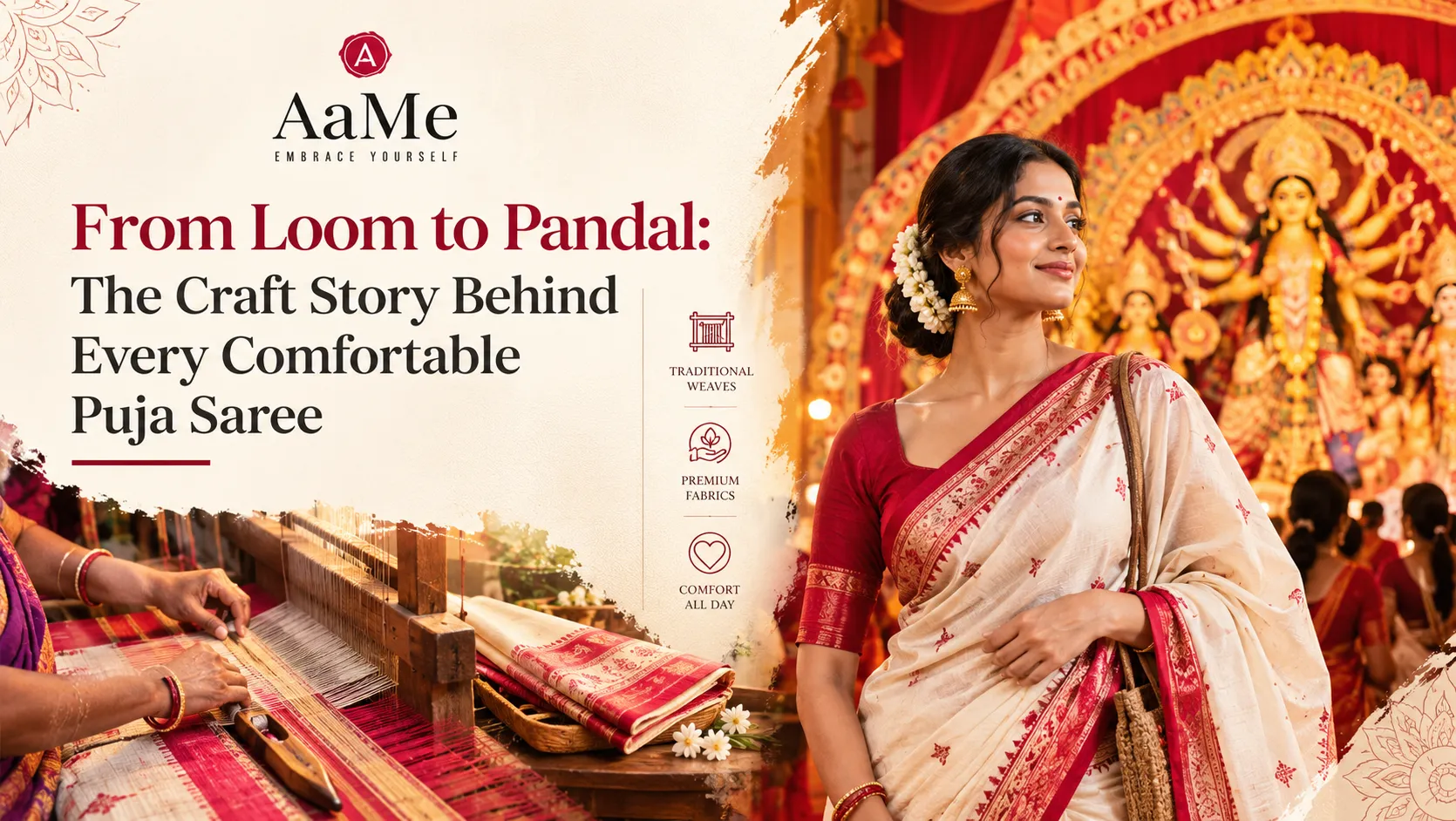
Durga Puja opens the season, and nowhere is the saree more tied to ritual than here. The white-and-red combination — known in Bengali homes as laal paar sada — isn't a fashion choice. It's worn specifically for Anjali, the collective flower-offering ritual on Ashtami morning, and for Sindoor Khela on Vijaya Dashami, when married women (and, increasingly, women regardless of marital status) smear vermilion on the goddess and on each other before her immersion.
White stands for purity and stillness. Red carries shakti — the same fierce energy the goddess herself embodies. Together, on one saree, they hold both sides of Durga's character: gentle mother, formidable protector.
For a morning that involves standing for close to an hour, folding your hands repeatedly, and later getting sindoor smeared across the fabric on purpose, cotton is really the only fabric built for the job. Silk clings, resists colour, and doesn't forgive October humidity. A well-woven khadi cotton, on the other hand, breathes through the ritual and takes the sindoor stains beautifully by evening — turning a practical choice into a keepsake.
The Aabha Laal Sada — White & Red Khadi Cotton Saree fits this brief closely, with an abstract, Jamdani-inspired border on a breathable khadi base — light enough for a 6 a.m. Anjali, sturdy enough to survive the day. For those who prefer the border rendered in a more classic red-and-white check, closer to the sarees seen in decades-old family Puja photographs, the Sati Laal Sada — White & Red Cotton Saree leans into that familiar, traditional look.
Kojagari Lakshmi Puja and Navratri: Between Two Goddesses
As Durga Puja winds down, the season doesn't pause — it shifts register. In many Bengali and Odia households, Kojagari Lakshmi Puja falls on the full moon just days after Dashami, inviting the goddess of prosperity into a home that's still recovering from five days of celebration. Elsewhere in the country, Navratri stretches across nine nights of its own, with several regions — Gujarat especially — associating each day with a particular colour worn during garba and dandiya.
What both occasions share is a preference for sarees that feel considered but not heavy — pieces with enough presence for an evening puja or a gathering, without the weight of full festive silk. This is where soft, hand-embroidered mulmul cotton earns its keep: delicate enough to look deliberate, light enough to wear through a puja that involves sitting on the floor, standing for aarti, and moving between rooms all evening.
The Lotus Poise — Embroidered White Mulmul Cotton Saree works well for exactly this kind of occasion. Its white base echoes the same purity associated with the goddess, while the hand embroidery gives it enough detail to hold its own at an evening Lakshmi Puja — a quieter, softer counterpart to the more structured red-and-white pieces worn earlier in the same season.
Diwali: Colour, Light and the Saree Wardrobe Refresh
If Durga Puja is about ritual, Diwali is about renewal. New clothes are a well-established part of the festival across most Indian communities, tied to the idea of starting the year — many businesses close their old accounting year and open a new one on this day — with something fresh. Homes are lit, sweets are exchanged, and by evening, everyone is dressed a shade brighter than usual.
Why do people buy new sarees for Diwali? Diwali marks a symbolic new beginning in many Indian traditions, and wearing new clothes — including a new saree — is considered part of welcoming prosperity and good fortune into the home. It's also simply the one evening of the year when most families gather in their festive best.
Colour plays a bigger role here than on any other day in the season. Deep pinks, greens, golds, and jewel tones dominate Diwali evenings, chosen as much for how they photograph under diya-light as for their auspicious associations. A saree that pairs two festive colours in one weave tends to work particularly well for this — it gives you a single piece that photographs richly indoors and still reads as considered, not costume-like.
The Meher Gul — Green & Pink Embroidered Mulmul Cotton Saree sits comfortably in this space, pairing two colours that are both traditionally associated with celebration and prosperity, in a mulmul cotton base that stays wearable through a long evening of guests, lamps, and photographs.
Bhai Dooj: The Saree That Marks a Sibling's Blessing
The season closes on a smaller, more intimate note. Bhai Dooj — also known as Bhau Beej or Yama Dwitiya in different regions — falls two days after Diwali and centres on the bond between siblings. A sister applies tilak to her brother's forehead, prays for his wellbeing, and the day is marked with a shared meal and an exchange of gifts, echoing the sentiment behind Raksha Bandhan earlier in the year.
Unlike the elaborate dressing of Diwali evening, Bhai Dooj mornings call for something festive but unfussy — a saree worn for a ritual performed at home, among family, rather than in a crowd. Yellow, associated with auspiciousness and new beginnings across several Indian traditions, works particularly well here, carrying festive intent without the visual weight of deeper jewel tones.
The Lotus Valley — Embroidered Yellow Mulmul Cotton Saree suits this quieter close to the season — a soft, embroidered mulmul in a colour that reads as celebratory without competing with the ritual itself. It's the kind of saree that feels appropriate whether the morning involves a small family gathering or a slightly larger one, and comfortable enough for a day that usually stretches into a long, unhurried lunch.
How to Choose a Festive Cotton Saree for the Season Ahead
What makes a handcrafted cotton saree special for the festive season? A handcrafted cotton saree combines breathability with visible craftsmanship — hand embroidery, traditional borders, or woven detailing — made by artisans rather than machines. This makes it comfortable enough for long rituals and gatherings, while still carrying the visual richness expected of festive dressing.
With six weeks of pujas, gatherings, and rituals ahead, it helps to shop with the calendar in mind rather than picking sarees one occasion at a time.
Think About the Occasion Before the Colour
A saree for a morning ritual that involves standing and movement has different requirements from one worn for an evening gathering where you're mostly seated. Lighter khadi and mulmul cottons suit the former; pieces with more embroidery or a fuller border suit the latter.
Prioritise Fabric Behaviour, Not Just Appearance
Which cotton sarees are comfortable for long celebrations? Khadi and mulmul cotton sarees are generally the most comfortable for long festive days, since both fabrics are breathable, lightweight, and drape predictably even after hours of wear — unlike stiffer silks that can feel restrictive during rituals involving standing, sitting, or repeated movement.
Let One Saree Do Double Duty
A well-chosen border or embroidery pattern can move from a daytime puja to an evening gathering without feeling repetitive — useful during a season where you may be dressing for an occasion every second or third day.
Shop With the Full Season in Mind
Rather than sourcing sarees occasion by occasion, it's often easier to shop a collection curated specifically for this stretch of festivals. AaMe's Utsav — Traditional Cotton Saree Collection brings together handcrafted cotton sarees suited to exactly this kind of rotation — from ritual-ready white-and-red pieces to softer, embroidered mulmul cottons for the quieter days in between. If you're looking to buy handcrafted sarees online for the season ahead, browsing by occasion within a single curated collection tends to be far less overwhelming than searching festival by festival.
Frequently Asked Questions
What is a handcrafted cotton saree?
A handcrafted cotton saree is woven and finished with significant manual involvement — hand embroidery, traditional weaving techniques, or artisan-applied detailing — rather than being mass-produced. This typically gives each piece subtle variations that machine-made sarees don't have, along with a distinct textural quality.
Why are cotton sarees suitable for Indian festivals?
Cotton sarees are breathable, lightweight, and comfortable for the long hours of standing, sitting, and movement that most festive rituals involve. They also drape reliably through humid or warm weather, which matters during a festive season that spans late monsoon and early winter across much of India.
How do I choose a traditional cotton saree for a festive occasion?
Match the saree to the occasion first — lighter khadi or mulmul for ritual mornings that involve movement, and pieces with more embroidery or a fuller border for evening gatherings. Colour matters too, but comfort and drape usually determine how well the saree actually holds up through the day.
Which cotton sarees are comfortable for long celebrations?
Khadi and mulmul cotton sarees tend to be the most comfortable choices, since both are lightweight, breathable, and hold their drape through hours of wear, unlike heavier or more structured fabrics.
How can I style a handcrafted cotton saree for a festive event?
A handcrafted cotton saree pairs well with minimal jewellery that lets the embroidery or border pattern stand out, and a blouse in a complementary or contrasting festive colour. For daytime rituals, simpler styling works best; for evening gatherings, statement jewellery or a more elaborate blouse can elevate the same saree.
Is it necessary to buy a new saree for every festival in this season?
Not at all. Many families rotate a small set of festive cotton sarees across the season, choosing based on occasion and comfort rather than buying something new for each event. A well-chosen handcrafted piece is versatile enough to be worn more than once across the festive calendar.
Where can I buy handcrafted festive cotton sarees online?
You can shop AaMe's traditional handcrafted cotton sarees, handwoven and hand-finished for occasions across the festive season, from Durga Puja rituals through Diwali and Bhai Dooj gatherings.
A Season Stitched Together, One Saree at a Time
What makes this six-week stretch so distinct isn't any single festival — it's the way the saree quietly tracks the whole journey, changing with each occasion while staying recognisably part of one continuous season. A laal paar sada for Ashtami morning. A soft white mulmul for Lakshmi Puja. Something in green and pink for Diwali evening. A yellow mulmul for Bhai Dooj. Different sarees, same thread of intention running through all of them.
That's really what handcrafted cotton sarees offer during this season — not just something to wear, but something considered enough to match the weight of each occasion, and comfortable enough to actually get you through it.
Ready to build your festive wardrobe? Explore AaMe's handcrafted cotton saree collection and find pieces for every ritual, gathering, and celebration on this season's calendar.




















Sign in to leave a comment.