
Selecting the ideal flooring material represents one of the most critical decisions in architectural design and residential renovation. Flooring establishes the aesthetic baseline of an interior environment while absorbing daily mechanical stress, foot traffic, moisture, and chemical exposure. Modern property owners, architects, and interior designers regularly weigh three primary surfaces against one another: marble, granite, and porcelain or ceramic tile. Each material exhibits distinct geological origins, physical performance attributes, aesthetic values, and lifecycle costs.
Understanding the structural characteristics of these materials enables specifiers to align functional demands with design vision. Galaxy Exports Udaipur has spent decades analyzing how raw quarried minerals perform across residential, commercial, and industrial installations worldwide. By evaluating porosity, compressive strength, aesthetic longevity, and maintenance requirements, property owners can make technically sound, durable decisions for every room.
The Organic Distinction of Natural Stone versus Engineered Tile
Flooring materials fall into two distinct manufacturing classes: quarried natural stone and manufactured factory tiles. Natural stones like marble and granite are harvested directly from continental bedrock. Because natural stone forms over millions of years through tectonic heat and immense lithostatic pressure, every cut slab presents unique structural veining, mineral crystallization, and color variation.
Procuring these raw slabs requires seasoned quarrying operations. As a seasoned natural stone block exporter, industry operators observe firsthand how geological formation impacts density and moisture absorption rates. Premium stone slabs cut directly from tectonic blocks offer unmatched structural longevity, retaining their polish and structural integrity across generations.
In contrast, porcelain and ceramic tiles are engineered through vitrification. Manufacturers blend refined clays, feldspar, and silica, pressing the slurry under mechanical force before firing the bodies at temperatures between 1,200 and 1,400 degrees Celsius. Glazed modern tiles emulate stone patterns via high-definition digital inkjet printing, yet they remain manufactured units with uniform structural profiles, repetitive print faces, and rigid grout line requirements.
Marble Flooring: Elegant Aesthetics and Formal Interiors
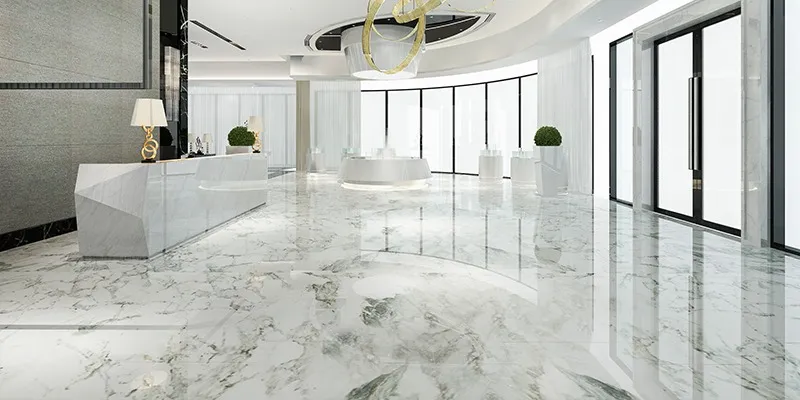
Marble is a metamorphic rock formed when limestone undergoes recrystallization under regional tectonic heat. Its mineral structure is dominated by calcite or dolomite crystals, creating a distinctive translucent surface that refracts ambient light. This geological trait yields the classic luminous appearance celebrated in monumental architecture.
Optimal Applications for Marble
Marble performs best in low-impact, highly visible spaces where visual prestige takes precedence over abrasive resistance:
- Formal living rooms and reception foyers
- Master bedroom suites and private sitting areas
- Executive boardrooms and upscale commercial lobbies
- Feature walls and master bathroom vertical surrounds
Because marble is composed primarily of calcium carbonate, it demonstrates susceptibility to acidic chemical reactions. Everyday substances such as citrus juices, vinegar, wine, and harsh chemical cleaners can etch an unsealed polished marble surface. For projects prioritizing high-end architectural grandeur, sourcing directly through an experienced marble exporter in India guarantees access to dense, structurally inspected slabs suited for precision floor layups.
Granite Flooring: Unyielding Strength for High-Traffic Zones
Granite is a plutonic igneous rock formed by the slow subsurface cooling of silica-rich magma. It consists mainly of quartz, alkali feldspar, and plagioclase, creating an interlocking crystalline matrix that ranks among the hardest natural materials on earth. Measuring between 6 and 7 on the Mohs mineral hardness scale, granite offers exceptional resistance to scratching, abrasion, and surface chipping.
Where Granite Delivers Superior Value
The physical resilience of granite makes it the premier flooring choice for demanding environments:
- High-traffic commercial hallways and airport concourses
- Residential kitchens and dining zones exposed to spills
- Outdoor patios, pathways, and exterior stair treads
- Commercial building entrances subject to heavy foot volume
Granite exhibits low porosity compared to other natural stones. It withstands acidic spills, moisture infiltration, and heavy furniture loads without dulling its original factory polish. Sourcing your architectural surfaces from a reliable granite exporter in India ensures consistent dimensional calibration and mineral quality across large project floor areas.
Vitrified and Ceramic Tile: Utility and Standardized Performance
Porcelain and ceramic tiles serve as versatile, cost-effective options for utility-focused construction. Modern porcelain tiles absorb less than 0.5 percent moisture, making them impervious to standing water and household stains without requiring topical sealers.
Best Scenarios for Tile Installation
Tile is widely specified for utilitarian settings where moisture exposure is constant:
- Laundry utility rooms and secondary bathrooms
- Budget-conscious rental housing developments
- Commercial food preparation zones and back-of-house utility areas
While tile provides uniform color and minimal routine upkeep, it lacks the thermal mass and authentic uniqueness of quarried rock. Damaged or cracked tiles cannot be resurfaced on-site; they must be chipped out and replaced, which often highlights dye-lot variations in replacement batches.
Technical Comparison of Flooring Materials
| Performance Parameter | Marble | Granite | Vitrified Tile |
|---|---|---|---|
| Material Origin | Metamorphic natural stone | Igneous natural stone | Engineered vitrified clay |
| Mohs Hardness | 3 to 5 (Moderate) | 6 to 7 (High) | 6 to 8 (High) |
| Porosity | Moderate; requires sealer | Very low to low | Extremely low (<0.5%) |
| Chemical Resistance | Low; sensitive to acids | High; resistant to acids | Very high; chemically inert |
| Refinishing Capability | Can be ground and repolished | Can be repolished on-site | Cannot be refinished |
| Surface Uniqueness | 100% individual natural veining | Unique crystalline patterns | Repeated digital pattern faces |
Making the Final Decision
Choosing between marble, granite, and tile depends on balancing mechanical exposure, maintenance expectations, and design intent. Marble remains unmatched for timeless, luminous indoor living areas where natural warmth is paramount. Granite provides dependable durability, thermal stability, and low-maintenance permanence for active homes and commercial spaces. Vitrified tile serves utility areas where moisture resistance and straightforward initial installations are required. Evaluating your site conditions against these material properties ensures a floor that performs reliably throughout its service life.



















Sign in to leave a comment.