

The advice was twenty minutes a day on the floor, following the child's lead. A mother in Weymouth wrote it down and then went looking for the twenty minutes. Between the school run, a job that ends at five, a second child with a Tuesday commitment, dinner, the bath and a bedtime that already runs long, the only unclaimed stretch she could find began at twenty to ten at night, when everyone in the house was asleep except her.
This is the point at which most parents quietly decide the recommendation is not for them. It is a reasonable conclusion from the way it was presented, and it is usually wrong, because the twenty minutes was never supposed to be an additional item on a day that has no room left in it.
What Floortime is, and where it came from
Floortime is the best known part of the DIR model, developed by Stanley Greenspan and Serena Wieder, where DIR stands for Developmental, Individual differences and Relationship based. The adult joins whatever the child is already doing, at the child's level, and works to extend the exchange rather than to redirect it toward a task.
The unit of interest is what the model calls a circle of communication: the child does something, the adult responds in a way that invites a further response, and the child comes back. Two turns is a circle. The aim is more circles and longer chains, rather than any particular correct response.
Families should know that the research base behind DIR is smaller than the one behind applied behavior analysis, or ABA. That does not make it worthless, and plenty of clinicians draw on it, but it is fair for a parent to ask about directly. Overviews of the evidence for autism interventions are maintained by the NICHD.
The play-based teaching already inside many behavior programs
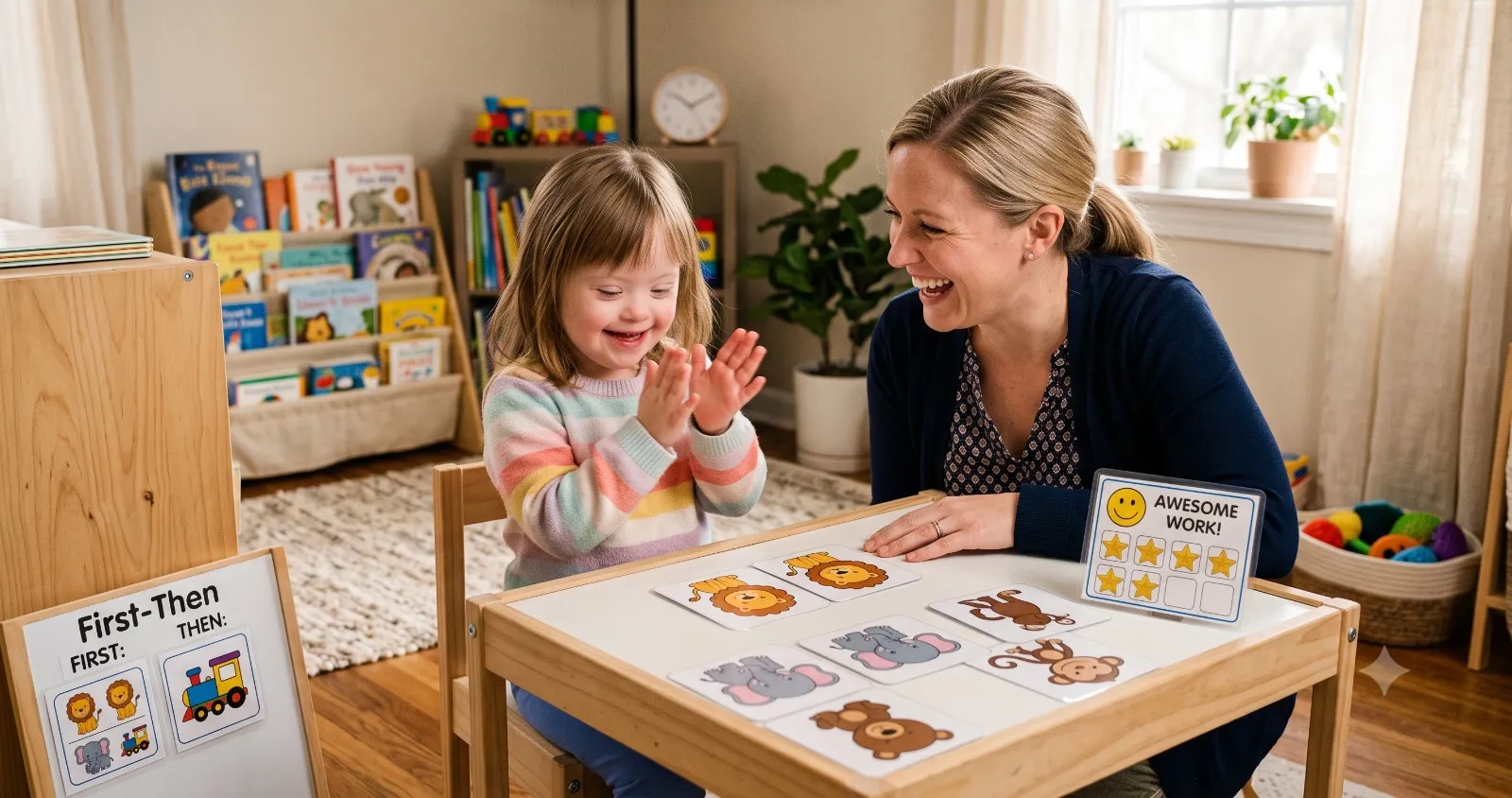
Parents are often surprised that following a child's lead is standard practice in much of contemporary behavior analysis. Naturalistic teaching, incidental teaching and natural environment teaching all describe the same broad idea: the adult arranges the environment, waits for the child to show interest, and teaches inside that moment rather than at a table.
A technician who spends twenty minutes on the carpet with a train set is very often running a program. The reinforcer is the train, the target is embedded in the play, and the data is being taken afterwards rather than during. Families curious about how one Massachusetts provider writes about play-based and developmental approaches can read more here before raising the question at their next meeting.
The two traditions have converged more than their public arguments suggest. It is worth asking any provider what proportion of sessions happen on the floor, in the child's chosen activity, and how that balance is expected to change.
Twenty minutes that is not an extra twenty minutes
The way this fits a tight week is by attaching it to something already happening. The bath is ten minutes of unavoidable close contact. The car has a captive audience. Cooking dinner has a child underfoot who could be handed a wooden spoon and a job.
The shift is not in the schedule, it is in what the adult does during those minutes: fewer questions, fewer instructions, more waiting, more responding to whatever the child offers. That is harder than it sounds and it costs nothing in time.
A parent who wants a measure can count circles rather than minutes. Five back-and-forth exchanges over a bath, counted honestly on a Tuesday and again a month later, says more about how a relationship is developing than a stopwatch ever will, and it can be done by an exhausted adult with wet sleeves.



























Sign in to leave a comment.