
FOB or CIF for Essential Oil Shipments from India: What Changes in Your Landed Cost
By Piyush Gupta, Founder & CEO, Kanha Nature Oils · 27 years in the fragrance and essential oils industry · Regional Secretary (North Zone), FAFAI · Treasurer, EOAI · Vice President, Sugandh Vyapar Sangh North Zone
Two Indian suppliers quote you for the same bulk lavender oil. One says FOB, the other says CIF, and the CIF price looks higher. Which is cheaper once the drums reach your warehouse?
For most buyers comparing fob or cif essential oil import from india , the short answer is this. FOB gives you control of freight, insurance and the carrier, and usually the lower total if you have a reliable forwarder. CIF is simpler when you do not, but you pay for freight you cannot see and get only minimum insurance. Where you import also matters: the US charges duty on a value that excludes freight, while the EU charges it on a value that includes it.
This guide shows exactly what each term covers, where risk moves, how each one changes your landed cost, and when neither is the right term at all.
fob or cif essential oil import from india
Both are Incoterms 2020 rules published by the International Chamber of Commerce. The cost split is the main difference.
| FOB (Free On Board) | CIF (Cost, Insurance and Freight) | |
|---|---|---|
| Named place | Port of shipment in India, e.g. FOB Nhava Sheva | Port of destination, e.g. CIF Rotterdam |
| Inland transport to Indian port | Seller | Seller |
| Indian export clearance | Seller | Seller |
| Loading on the vessel | Seller | Seller |
| Ocean freight | Buyer | Seller |
| Cargo insurance | Buyer’s choice | Seller, at minimum cover |
| Who chooses the carrier | Buyer | Seller |
| Destination port charges, import clearance, duty, tax | Buyer | Buyer |
| Risk passes to buyer | When goods are on board in India | When goods are on board in India |
The last row surprises many buyers. Under both terms the risk is yours from the moment the drums are loaded in India. CIF moves cost, not risk.
Where risk moves, and why CIF insurance may not be enough
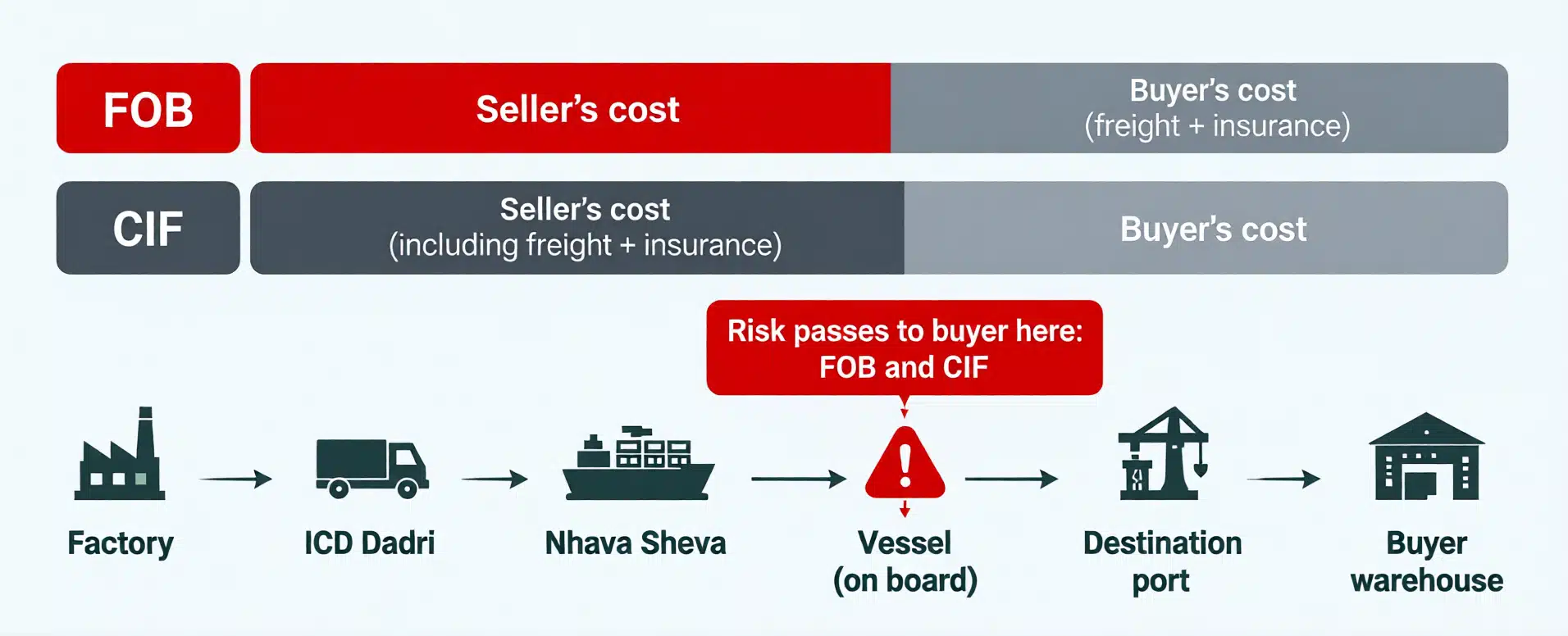
Under both FOB and CIF, risk passes to the buyer once the goods are on board in India.
Because risk transfers at loading under both FOB and CIF, any loss at sea is your claim to make. Under CIF the seller must insure the goods for you, but Incoterms 2020 sets that cover at the minimum. The seller insures at least 110% of the contract value under Institute Cargo Clauses (C), unless you agree otherwise.
Clauses (C) is a named-perils policy. It covers events such as fire, sinking and collision, not all loss. For essential oils, the realistic losses are leaking drums, contamination and temperature damage, which sit outside that narrow cover.
If you buy CIF, ask the supplier to quote Institute Cargo Clauses (A), or top up the cover yourself. If you buy FOB, your own policy or your forwarder’s open cover applies from loading.
How FOB and CIF change your landed cost
Landed cost is everything you pay until the oil is in your warehouse:
- product price
- inland transport and export clearance in India (in the price under both terms)
- ocean or air freight
- cargo insurance
- destination port and terminal charges
- customs duty and import tax
- customs broker fees
- delivery to your warehouse
Only freight and insurance change hands between the two terms. Everything after the destination port is yours either way.
Worked example on one essential oil consignment
The figures below are illustrative, not quotes or real tariff rates.
| Line | FOB route | CIF route |
|---|---|---|
| Supplier price | USD 20,000 FOB Nhava Sheva | USD 22,300 CIF destination port |
| Ocean freight booked by your forwarder | USD 1,800 | Included in price |
| Insurance, Clauses (A) | USD 60 | Included, Clauses (C) only |
| Cost to destination port | USD 21,860 | USD 22,300 |
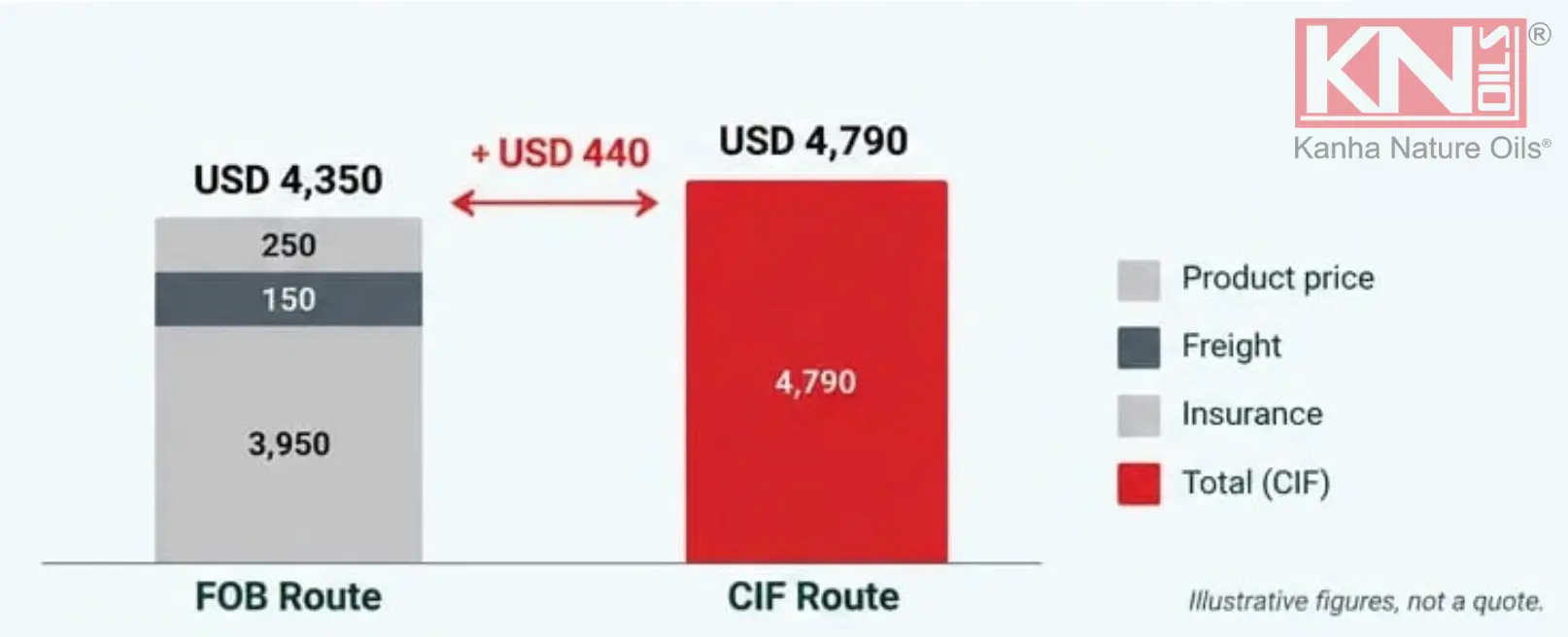
In this example, the CIF quote costs USD 440 more and carries thinner insurance.
The CIF quote carries USD 440 more than the FOB route, plus thinner insurance. That gap is common, because the seller’s freight booking can include a margin you cannot see. It can also go the other way when the seller ships volume and has better contract rates. The point is to compare like with like: ask the CIF supplier to show freight and insurance as separate lines on the invoice.
Know More :- https://kanhanatureoils.com/blog/fob-vs-cif-essential-oil-import-india/





























Sign in to leave a comment.