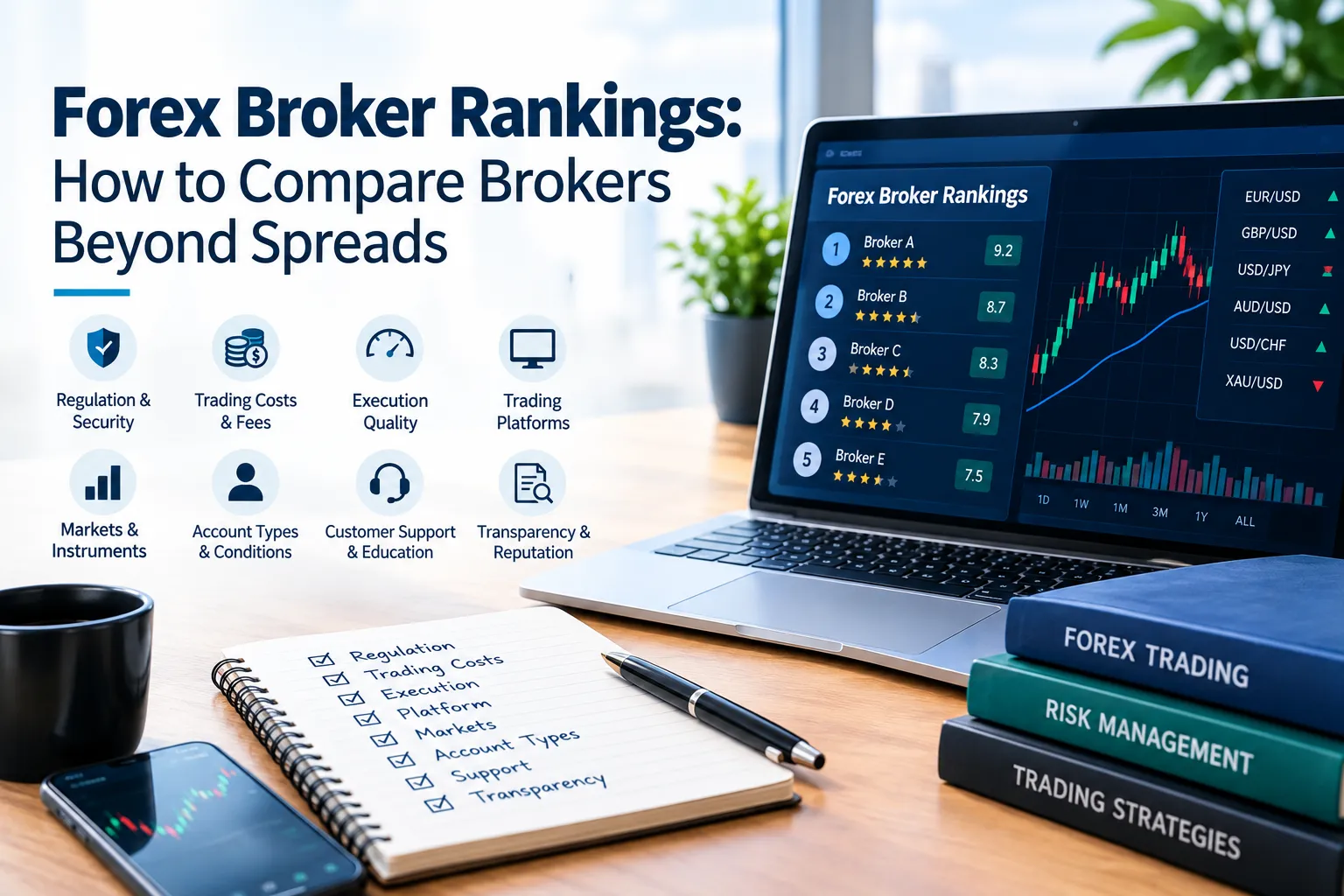

When traders search for forex broker rankings, spreads are often one of the first things they compare. While competitive spreads can help reduce trading costs, they are only one part of evaluating a forex broker.
A broker may advertise low spreads but have different commissions, execution conditions, platform features, or account requirements. For this reason, traders should look beyond a single number and consider the overall trading environment before choosing a broker.
Why Spreads Should Not Be the Only Factor
The spread represents the difference between the bid and ask price of a currency pair. A lower spread can be attractive, especially for active traders, but the advertised spread may not always represent the total cost of trading.
Some brokers offer raw or very low spreads while charging commissions. Others may include their costs primarily within wider spreads. Market conditions can also cause spreads to change.
A useful broker comparison therefore considers spreads, commissions, and other trading costs together.
1. Regulation and Security
Regulation should be one of the most important factors in forex broker rankings.
Before opening an account, traders should check which financial authority regulates the broker and which legal entity will provide the services in their jurisdiction. Regulatory requirements and available protections can differ between countries.
Traders should also look for clear information about client funds, company ownership, and regulatory status.
A transparent broker should make this information reasonably easy to verify.
2. Trading Costs and Fees
Beyond spreads, traders should examine the broker's complete fee structure.
Potential costs can include:
- Trading commissions
- Overnight or swap charges
- Deposit and withdrawal fees
- Currency conversion costs
- Inactivity fees
- Account-related charges
The cheapest broker on spreads alone may not necessarily be the least expensive option overall.
3. Execution Quality
Execution can be particularly important when markets move quickly.
Factors such as execution speed, slippage, order types, and liquidity can affect the final price at which a trade is executed.
For example, an extremely competitive advertised spread may be less meaningful if execution conditions are unsuitable for a trader's strategy.
This is why forex broker rankings should consider the broader trading experience rather than relying entirely on advertised pricing.
4. Trading Platforms and Technology
The trading platform is another important consideration.
Different brokers may support platforms such as MetaTrader 4, MetaTrader 5, cTrader, TradingView, or proprietary platforms. Each platform can offer different charting tools, order functionality, automation options, and mobile experiences.
Traders should consider whether a platform provides the tools they actually need.
A beginner may prefer a simple interface, while an experienced trader may prioritize advanced charts, automated trading, multiple order types, and customization.
5. Range of Tradable Instruments
Forex traders do not necessarily have identical requirements.
Some may focus primarily on major currency pairs, while others may want access to minor and exotic pairs or additional markets such as indices, commodities, and shares.
When comparing brokers, check which instruments are available in your region and under the account type you intend to use.
A wider product range is not automatically better if you only need a small selection of markets.
6. Account Types and Trading Conditions
Account structures can vary significantly between brokers.
Some offer standard accounts, while others provide raw-spread or commission-based accounts. Minimum deposits, leverage, minimum trade sizes, margin requirements, and other conditions can also differ.
Before choosing a broker, traders should make sure they understand the account terms and how they apply to their trading strategy.
7. Customer Support and Educational Resources
Customer service can become important when traders experience problems with accounts, deposits, withdrawals, or platforms.
Look at the available support channels, operating hours, response times, and available languages.
Educational resources can also be useful, particularly for newer traders. Guides, market analysis, webinars, demo accounts, and trading tutorials may help users become more familiar with the platform and markets.
8. Transparency and Broker Reputation
Transparency is another useful consideration when reviewing forex brokers.
Look for clear information about:
- Company ownership
- Regulation
- Fees
- Trading conditions
- Risk disclosures
- Available products
- Account requirements
Independent broker reviews and comparisons can also help traders identify differences between providers. However, rankings should be treated as a starting point rather than a guarantee that one broker will be suitable for everyone.
How to Use Forex Broker Rankings Effectively
A ranking can make the initial research process easier by bringing important information together. However, traders should understand how the ranking is produced and which criteria are being evaluated.
Instead of asking only, "Which broker is number one?", consider questions such as:
Is the broker regulated in my jurisdiction?
Are its total trading costs suitable for my strategy?
Does it offer the platform and instruments I need?
Are the account conditions appropriate for me?
Is the broker transparent about its services and fees?
These questions can turn a general ranking into a more useful comparison.
Final Thoughts
Forex broker rankings can be a helpful starting point for researching different brokers, but spreads should never be the only consideration.
Regulation, security, total trading costs, execution, platforms, available instruments, account conditions, customer support, and transparency can all influence whether a broker is suitable for a particular trader.
The right approach is to compare several brokers using consistent criteria and then review the current terms that apply to your location and account.
Forex and CFD trading involves significant risk, especially when leverage is used. A broker ranking can help with research, but it does not eliminate the risks associated with trading. Always conduct your own research and understand the relevant costs and risks before opening an account.























Sign in to leave a comment.