
Some manufacturing sites route forklift traffic through more junctions in a single shift than a small town sees in a day. Multiply that across storage, production, and dispatch, and you've got a traffic network with far less structure than it needs. Unlike a purpose-built logistics hub, most manufacturing facilities evolved their layout over years of expansion, leaving vehicle routes that snake around legacy equipment, temporary storage, and retrofitted production cells. Pedestrians, meanwhile, still need to cross those routes constantly. Getting traffic management right here is harder than it looks — and the consequences of getting it wrong are severe.
Why Manufacturing Facilities Have Complex Internal Vehicle Routes
Manufacturing sites rarely get the luxury of a clean-sheet layout. Buildings are extended, production lines relocated, and storage areas repurposed as demand shifts, and each change leaves vehicle routes that weren't designed together as a system. The result is a network of routes with varying widths, sightlines, and surface conditions, often converging at a handful of pinch points. You inherit this complexity whether you designed it or not, and your traffic management plan has to work with the site as it actually is, not as it would be on a blank plan.

Forklift Traffic Between Storage, Production and Dispatch
Material flow through a typical manufacturing facility runs in three broad phases: raw material and component storage, production feed, and finished goods dispatch. Forklifts move constantly between these zones, often on routes that cross production cell walkways, canteen access corridors, or shift-change pedestrian flows. Peak traffic tends to cluster around shift starts, break periods, and dispatch deadlines — precisely when pedestrian volume is also highest. Facilities across South Yorkshire, the North East, and the Black Country, all established industrial manufacturing regions, have had to rework these routes repeatedly as production has intensified.
Shared Routes Used by Maintenance Personnel
Maintenance teams add a layer of risk that's easy to overlook in a standard traffic assessment. They move through the site on an unpredictable schedule, often carrying tools or parts that limit their attention to vehicle movement, and they frequently need access to areas forklifts also use for staging or turning. A route that's safe for scheduled production traffic can become hazardous the moment a maintenance engineer needs unplanned access to a plant room or conveyor line. Your risk assessment should explicitly account for this irregular pedestrian pattern, not just predictable shift-based movement.
Identifying Vehicle-Pedestrian Interaction Points
Mapping interaction points properly takes more than a walk-through with a clipboard. Effective identification typically involves:
- Reviewing forklift telematics or route logs where available to spot high-frequency paths
- Interviewing operators and pedestrians separately, since each group notices different near-misses
- Checking incident and near-miss records against a site plan to find recurring locations
- Reassessing after any layout change, however minor it seems at the time
Once you've identified genuine interaction points, rank them by frequency and severity potential, and prioritise controls accordingly rather than treating every crossing equally.
How Red Forklift Safety Lights Create a Moving Visual Boundary
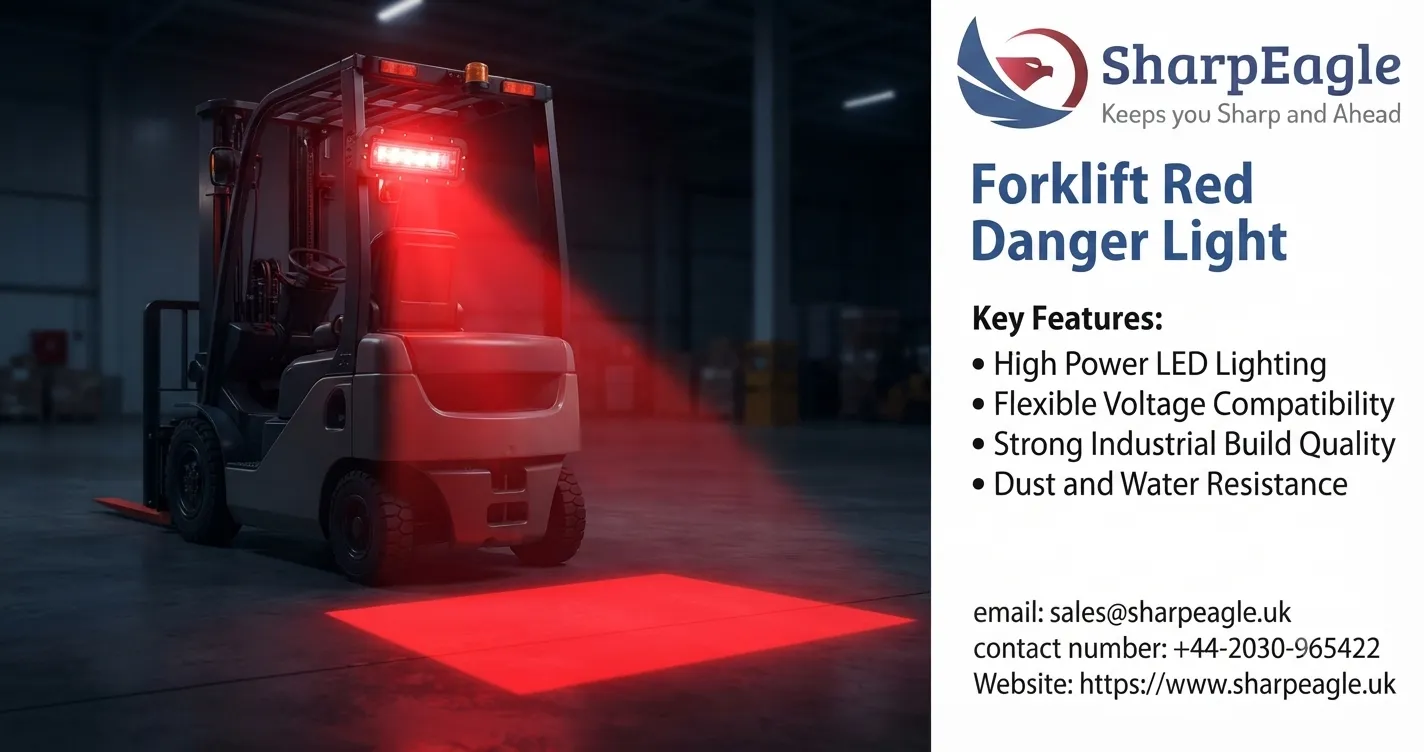
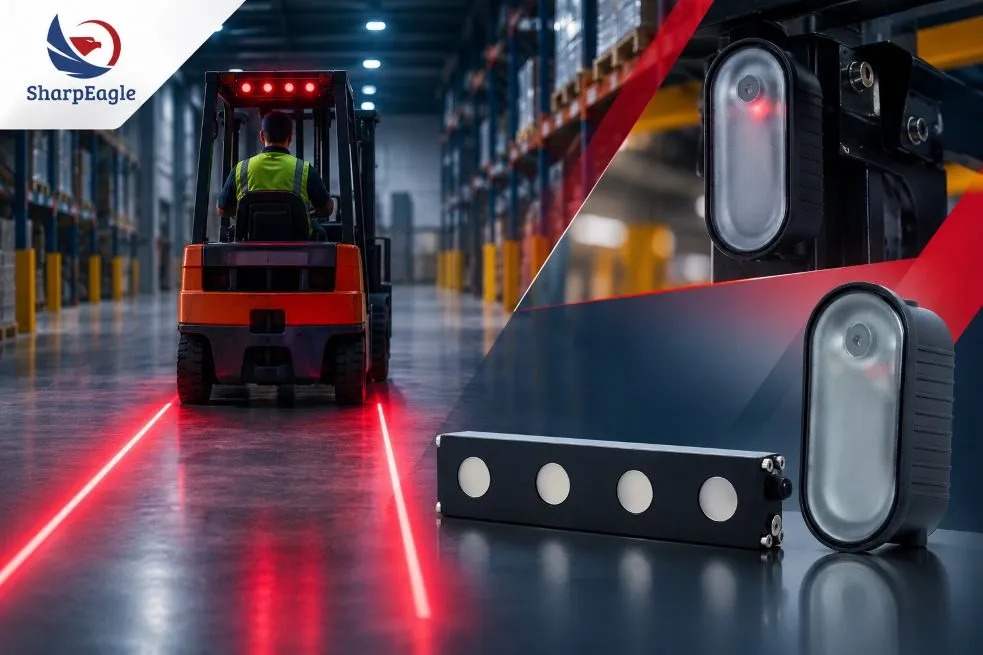
Forklift red zone warning lights solve a specific problem that fixed markings can't: they move with the vehicle, projecting a warning boundary that adjusts as the forklift changes direction or speed. This matters most at the pinch points identified above, where a static floor line can't account for a truck approaching from an unexpected angle. The projected zone gives pedestrians a live, unambiguous signal — not a static reminder they've learned to filter out after months on site.
Limitations of Relying Solely on Floor Markings
Floor markings degrade. Forklift tyres wear them down, spillages obscure them, and repainting schedules rarely keep pace with actual wear. They're also easy to miss if someone isn't looking down, which describes most pedestrians most of the time. A forklift red zone light doesn't replace markings — it compensates for their weaknesses by putting the warning at eye level or in peripheral vision, where it's far more likely to register before a collision risk develops.
Incorporating Lighting into a Wider Traffic-Management Strategy
Visual warning lights work best as one layer within a documented traffic management strategy that also covers segregation, signage, speed limits, and site induction. Under HSE workplace transport guidance and your obligations around PUWER-compliant equipment, you're expected to demonstrate a systematic approach to risk reduction, not an ad hoc collection of measures. Recording where and why each control was applied — including any red forklift safety lights UK installation — strengthens your position during both internal audits and external inspection.
Measuring Whether Additional Visual Controls Are Justified
Before specifying new lighting across every route, quantify the actual risk. Track near-miss frequency at each junction, review whether existing controls have reduced reported incidents, and weigh installation cost against the severity of potential outcomes at that specific point. Not every crossing needs the same level of control — the goal is proportionate, evidence-based investment, not blanket coverage that dilutes attention from your genuinely high-risk points.
SharpEagle forklift red danger light supplier UK
SharpEagle Technology supplies a forklift red danger light designed for exactly this kind of complex, high-traffic manufacturing environment. The unit delivers a sharp, clearly defined red projection that remains visible across varied lighting conditions and site layouts, from dim storage areas to well-lit production floors. Its rugged housing is built to withstand the vibration, dust, and daily wear typical of manufacturing forklift fleets, while straightforward mounting means it fits existing vehicles without extensive retrofitting. For facilities managing multiple interaction points across storage, production, and dispatch, it offers a scalable way to strengthen pedestrian warning at exactly the junctions that need it most.
Conclusion
As manufacturing layouts keep evolving around legacy infrastructure, traffic management can't rely on markings and signage designed for a simpler site. A layered approach, with visual warning technology reinforcing your segregation and route planning, gives you a system that adapts as your facility does. Get in touch with SharpEagle Technology to discuss the right solution for your site's traffic routes.


























Sign in to leave a comment.