


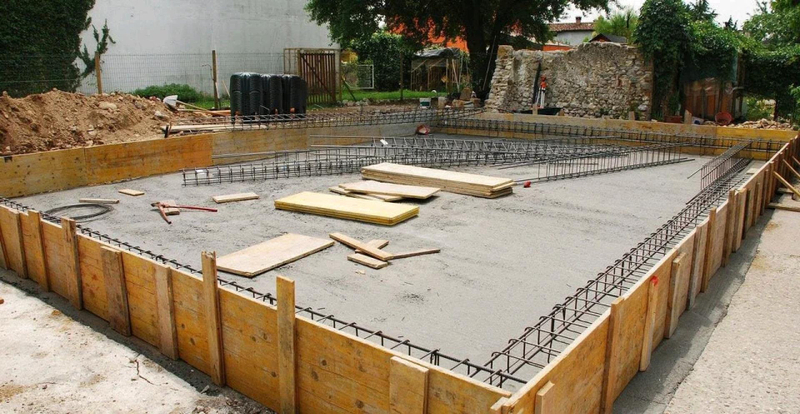
The foundation is the basis of any house. Much depends on its quality and reliability, but the most important thing is how long the built house will serve its owners and how comfortable it will be. The foundation bears the main load of all structures and buildings, and also resists temperature changes and underground water.
Foundations differ in their type and design features. The choice of foundation type depends on the geodetic features of the soil and materials that will serve as the basis for the construction of the future house.
What should be the depth of the foundation?
The foundation must be built above the groundwater level, but below the level of soil freezing. This will be approximately at a level of about 1 meter. If you follow all the recommendations of construction professionals, including laying the foundation, it will be a reliable support for your home for a long time. However, there are cases when the design of the house involves the construction of a recessed garage or basement, in which case it is necessary to strengthen the soil with steel rods.
Sometimes, when laying the foundation, a raised embankment is constructed to raise the level of the house's blind area. This is done in the case of close groundwater.
There is a common misconception that the deeper the foundation, the better, more reliable and durable it is. Although this is not true at all. In the case of building a light small wooden house on a deep and powerful foundation, in the spring during the period of snow melting and rising groundwater levels, the foundation slabs will shift and thus contribute to the destruction of the house without feeling the weight of the house structure on themselves.
Soil types and their properties
When designing and choosing the type of foundation for a future home, the type of soil on which the house will be built plays an important role. There are three main types: rocky, non-rocky, conglomerate.
The first type includes shale, sandstone, limestone, dolomites and others, all of which are divided into sedimentary and crystalline rocks. On rocky soil, any foundation and house of any size can be built. The difficulty is that the work is done with hard soil.
Non-rocky soils, based on their natural composition, are a good basis for building a house, but the depth of the foundation depends on it. If the soil consists of coarse sand with an admixture of gravel, then the foundation is deepened to a distance of at least 50 cm. With dry soil with an admixture of dusty sand and hard clay, in this case, the foundation is laid to a depth of at least 70 cm. If the soil consists of wet sand and plastic clay, the depth of the foundation will be up to 1 m. This type of non-rocky soil is divided into cohesive (clay, loam) and non-cohesive (sand, sandy loam), as well as containing various impurities.
Conglomerates consist of crystalline rocks and sedimentary fragments. They are the most durable soil in themselves, so they do not require strengthening and are well suited for laying any foundation for a house.
Features of foundation construction
The ideal soil for laying the foundation of a future building or house is dry and compacted soil. However, most often the basis for the foundation is clay soil, which has the property of swelling during frosts and thereby destroying the entire foundation.
The same problems can arise when laying a house on peat or silt soil, on soil with an admixture of clay and dusty sand. If you have similar problems, then experts recommend making a sand cushion. In this case, the sand should be wet, compacted and 20 cm thick.
One of the important points in addition to the soil composition when laying the foundation of a house is the composition of groundwater. So, if the soil on which you plan to build your house is saturated with waters saturated with sulfates, then in this case it is necessary to use sulfate-resistant cement for pouring the foundation. Otherwise, such a chemical composition of groundwater can gradually destroy the foundation based on ordinary concrete.