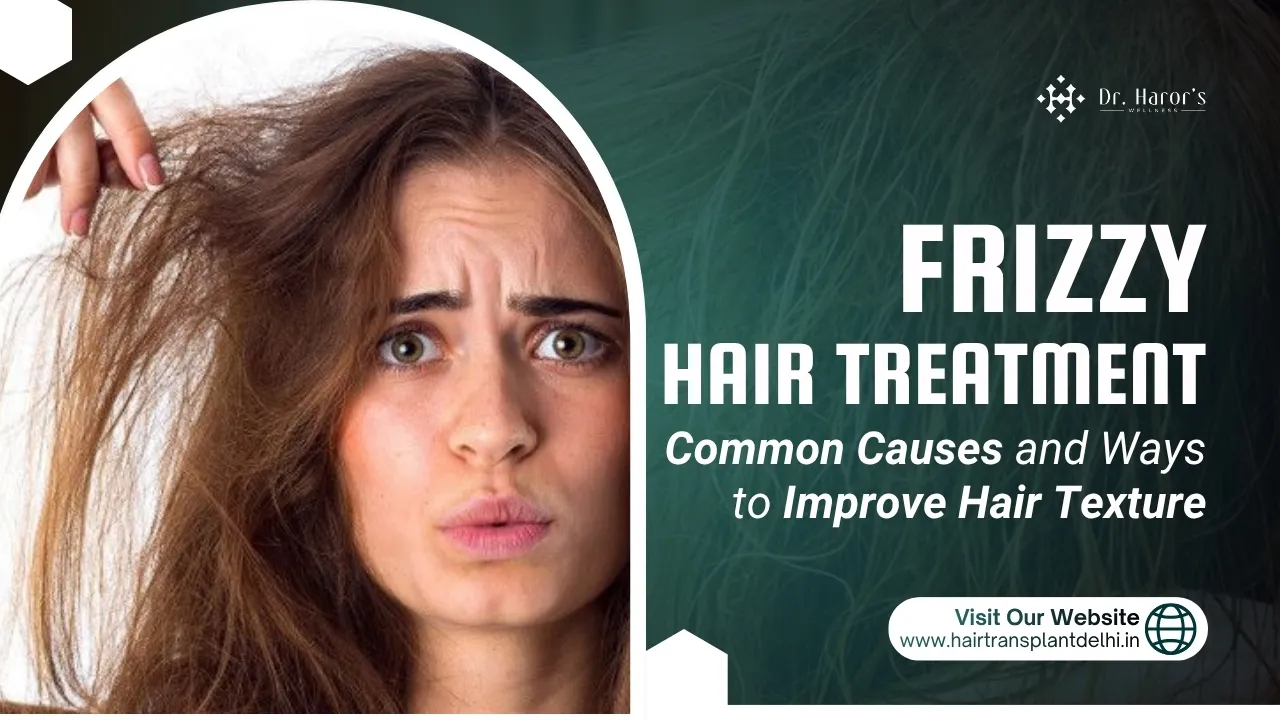


Does your hair turn dry, puffy, and unruly just ten minutes after you step away from the mirror? Frizzy hair is a daily annoyance for men and women across India, especially when sticky monsoon humidity, harsh summer heat, or dry winter winds undo your styling efforts in seconds.
Battling coarse, unmanageable strands isn't just about applying more serum—it requires understanding why your hair is losing moisture in the first place. Adopting a protective hair care routine can bring back softness and shine, but when chronic frizz is driven by deep structural damage or follicle stress, a medical evaluation and the best hair treatment in Delhi can help rebuild your hair from root to tip.
What Is Frizzy Hair?
Hair turns frizzy when individual strands become parched, brittle, or frayed instead of resting flat against one another. Under a microscope, a healthy hair fiber resembles closed pinecone scales. When moisture levels drop or cuticles suffer damage, those microscopic scales lift.
Once the outer cuticle stands open, dry hair acts like a sponge, pulling water vapor straight out of the humid air. That influx makes the cortex swell unevenly, resulting in an unkempt, fuzzy halo that resists combing and styling.
Common Causes of Frizzy Hair
Frizz is rarely random; it is usually the direct result of moisture loss combined with environmental and styling habits:
- Dryness and lack of moisture: When your scalp doesn't produce enough natural sebum, or when moisture is stripped away by harsh cleansing, strands become rough and porous. Dry hair naturally searches for ambient moisture, causing instant frizz.
- Heat styling: Cranking up curling irons, flat irons, and blow dryers without a heat shield strips away the hair's protective lipid barrier. Over time, high temperatures create microscopic cracks in the keratin shaft, making strands brittle and prone to snapping.
- Chemical treatments: Repeated bleaching, permanent coloring, chemical rebonding, and straightening break the internal disulfide bonds that give hair its strength. This chemical disruption leaves the cuticle permanently lifted and vulnerable.
- Humidity: Delhi's extreme seasonal shifts make frizz worse. High moisture levels in the air penetrate lifted cuticles, forcing the hair shaft to swell and lose its smooth shape.
- Rough hair care practices: Rubbing wet hair aggressively with a rough bath towel, brushing vigorously when damp, washing daily with sulfate-heavy shampoos, and skipping conditioner all cause mechanical friction, split ends, and immediate frizz.
Ways to Improve Hair Texture
Restoring rough, unruly hair takes a mix of gentle habits and consistent hydration:
- Switch to sulfate-free cleansers: Wash with gentle, hydrating shampoos that cleanse the scalp without stripping its essential natural oils.
- Never skip conditioner: Apply a nourishing conditioner from mid-lengths to ends every single time you wash to smooth down lifted cuticles.
- Incorporate weekly deep conditioning: Use a moisture-rich hair mask infused with ceramides, argan oil, or shea butter once or twice a week to replenish lost lipids.
- Ditch the cotton towel: Swap rough terrycloth towels for a soft microfiber towel or a plain cotton t-shirt, gently pressing water out rather than rubbing.
- Protect against thermal damage: Keep heat tools on medium settings and always apply a silicone- or oil-based thermal protectant spray before blow-drying.
- Schedule regular trims: Snip away split ends every 8 to 10 weeks to prevent frayed fibers from traveling up the hair shaft.
Is there any best hair treatment in Delhi to manage frizzy hair?
There is no single, one-size-fits-all cure for dry and frizzy hair because scalp biology and strand damage vary from person to person.
If your frizz is mild, switching to restorative hair masks, using leave-in conditioners, and cutting back on hot tools will often keep it manageable. However, if your hair feels straw-like, breaks easily, or is accompanied by an itchy scalp and noticeable thinning, salon-grade smoothing treatments can actually do more chemical harm than good.
In such cases, booking an appointment with a specialist for the best hair treatment in Delhi is the smartest move. Clinical treatments like Growth Factor Concentrate (GFC), Platelet-Rich Plasma (PRP) therapy, deep scalp detox protocols, and medical-grade peptide infusions nourish the follicle matrix from within, ensuring new hair grows in smoother, thicker, and far more resilient.
Conclusion
Frizzy hair is fundamentally a cry for moisture and gentle handling. By limiting thermal tools, avoiding aggressive chemical processes, and sticking to an ultra-hydrating hair care regimen, you can bring softness and control back to your everyday routine.
However, when chronic dryness and rough texture persist despite proper home care, self-treatment reaches its limit. Scheduling a consultation with the best dermatologist in Delhi NCR will give you an accurate digital scalp and hair shaft analysis. A qualified specialist can pinpoint the root cause of your damage and design a personalized clinical treatment plan to restore silky, healthy, and long-lasting hair growth.

























Sign in to leave a comment.