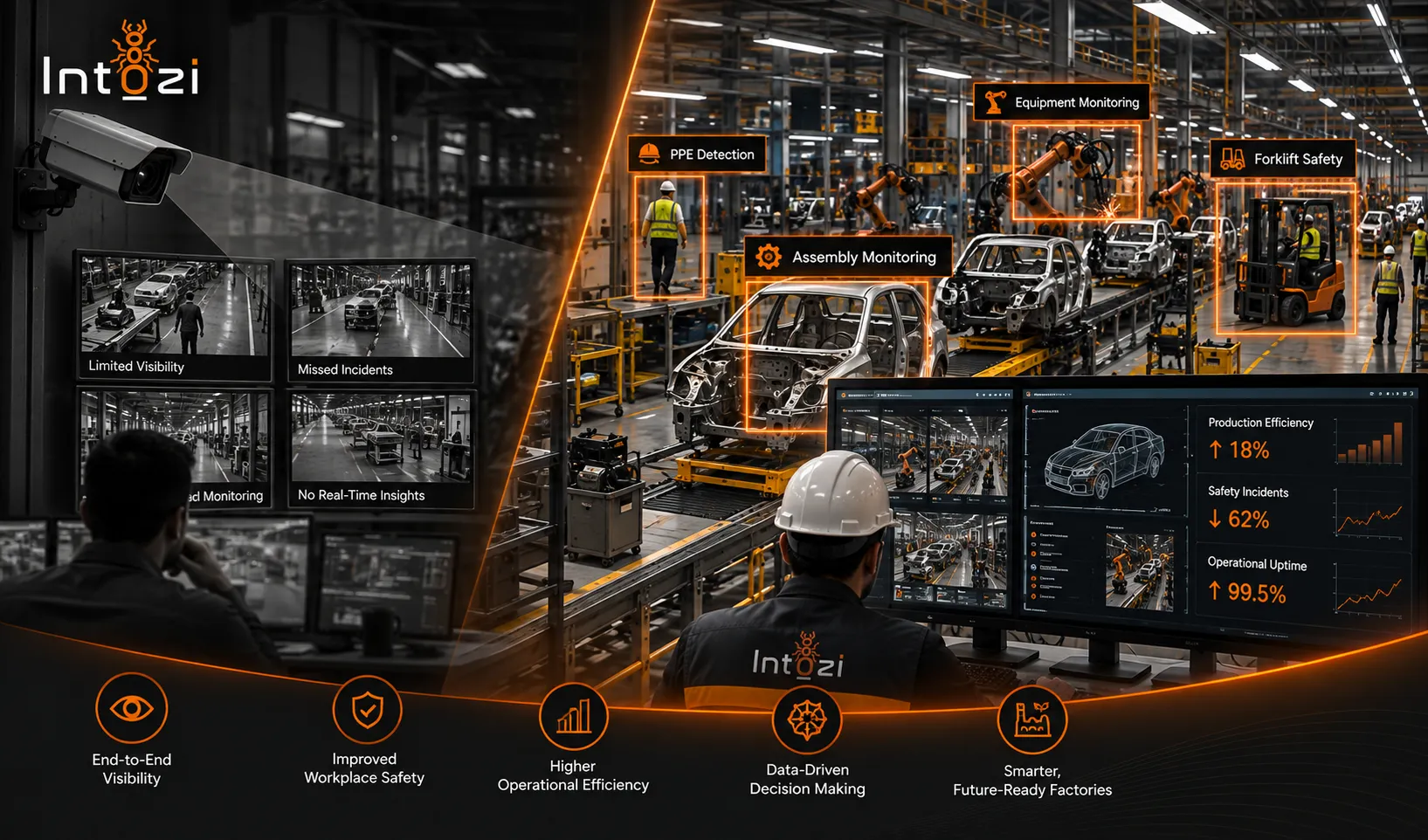


Manufacturing facilities often have hundreds of cameras recording activity across production floors, warehouses, loading areas, and restricted zones. However, factory safety analysis system technology is becoming important because recording video alone does not tell teams what is happening in real time. When critical events remain unnoticed, safety risks, process disruptions, and operational inefficiencies can escalate before someone responds.
Why Traditional CCTV Creates Visibility Gaps
Traditional CCTV is useful for recording incidents, but it depends heavily on people continuously watching screens or reviewing footage afterward. In a large manufacturing facility, monitoring every camera at all times is difficult and inconsistent.
This creates several challenges:
- Safety violations may go unnoticed.
- PPE compliance can be difficult to monitor continuously.
- Unsafe worker-vehicle interactions may not be identified immediately.
- Critical events may only be discovered after an incident.
- Reviewing hours of recorded footage can consume significant time.
The result is a reactive approach to safety and operations rather than continuous awareness.
How AI Turns Factory Cameras Into Real-Time Insights
AI video analytics enables cameras to become sources of structured information rather than simply recording devices. Computer vision models analyze video feeds and identify predefined objects, activities, movements, and events.
For example, an AI system can detect whether a worker enters a restricted zone, whether required PPE is being worn, or whether an unsafe interaction occurs between workers and vehicles.This supports real-time manufacturing analysis by converting visual information into events that operators and safety teams can act upon.
Worker Safety Analytics for Proactive Risk Detection
Worker safety analytics can help manufacturers identify potentially unsafe conditions without relying entirely on manual observation. Depending on the deployment, analytics can monitor activities such as restricted-area entry, unsafe movement, crowding, or proximity between workers and industrial vehicles.
Instead of waiting for an incident to occur, safety teams can receive information about predefined risks as they happen. This can support faster intervention while also creating useful historical data for identifying recurring safety patterns.
Using AI for PPE Compliance and Safety Monitoring
PPE compliance is another area where continuous manual inspection can be challenging. A PPE detection system for factory environments can use computer vision to identify whether workers are wearing required safety equipment.
Depending on the configured models, systems may detect items such as:
- Safety helmets
- High-visibility vests
- Safety footwear
- Other designated protective equipment
Automated detection does not replace safety policies or human supervision. Instead, it provides another layer of monitoring that can help teams identify repeated compliance issues across different work zones.
What an AI-Powered Industrial Safety Solution Can Detect
An AI-powered industrial safety solution can combine multiple analytics capabilities within one monitoring environment. This can help manufacturers address different safety and security requirements without relying solely on separate manual monitoring processes.
Common applications include:
- Worker safety monitoring
- PPE compliance detection
- Restricted-area monitoring
- Vehicle and forklift monitoring
- Fire and smoke detection
- Intrusion detection
- Loitering detection
- Safety-zone monitoring
The most appropriate applications depend on the facility layout, camera coverage, environmental conditions, and specific operational risks.
Moving From Video Recording to Intelligent Manufacturing
AI video analytics for manufacturing can help organizations make better use of their existing camera infrastructure. Instead of searching through footage after an event, teams can receive structured information about relevant activities as they occur.
This can improve several aspects of manufacturing operations, including:
Faster response: Relevant events can be highlighted for operators and safety teams.
Better visibility: Managers can gain greater awareness of activities across large facilities.
More efficient investigations: Event-based information can make locating relevant footage easier.
Improved safety monitoring: Automated detection can supplement manual safety inspections.
Data-driven improvement: Historical events can reveal recurring risks and operational patterns.
Intozi and Intelligent Factory Video Analytics
Intozi works in the video analytics and computer vision space, providing solutions for environments that require continuous visual monitoring. Its Ikshana platform is designed to analyze camera feeds and identify predefined events and activities.
For manufacturing environments, such technology can provide a foundation for applications such as worker safety monitoring, PPE detection, restricted-area monitoring, vehicle safety, and other computer vision use cases. The effectiveness of any deployment depends on factors including camera positioning, lighting, scene complexity, analytics configuration, and operational requirements.
Factory Safety Analysis System Enables Better Visibility
Manufacturers do not necessarily need more cameras to solve every visibility problem. In many cases, the greater opportunity is to make existing video infrastructure more intelligent.
A factory safety analysis system can help convert passive CCTV footage into actionable information, allowing teams to identify predefined risks, investigate incidents more efficiently, and improve awareness across complex facilities. As factories become more automated and connected, the ability to understand video data in real time can become an important component of safer and more informed manufacturing operations.
Frequently Asked Questions
Why is traditional CCTV not enough for manufacturing safety?
Traditional CCTV is primarily designed to record and display video, so it often depends on people to identify important events manually. In large factories with many cameras, continuous monitoring can be difficult.
How does AI improve visibility in manufacturing?
AI improves manufacturing visibility by analyzing camera feeds and converting visual information into structured events or alerts. Instead of relying entirely on operators to watch screens, computer vision can identify predefined activities, objects, and safety conditions.
Can AI detect PPE violations in factories?
Yes, AI can detect predefined PPE violations when suitable cameras, computer vision models, and deployment conditions are available. A PPE detection system can identify whether workers are wearing specified protective equipment, such as helmets or high-visibility vests.
What can AI video analytics detect in manufacturing?
AI video analytics can detect a wide range of predefined visual events in manufacturing environments. Common examples include PPE compliance, restricted-area entry, worker-vehicle interactions, forklift activity, intrusion, loitering, and fire or smoke indicators.
How can factories use existing CCTV with AI analytics?
Factories can often use existing camera infrastructure with AI analytics if the cameras provide suitable video quality, coverage, positioning, and connectivity. Analytics software can process camera feeds and identify predefined events without requiring operators to manually watch every stream.






















Sign in to leave a comment.