From Corporate Cubicle to Classroom Owner: Why More Indians Are Investing in Education Franchises


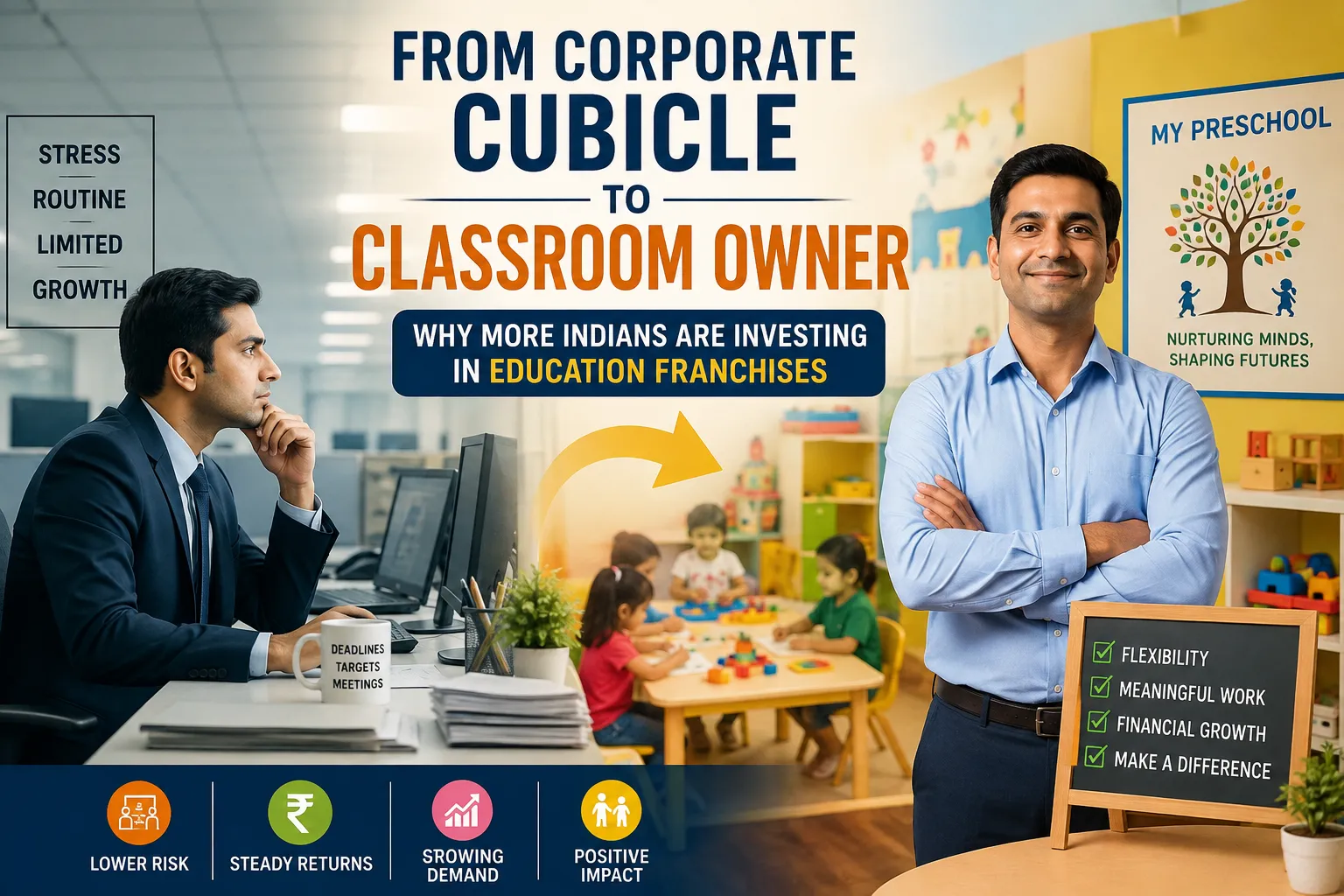
Ritu Malhotra worked in marketing for eleven years, not hating it but also not loving it. Like many others in their late thirties, she found herself pondering the same question: what if the next decade looked different? Ritu's response wasn't a company or a side hustle in stocks; it was a little building in her neighbourhood, brightly painted, with children giggling through the windows.
She is not alone. A silent change is taking place across Indian cities, from Tier 1 metros to rapidly rising Tier 2 towns. Working professionals, homemakers looking to restart their careers, and retired instructors are all considering the same opportunity: a preschool franchise business. The reasons are simple once you look at the numbers.
Why Education Is Becoming the Next "Safe Bet" Business
Even during economic downturns, India's early childhood education sector has developed steadily, owing to the fact that parents rarely lower their children's educational expenses. That durability is precisely why so many entrepreneurs are now looking for low cost franchise opportunities in India rather than putting their money on trend-driven retail or food enterprises that can go out of business overnight.
Unlike a solitary school, franchising provides you with something invaluable when you're new to a sector: a proven system. Curriculum, teacher training, brand recognition, marketing templates, and operational playbooks are pre-made. You are not innovating early education; rather, you are implementing a tried-and-true paradigm locally.
Preschool vs. Primary: Understanding Your Entry Point
Many first-time entrepreneurs believe that preschool and elementary schools are interchangeable business concepts. They are not. A primary school franchise often requires more space, greater regulatory compliance, and a longer break-even period. It's a serious long-term commitment that's best suited to someone with prior education or substantial financial resources.
In comparison, a preschool is frequently a more approachable starting place, with less space needs, shorter clearance waits, and a faster path to enrolment. That is why many new entrants go for a primary school franchise in India only after they have successfully run a preschool and understood the local demand patterns.
The Delhi advantage
Location is extremely important in this sector, and few markets demonstrate this more clearly than the capital region. Rising dual-income households, greater awareness of early childhood development, and a highly competitive mindset among parents have made a preschool franchise in Delhi one of the most sought-after prospects among new-age entrepreneurs. Areas with dense residential growth and few existing quality preschools are especially appealing — franchising consultants frequently recommend this type of underserved-but-affluent neighbourhood as the ideal start location.
What Nobody Told You About Getting Started
If you've ever searched for how to start a preschool franchise at midnight, you know how fragmented the information is. Here's a simplified reality:
- Assess your space: most brands require 1,500-3,000 square feet, depending on the model.
- Understand the fee structure: franchise fees, royalties (or lack thereof), and operations costs vary greatly across brands.
- Check training and support: teacher training, admissions support, and marketing aid distinguish real companies from those that only offer a logo.
- Talk to current franchisees: This single step protects more individuals from making poor selections than any pamphlet ever will.
The Budget Question Everybody Asks First
Most persons investigating this path do not have unlimited capital. They are seeking a legitimate franchise in low budget category that does not require them to liquidate their funds or incur significant debt. The good news is that early education franchising has matured to the point where cost-effective solutions are now available without sacrificing curriculum quality or brand support.
Royalty arrangements are an important feature to comprehend. A play school franchise without royalty model means that your monthly revenues are not reduced by recurrent brand costs — a significant difference over a 5-10 year period, particularly for someone managing a single center.
A daycare franchise adjacent to or alongside a preschool model has become an increasingly attractive add-on for businesses looking to expand further, capitalising on the growing number of working parents who require extended-hours childcare rather than just a few structured learning hours in the morning.
Making the Numbers Work.
Finally, this is a commercial choice, not a passion project. Before signing anything, anyone genuinely considering a low cost franchise in India should plan out three things: the estimated break-even timetable, local rival density, and actual enrolment forecasts based on the demographics of the neighbourhood — not the brand's marketing pitch.
Ritu, for what it's worth, broke even during her second year. She'll tell you it wasn't easy—admissions season took a lot of work, and managing a young team had its own set of challenges. However, she will tell you that she hasn't missed her former cubicle once.
For hundreds of others who are considering the same decision right now, the sector provides something unique: a business that can be both successful and important at the same time. Whether that journey begins in a single preschool classroom or eventually leads to a primary school campus, the opportunity in India's education franchising area shows no signs of diminishing.




Sign in to leave a comment.