
Most people think honey is just a sweet preparation. You buy it at the grocery store, it tastes vaguely sweet, and you move on. I thought the same thing until I spent a few weeks tracing where specialty chestnut honey actually comes from, and realized how radically different the production chain can be between a commodity product and something genuinely single-origin. Chestnut honey is classified as monofloral, meaning the bees produce it by feeding almost entirely on nectar from chestnut tree blossoms. That sounds simple. The actual supply chain, from flowering tree to labeled jar, is anything but.
Where does chestnut honey come from?
Bees get to work in summer when the trees are in bloom, typically between June and July, and the honey is harvested in the following months. The chestnut species matters, too. Castanea sativa dominates European production, while the Himalayan region is defined by a distinct forest ecosystem: the Schima-Castanopsis forest belt, which includes Castanea mollissima alongside other broadleaf species. Each geography produces a distinct compound profile, and those distinctions are traceable if you know what to test for.
How is chestnut honey made, and what happens during processing?
Extraction begins by removing wax cappings from the honeycomb frames using a specialized tool. The frames are then placed in an extractor, which spins to release the honey. Beekeepers harvest by collecting these frames and scraping off the wax caps that seal the honey in each cell.
The processing decision that follows extraction is where producers diverge sharply. Artisan producers extract at minimal heat to preserve the volatile aromatic compounds responsible for the smoky, earthy character. High-heat processing removes those compounds and flattens the profile toward generic sweetness. Cold extraction is more labor-intensive and produces less volume per batch. It also retains the phenolic density and enzyme activity that make chestnut honey distinctive as a raw product. Chestnut honey is typically dark brown, with slow crystallization and a full-bodied, woody flavor, sometimes with a slightly bitter, astringent finish. That bitterness is a feature, not a defect.
How is chestnut honey harvested and processed by commercial producers?
The commercial model and the artisan model look almost nothing alike. Commercial producers usually blend honey from multiple apiaries across wide geographic areas to achieve volume and consistency. Monofloral purity is declared, but verification is often limited to basic pollen analysis, which can be manipulated.
The premium price of honey and its resource-intensive production have led to a rise in honey fraud. This harms beekeepers who cannot compete with cheaper adulterated alternatives and damages consumer trust. Traditional testing methods, focused on one or a few parameters, cannot reliably detect counterfeit products because fraudsters find new methods to bypass them.
This is where verification technology has changed the category. NMR spectroscopy is a versatile method that provides comprehensive information about the sample under study. It is fast, reproducible, and non-destructive, capable of detecting a wide range of chemical compounds in a single run. For producers who use it, NMR testing can authenticate botanical origin and entomological source (i.e., which bee species produced the honey), and flag any adulteration using a database of reference compounds.
What does traceability actually look like in practice?
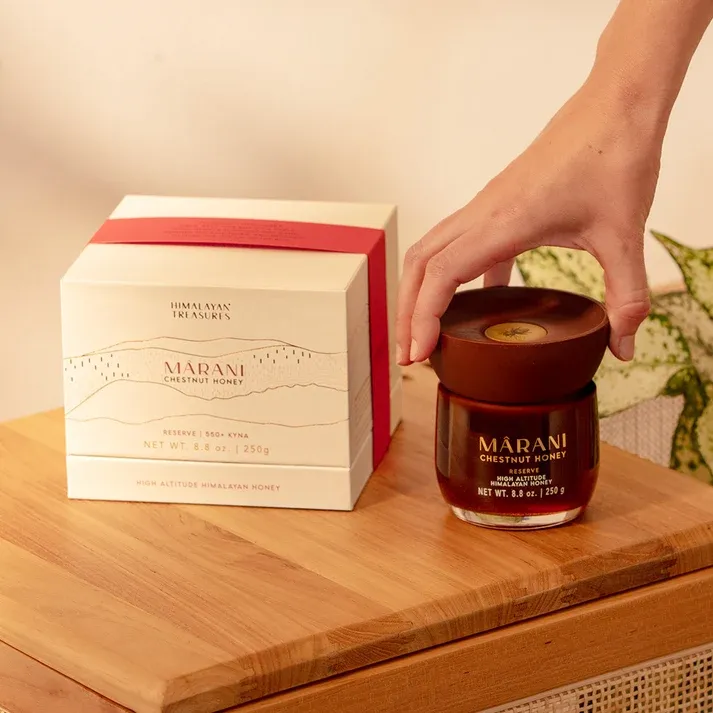
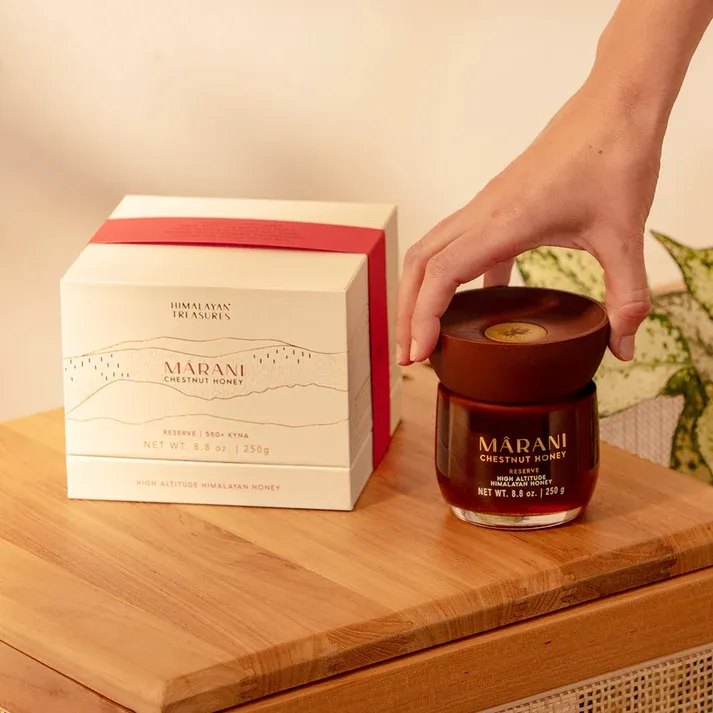
When I looked at what a rigorous honey supply chain could document, I found Himalayan Treasures as a useful case study. Their Mârani Gold is sourced from Apis cerana colonies in the Schima-Castanopsis forest belt of Nepal, cold-extracted, and NMR-verified against more than 200 biochemical parameters per batch. Each jar carries a QR code linked to blockchain provenance records, making the batch history accessible at the point of purchase.
One of their compositional differentiators is kynurenic acid (KYNA), a tryptophan-pathway metabolite found at concentrations not typical in other commercial honeys. Mârani Gold is verified to contain KYNA at ≥200 µg/g; the Mârani Reserve tier is ≥550 µg/g. Published research has explored kynurenic acid as a neuromodulator and NMDA receptor ligand, and those verified concentrations are treated as composition facts, not health claims.
The brand produces around 1,200 jars per year globally. That figure is set by the biology of Apis cerana colony cycles, not by commercial decisions on scale.
The question worth asking before you buy
Most honey labels tell you very little. "Raw" is not a legal standard in the US. "Pure" is not a verified claim. "Himalayan" can be applied to any honey that crosses the region, regardless of actual origin or process.
The question that matters is: What bee species? What exact forest ecosystem? What extraction method? And what verification standard applies to each batch? If the answer to any of those is vague, the label is doing more work than the honey.
For buyers who want to track the answer to all four, the transparency gap between commodity and single-origin specialty honey is one of the more



























Sign in to leave a comment.