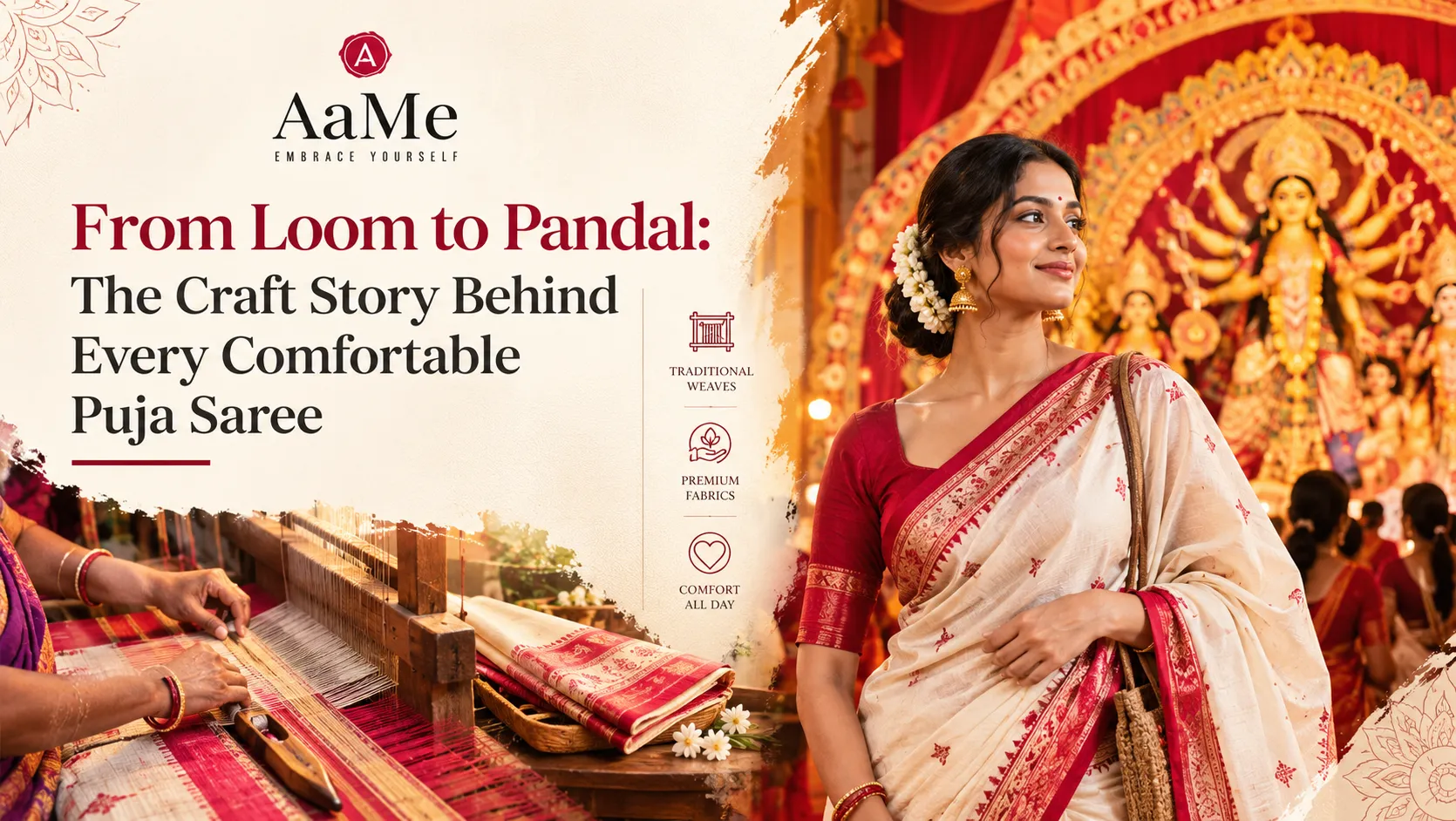

Somewhere in Nadia, West Bengal, a few weeks before Mahalaya, a weaver sits down at a pit loom before sunrise. The shuttle moves left, then right. A thread of white cotton crosses another. It is slow work, the kind that cannot be rushed by a deadline or a festival calendar, even though the festival is exactly why this particular length of cloth is being woven right now.
Months later, that same length of cotton will be pleated at the waist of a woman standing in a pandal queue, waiting her turn for anjali, the dhaak already warming up somewhere behind the crowd. She may never know the weaver's name. But she will know, the moment she sits down after four hours on her feet, whether the saree she chose was woven with her comfort in mind or simply for how it photographs.
This is the story of that gap between the loom and the pandal and why closing it matters more than most Puja shopping guides let on.
The Journey Begins at a Loom in Nadia
Long before Durga Puja became India's most photographed festival, Nadia district in West Bengal was already known for one thing: its looms. Shantipur, one of the region's oldest weaving centres, has records of saree weaving going back to the 15th century, and the craft received royal patronage through the Mughal era alongside Bengal's other famous exports, muslin and jamdani.
The town of Phulia, just next door, has a newer but equally significant story. After the Partition of Bengal in 1947, and again after 1971, weaver families from Tangail in East Bengal crossed over and resettled here, bringing their own weaving vocabulary with them. Over time, the Tangail technique met the older Shantipur tradition, and the two styles merged into what is now known as the Phulia-Tangail weave — recognisable for its restrained motifs, fine cotton or silk yarn, and an attention to detail that machine looms still struggle to replicate.
It's worth pausing on what "handloom" actually means in this context. A handloom saree is woven manually on a loom, thread by thread, by a weaver controlling the shuttle and the pace entirely by hand. No two lengths turn out identical, because no two passes of the shuttle are identical — and that quiet inconsistency is exactly what gives a handloom piece its character. If you've ever wondered why some sarees marketed as "handcrafted" don't feel quite like the handwoven ones your grandmother kept in her almirah, our earlier piece on handcrafted vs handloom sarees breaks down that difference in more detail.
Khadi belongs to a related but distinct family. Where a handloom saree can be woven from mill-spun yarn, khadi is defined by its yarn first cotton that is hand-spun before it is ever placed on the loom. The result is a fabric that is famously breathable, slightly textured to the touch, and known for softening beautifully with every wash. It is this combination of hand-spun yarn, hand-operated loom, and unhurried process that gives a genuine khadi cotton saree its particular weight and drape, closer to something lived in than something merely worn.
Why the Puja Saree Wears Red and White
Walk through any pandal on Ashtami morning and one colour combination will repeat itself more than any other: a white body, a red border. This is the laal paar shada saree literally, "red-bordered white" and in Bengal, it is less an outfit choice and more a visual shorthand for the festival itself.
The symbolism is old and fairly consistent across the region's oral history. White stands for purity, calm, and the quiet strength of womanhood. Red carries the opposite energy — power, fertility, auspiciousness, the same colour associated with Durga herself and with the sindoor worn on the forehead. Together, the two are meant to echo the goddess's own presence: gentle and formidable at once.
Traditionally, the laal paar shada was reserved for married women, worn with red and white shakha-pola bangles, particularly on Ashtami and Dashami — the days considered most sacred within the nine. That rule has loosened considerably over the decades. Today, the red-and-white saree is worn by anyone who wants to mark the occasion, married or not, regardless of age.
What hasn't changed is the fabric it's traditionally woven in. Because the laal paar shada is meant to be worn through anjali, a Puja lunch, and hours of visiting one pandal after another, it has almost always been a cotton saree — light enough to survive a full day of standing, kneeling for pushpanjali, and walking between pandals in Kolkata's still-warm October air. AaMe's Aabha – Laal Paar Sada White Red Khadi Cotton Saree keeps close to this original template, with an abstract jamdani-inspired border on breathable khadi cotton, while Sati – Laal Paar Sada White Red Cotton Saree offers the same classic silhouette with a softer floral red border for those who want a slightly gentler take on the motif.
Cotton That Was Built for a Long Puja Day
Anyone who has spent Ashtami morning in a saree knows the real test isn't how it looks in the mirror at 7 a.m. — it's how it feels by 2 p.m., after the anjali crowd, the lunch, and the walk to the next pandal.
This is where the fabric conversation matters more than the design one. Cotton, particularly khadi cotton, is spun and woven to let air move through it, which is precisely why it has remained the fabric of choice for daytime Puja wear across generations of Bengali households, long before "breathable fabric" became a marketing phrase. It creases without complaint, softens with every wash instead of losing shape, and doesn't cling the way heavier silks or synthetic blends tend to by late afternoon.
For the days leading up to the main Puja — Panchami, Sasthi, the quieter mornings of pandal-hopping before the big rituals begin — a simpler khadi cotton saree does most of the work. AaMe's Khaadi Cotton Sarees for daily wear collection is built around exactly this need: pieces like Godhuli – Brown Khadi Cotton Saree, hand-spun and woven with a joda border and a pompom-finished aanchal, are easy enough to wear from a morning market run straight into an evening at the pandal, without a single re-pleat in between.
When the Saree Moves Beyond the Classic Red Border
Not every day of the Puja calls for the laal paar shada, and not every woman wants to wear the same silhouette five days running. Saptami and Navami, in particular, have become days where colour and embroidery take over — florals, pastels, hand-worked motifs that still read as festive without repeating the red-and-white template.
Mulmul cotton has become the quiet favourite for this part of the wardrobe. Finer and lighter than khadi, it drapes with less structure and takes hand embroidery particularly well, which is why lotus motifs — long associated with the goddess and with Bengal's own wetlands — show up so often on festive mulmul pieces. AaMe's Lotus Poise – Hand Embroidered White Mulmul Cotton Saree keeps the white base of a traditional Puja saree but replaces the red border with delicate lotus embroidery, making it an easy choice for an evening pandal visit where photographs matter as much as comfort. For something with more colour, Lotus Glow – Hand Embroidered Pink Mulmul Cotton Saree brings the same lightweight comfort into a softer, more contemporary palette.
For those who'd rather move away from lotus motifs altogether, chikankari offers a different kind of festive detailing — finer, more linear, and traditionally associated with Lucknow rather than Bengal, but increasingly worn as part of the modern Puja wardrobe for its intricacy. The Kasturi – Yellow Chikankari Embroidered Mulmul Cotton Designer Saree is a good example of this crossover — a soft yellow that works particularly well for the earlier, brighter days of the festival.
How to Choose Your Puja Saree This Year
With five or more days to dress for, most Puja wardrobes end up working like a small capsule collection rather than a single outfit decision. A few things are worth thinking through before you buy:
Match the fabric to the day's schedule. A day spent mostly seated — visiting relatives, an evening cultural programme — can carry a slightly heavier or more embellished mulmul. A day spent on your feet, especially Ashtami with its anjali queue, calls for something lighter like khadi cotton.
Decide where the laal paar shada fits. Even if you're not following the married-women convention strictly, most Bengali wardrobes still keep at least one red-and-white saree aside for Ashtami or Dashami — it remains the one silhouette that instantly reads as "Puja" in every photograph from that week.
Think about draping time. Cotton and mulmul sarees, especially khadi, tend to be more forgiving for a quick pleat before you're rushing out the door — a real advantage on a festival morning when everyone in the house needs the same mirror at the same time.
Don't underestimate the blouse. Since most of AaMe's Puja sarees come without a stitched blouse piece, it's worth finalising your blouse and petticoat colours ahead of the festival rush, rather than the night before Sasthi.
Carrying the Loom's Story Into the Pandal
The distance between a pit loom in Nadia and a crowded pandal in Kolkata, Delhi, or Bengaluru isn't really measured in kilometres. It's measured in the months a weaver spends getting a border right, and the few hours a woman spends wearing that same cloth through anjali, lunch, and an evening of dhunuchi naach. Somewhere in between, a length of white and red cotton stops being just fabric and starts being a small, wearable piece of the festival itself.
That's really what a good Puja saree is meant to do to hold both ends of that journey at once. Comfortable enough to survive the day, and rooted enough in tradition to feel like it belongs at the pandal in the first place. If you're building your wardrobe for this festive season, AaMe's full collection of cotton and handcrafted sarees is a good place to start from the classic laal paar shada to the softer embroidered mulmul pieces for the days in between.
FAQ
Why do Bengali women wear a white saree with a red border during Durga Puja?
The white-and-red combination, known as laal paar shada, symbolises purity and strength respectively, and is traditionally associated with Goddess Durga. It was historically worn by married women, especially on Ashtami and Dashami, though today it is worn broadly across ages and marital status as a marker of the festival itself.
What is the difference between a khadi cotton saree and a regular handloom cotton saree?
Khadi is defined by its yarn cotton that is hand-spun before weaving while a handloom saree simply means the fabric was woven by hand on a manual loom, regardless of whether the yarn itself was hand-spun or mill-spun. All khadi sarees are handwoven, but not all handwoven cotton sarees are khadi.
Which fabric is most comfortable for a full day of Durga Puja pandal-hopping?
Khadi and mulmul cotton are generally the most practical choices for long Puja days, since both fabrics are breathable, lightweight, and less prone to clinging or wrinkling compared to silk or synthetic blends, an important factor during hours of standing in anjali queues or walking between pandals.
Is the laal paar shada saree only meant for married women?
Traditionally, the red-and-white saree was primarily worn by married Bengali women alongside shakha-pola bangles. In contemporary practice, this restriction has largely relaxed, and the saree is now worn by unmarried women and young girls as well, particularly on Ashtami and Dashami.
Can a mulmul cotton saree be worn for Durga Puja instead of the traditional red-bordered saree?
Yes. While laal paar shada remains the most recognisable Puja silhouette, mulmul cotton sarees with lotus embroidery, chikankari, or other festive detailing are widely worn for the other days of the festival, particularly Saptami and Navami, when the wardrobe tends to move toward colour and embroidery rather than the classic red border.
Where can I buy authentic handcrafted khadi and mulmul cotton sarees online for Durga Puja?
Handloom-focused labels working directly with Bengal's weaving clusters, such as AaMe, ship khadi and mulmul cotton sarees across India. Since many festive pieces are made closer to order, shopping a few weeks ahead of the Puja season is generally recommended to avoid a last-minute rush.
























Sign in to leave a comment.