

Many successful mobile applications do not begin with dozens of features. They often start with a simple idea that solves a specific problem for a particular group of users.
For a startup or growing business, trying to build the complete product from day one can be expensive and time-consuming. A better approach can be to start with a Minimum Viable Product (MVP), learn from real users, and gradually expand the application based on what the market actually needs.
This is where a reliable mobile app development services partner can play an important role. The right development approach can help businesses move from an initial concept to a usable MVP and eventually build a more scalable product without losing sight of performance, security, user experience, and long-term business goals.
What Is an MVP in Mobile App Development?
A Minimum Viable Product is an initial version of an application that contains the core functionality needed to solve a specific user problem.
The purpose is not to create an incomplete or low-quality application. Instead, an MVP focuses development on the features that matter most at the beginning.
For example, a food delivery application does not necessarily need an extensive loyalty program, advanced recommendation engine, or dozens of payment options in its first version.
The initial product might focus on:
- User registration
- Restaurant discovery
- Menu browsing
- Cart management
- Order placement
- Payment
- Order tracking
Once customers start using the application, the business can learn which features need improvement and which additional capabilities are actually valuable.
Why Start With an MVP?
Building an MVP can help businesses test assumptions before making a larger investment.
A business may have a strong idea for an application, but assumptions about customer behavior do not always match reality. Real users can reveal problems that were not obvious during the planning stage.
An MVP provides an opportunity to:
- Validate a product idea
- Understand user behavior
- Collect feedback
- Identify usability problems
- Test the business model
- Prioritize future features
- Reduce unnecessary development work
This does not mean businesses should rush to launch. The MVP still needs to provide a reliable and useful experience.
Start With the Problem, Not the Features
One of the most common mistakes in app development is starting with a long list of features.
Instead, businesses should first identify the problem they are trying to solve.
Consider a fitness application. The objective might not simply be to provide users with hundreds of exercises. The real problem could be helping people maintain a consistent workout routine.
Once the problem is clear, the team can determine which features are necessary for the first version.
This approach helps keep the MVP focused and makes it easier to measure whether the application is actually solving the intended problem.
Turning an Idea Into an MVP
The journey from an idea to an MVP usually involves several stages.
1. Requirement Analysis
The first step is understanding the business objective, target users, core functionality, technical requirements, integrations, and expected outcomes.
Good requirement analysis can prevent misunderstandings later in the development process.
It also helps separate essential features from those that can be introduced after the first release.
2. Wireframing and UX Design
Before development begins, the application's user flow and interface need to be planned.
Wireframes can help visualize how users will move between screens. UX design then focuses on making those interactions intuitive and useful.
For a consumer application, this could involve simplifying registration, search, checkout, booking, or account management.
A strong user experience is important even in an MVP because early users are forming their first impression of the product.
3. Development and Testing
Once the core functionality and designs are established, development can begin.
Depending on the project, businesses may choose native development for Android or iOS or consider cross-platform technologies such as Flutter or React Native.
Testing should happen throughout development rather than being postponed until the end.
Functional testing, usability testing, performance testing, compatibility testing, and security checks can help identify problems before the product reaches a wider audience.
4. Launch and User Feedback
After the MVP has been tested, it can be released to its intended audience.
The launch should not be treated as the final stage of product development.
Instead, it starts the next phase of learning.
Businesses can monitor how users interact with the application, identify frequently used features, analyze drop-off points, collect feedback, and understand where users experience difficulties.
From MVP to a Scalable Product
Once an MVP gains traction, the application usually needs to evolve.
The number of users may increase. More data may be generated. New integrations may become necessary. Customers may request additional functionality.
This is where scalability becomes important.
An application that works well for a few hundred users may face challenges when thousands or millions of users start accessing it.
Scalability therefore needs to be considered before growth creates technical problems.
Building Architecture That Can Grow
A scalable mobile application requires more than simply adding new features.
The architecture should allow different components to evolve without creating unnecessary dependencies.
This can involve:
- Modular application structures
- Scalable backend services
- Well-designed APIs
- Efficient database structures
- Cloud infrastructure
- Caching
- Automated testing
- Performance monitoring
The goal is to create a foundation that can support future development rather than repeatedly rebuilding the application as requirements change.
APIs and Integrations Become More Important as Apps Grow
An MVP may operate with relatively simple integrations. As the product grows, however, it may need to communicate with several external and internal systems.
For example, an e-commerce application may eventually integrate with:
- Payment gateways
- Inventory systems
- CRM platforms
- ERP systems
- Shipping services
- Customer support tools
- Analytics platforms
APIs provide a way for these systems to exchange information.
Planning integrations properly can help businesses expand functionality without turning the application into a collection of disconnected features.
Nextbrain's mobile application development services, for example, include RESTful and GraphQL API integrations as well as CRM and ERP connectivity, which can be useful when applications need to interact with broader business systems.
Choosing Between Native and Cross-Platform Development
As an application grows, businesses may also reconsider their technology choices.
Native Android and iOS development can provide platform-specific capabilities and control. Cross-platform technologies such as Flutter and React Native can allow businesses to develop for multiple platforms using a shared codebase.
The right choice depends on the application.
Factors to consider include:
- Target platforms
- Required performance
- Device-specific functionality
- Existing technical infrastructure
- Development timeline
- Budget
- Long-term maintenance
There is no universal technology stack that works for every product.
Security Should Scale With the Product
Security cannot be treated as an afterthought.
An MVP may initially handle a relatively small amount of user information, but that can change rapidly as adoption increases.
Growing applications may eventually handle personal information, payment-related data, business records, location information, or other sensitive data.
Security should therefore be considered throughout the product lifecycle.
Areas such as authentication, authorization, API access controls, encrypted communication, secure data storage, input validation, and vulnerability testing should be evaluated as the product develops.
Performance Becomes More Important With Growth
Users are generally less patient with slow applications.
As an app gains more users and functionality, performance can become more difficult to maintain.
Large amounts of data, complex API requests, heavy images, inefficient database queries, and poorly optimized code can all affect the user experience.
Performance should therefore be monitored continuously.
Businesses can use testing and monitoring to identify slow screens, failed requests, high resource usage, and other problems before they significantly affect customers.
Post-Launch Maintenance Is Part of Product Development
Launching an application is not the end of the development lifecycle.
Operating systems change. Devices change. Security vulnerabilities emerge. Third-party APIs are updated. Customers request new features.
Regular maintenance helps keep the application functional and compatible.
Post-launch work may include:
- Bug fixes
- Security updates
- Performance improvements
- OS compatibility updates
- Feature enhancements
- API updates
- User experience improvements
This ongoing process is what allows an MVP to develop into a mature digital product.
How User Feedback Should Influence the Roadmap
Not every feature request needs to be implemented immediately.
Businesses should look for patterns in user behavior and feedback.
For example, if many users abandon an application during registration, improving the signup experience may be more valuable than adding a new feature.
Similarly, if customers frequently request a particular capability, it may deserve higher priority on the product roadmap.
A useful roadmap balances:
Customer needs + business goals + technical requirements
This helps prevent product development from becoming driven solely by individual feature requests.
When Should an MVP Become a Full-Scale Product?
There is no fixed point at which every MVP should become a complete product.
Some applications can begin scaling after achieving consistent user adoption and validating their business model. Others may need more experimentation before significant investment makes sense.
Useful signals can include:
- Growing user adoption
- Strong user engagement
- Repeat usage
- Positive customer feedback
- Increasing transaction volume
- Clear demand for additional features
- Validated revenue potential
The decision should be based on evidence rather than simply adding features because competitors have them.
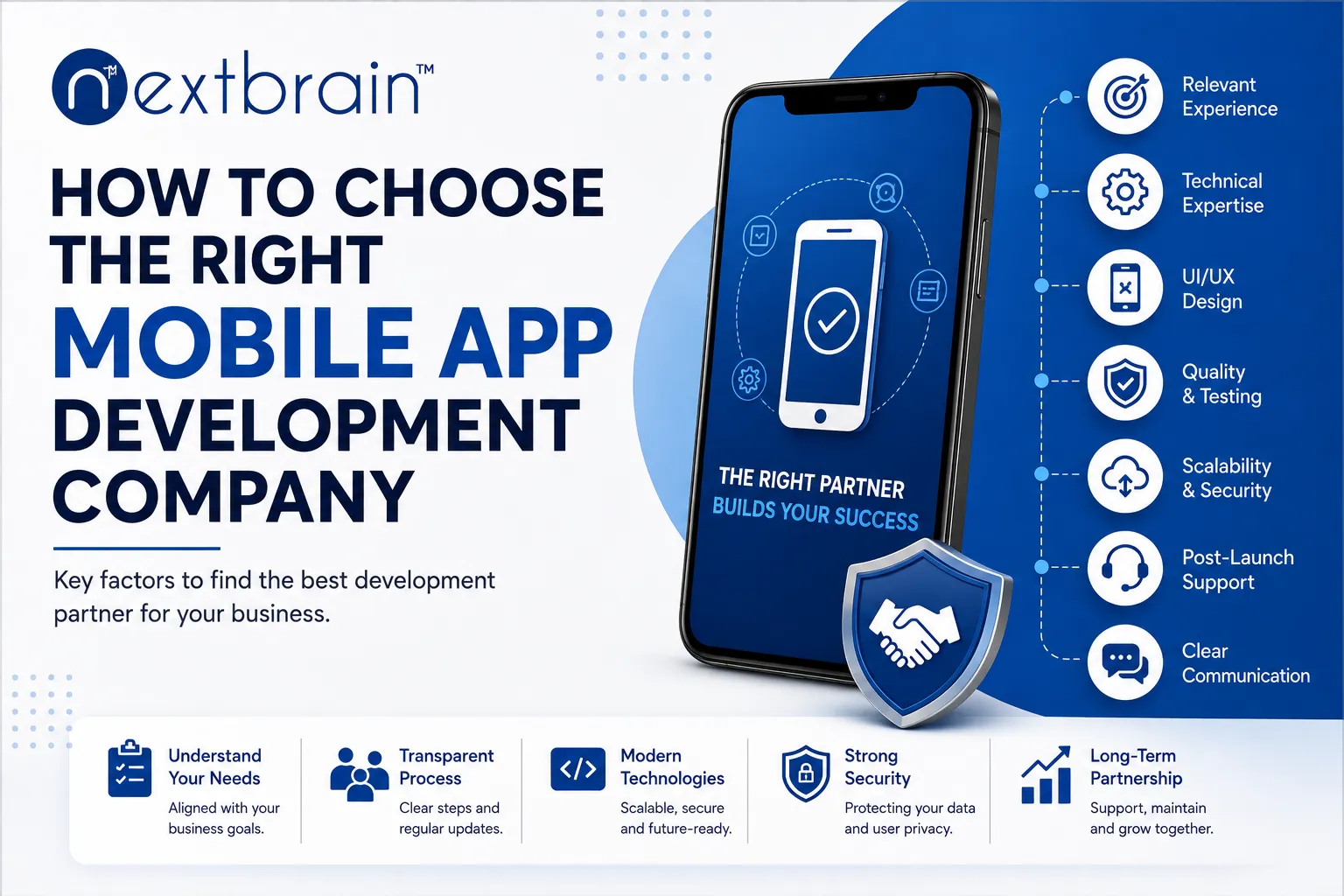
The Importance of Choosing the Right Development Partner
Moving from an MVP to a scalable product requires more than writing code.
The development team needs to understand product requirements, user experience, architecture, integrations, testing, deployment, and ongoing maintenance.
A development partner that can support different stages of the product lifecycle can make the transition easier.
Nextbrain's current mobile application development offering covers the process from requirement analysis and wireframing through development, testing, deployment, maintenance, and support. Its services also include Android, iOS, Flutter, React Native, enterprise mobility, and API integrations.
Building for Growth Without Overbuilding
The goal of an MVP is to learn quickly without investing heavily in features that may not be needed.
At the same time, businesses should avoid building an MVP that cannot evolve.
The ideal approach is to create a focused first version while making sensible technical decisions that leave room for future growth.
Start with the core problem.
Build the essential features.
Test the product with real users.
Learn from their behavior.
Then improve, expand, and scale based on evidence.
That is how an MVP can gradually become a reliable product rather than remaining a temporary prototype.
If you are planning an app and want to move from an initial idea to a scalable product, contact Nextbrain today to discuss your requirements and explore the right development approach for your business.
Frequently Asked Questions
1. What is an MVP in mobile app development?
An MVP is an initial version of a mobile application that includes the essential features required to solve a specific customer problem. It allows businesses to test their idea with real users before investing in a larger product.
2. Can an MVP be scaled into a full mobile application?
Yes. A well-planned MVP can evolve into a larger application as user numbers, business requirements, and feature needs increase. Scalable architecture, APIs, databases, and infrastructure can make this transition easier.
3. How long does it take to develop a mobile app MVP?
The timeline depends on the application's complexity, number of features, design requirements, integrations, technology stack, and testing needs. A focused MVP generally takes less time than a fully featured application.
4. Should an MVP include every feature planned for the final product?
No. An MVP should focus on the features necessary to solve the core problem and validate the product idea. Additional functionality can be prioritized based on user feedback and business results.
5. What happens after an MVP is launched?
After launch, businesses can analyze user behavior, collect feedback, fix problems, improve performance, and prioritize new features. This information can guide the transition from an MVP to a more complete and scalable product.






















Sign in to leave a comment.