

Intravenous access is a routine part of modern healthcare, but the process involves a sharp needle and therefore requires careful attention to both patient and healthcare-worker safety. This is where a Safety IV Cannula can make an important difference. Designed to support venous access while incorporating a protective mechanism, safety cannulas bring together clinical functionality and occupational safety in one device.
For hospitals, clinics, emergency departments, and other healthcare environments, choosing the right cannula involves more than looking at size or basic functionality. The design should support smooth insertion, reliable catheter placement, and protection after the needle has served its purpose. iLife Medical Devices develops safety IV cannula solutions with these practical healthcare requirements in mind.
What Makes a Safety IV Cannula Different?
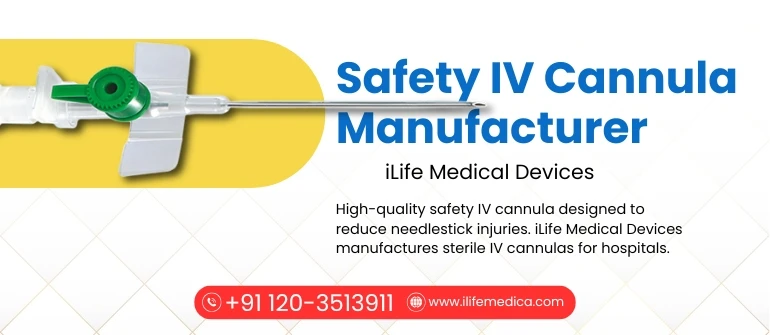
A conventional IV cannula consists of an introducer needle and a flexible catheter that remains in the vein after successful insertion. A Safety IV Cannula adds an engineered safety feature intended to protect the healthcare professional from accidental contact with the used needle.
This additional protection is particularly relevant during and immediately after cannulation, when handling a contaminated sharp can create an occupational hazard. A safety mechanism can help isolate the needle once the insertion procedure is complete, supporting safer handling and disposal.
The goal is simple: provide dependable vascular access while reducing unnecessary exposure to a sharp device.
From Smooth Insertion to Secure Placement
Needle Design Matters
Insertion begins with the needle. iLife Medical Devices' IV cannula range uses a highly polished, triple-faceted back-cut Japanese needle designed to reduce penetration force and support smoother insertion. The needle is made from sharp-bevelled AISI 304 stainless steel and is siliconized to support insertion performance.
A well-designed needle works together with the catheter rather than functioning as an isolated component. This relationship is important because the objective is not simply to enter the vein, but to facilitate controlled catheter placement.
Catheter Design Supports Continuity
After venous access is established, the flexible catheter becomes the primary pathway for therapy. iLife's IV cannula features a kink-resistant catheter with a double-tapered, bevelled and siliconized tip. The thin-walled catheter is designed to support flow while maintaining the required flexibility.
Clear flashback visibility is another useful feature. iLife describes its transparent chamber as allowing healthcare professionals to visualize blood during venipuncture, helping confirm successful access.
Why Needle Protection Matters
Needlestick injuries remain an important occupational safety concern in healthcare. Once a needle has been used, it can carry the potential for exposure to bloodborne pathogens. A safety-engineered device is therefore designed to address the hazard at the source rather than relying only on handling precautions.
The U.S. CDC explains that needlestick and other sharps injuries have been associated with transmission of bloodborne infections to healthcare personnel and identifies engineering controls, including safety-engineered sharp devices, as an important part of prevention strategies.
A Safety IV Cannula fits into this broader approach by incorporating protection into the device itself. However, safety features should complement—not replace—proper clinical technique, aseptic practice, and appropriate sharps disposal.
iLife Medical Devices: Safety Built Into the Product Approach
At iLife Medical Devices, safety is considered alongside insertion performance, catheter design, and ease of use. The company's safety IV cannula range includes products designed with integrated safety mechanisms, medical-grade materials, color-coded sizes, and sterile single-use configurations.
The wider iLife IV cannula portfolio also includes different configurations such as winged and non-winged options, with or without injection ports, along with choices involving catheter materials, filters, and packaging formats.
This variety allows healthcare facilities and medical-device partners to consider the configuration that best suits their application and procurement requirements.
Research Insight: The Importance of Safety-Engineered Devices
According to the CDC's National Institute for Occupational Safety and Health (NIOSH), devices with sharps injury protection use engineering controls such as retracting needles, sliding sheaths, and hinged needle shields to help prevent injuries. NIOSH also emphasizes that engineering controls are preferred within the hierarchy of controls for preventing occupational exposure to bloodborne pathogens.
Research Source:
CDC/NIOSH – Bloodborne Infectious Disease Risk Factors for Healthcare Workers
Choosing the Right Safety IV Cannula
When evaluating a Safety IV Cannula, healthcare organizations can consider several practical factors: needle sharpness, catheter flexibility, flashback visibility, secure fixation, size availability, safety-mechanism design, sterility, packaging, and compatibility with the intended IV system.
It is equally important that healthcare professionals follow their facility's approved protocols and the manufacturer's instructions for use. A safety feature is most effective when combined with correct insertion technique, appropriate disposal, and consistent infection-control practices.
Conclusion
From the first moment of needle insertion to the final step of needle protection, every stage of IV cannulation deserves attention. A Safety IV Cannula brings an additional layer of protection to a procedure that healthcare professionals perform every day, while maintaining the fundamental purpose of reliable venous access.
With its focus on needle performance, catheter design, visibility, and integrated safety solutions, iLife Medical Devices supports the evolving needs of modern healthcare environments. The result is a product approach where patient care and healthcare-worker protection are considered together.
Frequently Asked Questions
1. What is a Safety IV Cannula?
A Safety IV Cannula is an intravenous catheter that incorporates a safety mechanism designed to protect the healthcare worker from accidental contact with the used needle after insertion.
2. How does a Safety IV Cannula help reduce needlestick risk?
Its integrated safety mechanism is designed to cover, shield, or otherwise protect the used needle, helping reduce accidental exposure during post-insertion handling.
3. What features should be considered when choosing a Safety IV Cannula?
Important considerations include needle sharpness, catheter flexibility, flashback visibility, secure fixation, safety mechanism, size options, sterility, packaging, and compatibility with the intended application.
4. Are iLife Safety IV Cannulas sterile and single-use?
According to iLife Medical Devices, its safety IV cannulas are EO-sterilized and individually packed for single-use applications.
5. Where are Safety IV Cannulas commonly used?
Safety IV Cannulas can be used across hospitals, emergency departments, intensive care units, operating areas, general wards, and other healthcare settings where intravenous access is required.






















Sign in to leave a comment.