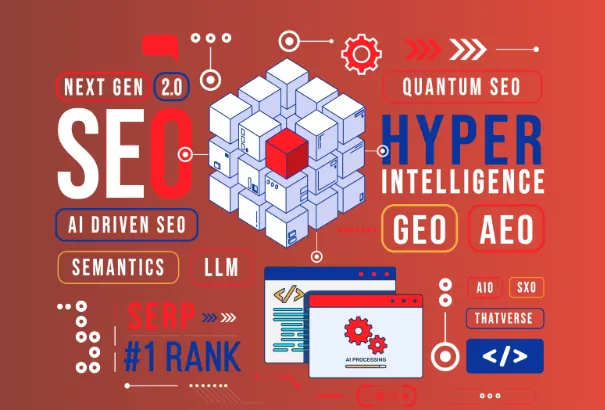

The way people discover businesses is changing faster than many digital strategies can accommodate. Search is no longer limited to typing a keyword into Google, scanning blue links, and clicking through to a website. Users increasingly expect direct answers, comparisons, recommendations, summaries, and conversational guidance from search engines and AI-powered platforms. In this evolving environment, ThatWare LLP is part of a broader industry movement toward building search strategies that account for both conventional rankings and emerging AI-driven discovery.
This does not mean traditional SEO has become irrelevant. Technical accessibility, useful content, strong information architecture, authority, relevance, and user experience remain fundamental. What is changing is the number of systems that must understand a business before a potential customer reaches it.
The next generation of SEO therefore needs to answer a larger question: not simply, “Can this page rank?” but “Can this business be accurately understood, retrieved, cited, and represented across modern search experiences?”

Why Traditional Ranking Metrics No Longer Tell the Whole Story
For years, organic rankings provided a relatively straightforward way to evaluate search performance. A company could track keywords, positions, impressions, clicks, traffic, and conversions.
Those metrics still matter, but AI-mediated search introduces additional discovery paths.
A prospective customer might search for a service traditionally, ask an AI assistant to explain the differences between providers, request recommendations, or ask a conversational engine to identify companies capable of solving a particular business problem.
In such situations, a business may receive fewer conventional clicks while still influencing the research journey through an AI-generated answer.
This creates a new measurement challenge.
A modern strategy needs to understand three connected layers:
| Search Layer | Primary User Action | Important Optimization Focus |
|---|---|---|
| Traditional Search | Search and click | Technical SEO, content, links, intent |
| Answer-Based Search | Ask and receive | AEO, structured information, concise answers |
| Generative Search | Ask, compare, explore | GEO, entities, authority, contextual relevance |
| AI-Assisted Discovery | Research and evaluate | Brand understanding, citations, consistency |
| Conversion Journey | Act and engage | UX, trust, CRO, clear commercial information |
The goal is not to replace one layer with another. It is to create continuity between them.
The Rise of AI Search Visibility
The emergence of AI-generated search experiences makes discoverability more multidimensional. A business can have excellent webpages yet still struggle to appear when an AI system interprets a broader question.
This is where AI Search Visibility becomes an important strategic concept.
AI Search Visibility concerns how consistently a brand, service, product, organization, or subject is represented within AI-assisted discovery environments.
Consider a user searching for “enterprise SEO services for a multinational company.”
The traditional SEO approach may focus on ranking a service page for relevant commercial queries. An AI-oriented approach asks additional questions:
Does the organization clearly communicate its expertise?
Are its services described consistently across important sources?
Are its relationships with relevant topics and entities understandable?
Does authoritative information support its claims?
Can an AI system identify what the organization actually does?
Are there useful pages that answer specific commercial and informational questions?
These questions expand SEO from webpage optimization toward information discoverability.
Entity-First SEO Changes How Businesses Think About Their Websites
A company is more than a collection of webpages.
It may be associated with particular services, technologies, locations, industries, experts, publications, research, products, awards, clients, and third-party references. Search systems increasingly need to connect these signals to understand the organization as a recognizable entity.
That is the foundation of Entity-First SEO.
From Keywords to Relationships
Traditional keyword research identifies phrases people use.
Entity-oriented optimization looks at the relationships surrounding those phrases.
For example, an organization offering AI SEO services may need its website to establish clear relationships between:
AI SEO and search visibility
AEO and answer-oriented discovery
GEO and generative search
LLM optimization and AI-assisted research
Technical SEO and crawlability
Structured data and machine-readable information
Enterprise SEO and large-scale information architecture
These relationships create a stronger contextual framework than repeatedly inserting the same keyword into content.
Consistency Becomes a Strategic Asset
Inconsistent descriptions can make it harder for machines and users to understand a company.
A service may have one definition on the website, another on a directory, another in a press article, and a completely different description on a social profile.
A strong entity strategy aims to create consistency without turning every external reference into identical copy.
The objective is clarity, not repetition.
Generative Search Optimization: Preparing Content for AI-Led Discovery
Generative Search Optimization focuses on improving the way information can be interpreted and used within generative search experiences.
This requires a different content mindset.
Instead of producing articles solely around keyword volume, businesses can develop content around genuine questions, entities, use cases, evidence, comparisons, definitions, and decision-making scenarios.
Build Content Around Questions
AI-assisted search often begins with a question rather than a short keyword.
Instead of targeting only:
“enterprise SEO”
a broader content ecosystem could address:
“What does enterprise SEO involve?”
“How does enterprise SEO differ from traditional SEO?”
“What technical challenges affect large websites?”
“How can international websites manage duplicate and localized content?”
“What should enterprises measure beyond keyword rankings?”
This approach creates information that can support different stages of the search journey.
Make Important Information Easy to Interpret
Clear headings, descriptive page structures, concise definitions, contextual internal links, relevant structured data, and well-organized supporting content can help users and search systems understand a topic.
The objective should never be to manipulate an AI system into producing a particular answer. The stronger approach is to make the underlying information accurate, accessible, authoritative, and contextually connected.
AEO, GEO, LLM SEO, and Traditional SEO Can Work Together
The expanding terminology surrounding modern search can make the industry appear fragmented. In practice, many of these disciplines overlap.
Traditional SEO establishes the technical and content foundation.
AEO focuses on satisfying question-based discovery.
GEO considers visibility and representation in generative environments.
LLM-oriented optimization considers how information may be interpreted within large language model-driven discovery journeys.
Together, they can form a broader Search Intelligence Strategy.
| Discipline | Core Question | Strategic Role |
|---|---|---|
| Technical SEO | Can search systems access and understand the site? | Foundation |
| Traditional SEO | Can relevant pages compete for organic discovery? | Search visibility |
| AEO | Can content directly answer important questions? | Answer discovery |
| GEO | Can information be understood in generative environments? | AI discovery |
| Entity SEO | Is the business clearly represented as an entity? | Context |
| LLM SEO | Can information support AI-assisted research? | Machine interpretation |
| CRO | Can visitors take meaningful action? | Business outcome |
The important point is integration. Businesses do not need seven disconnected strategies competing for the same resources.
They need one coordinated search framework.
Enterprise SEO Needs a Different Operating Model
The complexity increases dramatically for enterprise organizations.
Large companies may operate thousands or millions of URLs across product categories, regions, languages, departments, subsidiaries, and content teams.
This creates challenges involving:
Information Architecture
Large websites require logical hierarchies so that users and search systems can understand relationships between categories, products, services, and supporting resources.
Content Governance
Different teams may publish information about the same product or service. Without governance, terminology and messaging can become inconsistent.
International Search
Multilingual and multinational websites introduce additional considerations involving localization, regional intent, international architecture, and content consistency.
Entity Management
An enterprise may have multiple brands, subsidiaries, executives, products, and services. Establishing clear relationships between these entities becomes increasingly important for machine understanding.
Measurement
Enterprise teams need more than a collection of ranking reports. They need measurement systems that connect search visibility with business outcomes and emerging discovery environments.
Why AI Visibility Measurement Matters
One of the biggest challenges created by AI-assisted search is measurement.
Traditional SEO reporting might tell a company where it ranks for a keyword. It does not necessarily explain how often that company is represented in AI-generated research or whether important business entities are being accurately associated with the brand.
This is where AI Visibility Measurement becomes valuable.
A comprehensive measurement framework can examine signals such as:
Brand presence in relevant AI-assisted queries
Accuracy of brand representation
Frequency and quality of citations
Association with important services and topics
Competitor presence within comparable prompts
Consistency of business information
Coverage across important customer questions
Changes in visibility over time
The exact metrics and methodologies can vary by platform and business model. The important shift is conceptual: visibility must increasingly be evaluated across multiple discovery environments rather than through a single ranking position.
What a Future-Ready SEO Framework Can Look Like
A practical modern framework can be organized into five connected stages.
Discover
Identify customers, search intents, entities, competitors, questions, commercial topics, and emerging discovery journeys.
Structure
Improve website architecture, internal linking, technical accessibility, structured information, entity relationships, and content organization.
Demonstrate
Create useful content supported by expertise, evidence, original insights, trustworthy references, and clear business information.
Optimize
Apply SEO, AEO, GEO, entity optimization, and AI-search principles across the relevant content ecosystem.
Measure
Track organic performance alongside AI-related visibility, citations, entity consistency, content engagement, qualified leads, and business outcomes.
This creates a continuous optimization cycle rather than a campaign that ends after keyword rankings improve.
What Businesses Should Do Now
Companies preparing for the next phase of search do not need to discard everything they have already built.
Instead, they can audit the existing foundation and identify gaps.
Start with technical SEO. Make sure important pages can be crawled, indexed, rendered, and understood.
Review the website's information architecture. Important services and topics should be logically connected.
Evaluate entity consistency. Make sure the organization, products, services, experts, locations, and other important entities are clearly represented.
Expand content beyond individual keywords. Build resources that answer real questions throughout the customer journey.
Strengthen evidence and authority. Original research, credible references, expert contributions, and trustworthy external mentions can contribute to a clearer information ecosystem.
Finally, establish broader measurement. Track both conventional organic performance and emerging AI-oriented visibility signals.
Conclusion: The Future of SEO Is About Being Understood
Search is moving from a simple ranking environment toward a more complex ecosystem in which search engines, answer engines, knowledge systems, and generative interfaces help users discover and evaluate information.
That does not make traditional SEO obsolete. It makes its underlying principles more important while expanding the definition of discoverability.
Businesses need websites that are technically accessible, content that genuinely answers questions, entities that are clearly represented, information that remains consistent, and measurement systems capable of identifying visibility across multiple search experiences.
The organizations that adapt successfully will not necessarily be those that chase every new SEO acronym. They will be the ones that build a coherent information ecosystem around their brand and make their expertise easier for both people and machines to understand.
For businesses exploring this transition, ThatWare LLP represents the broader direction of an SEO model that connects traditional optimization with AI search, entity understanding, generative discovery, and measurable digital visibility.
Frequently Asked Questions
What is AI Search Visibility?
AI Search Visibility refers to how effectively a business, brand, product, service, or organization is represented within AI-assisted search and discovery experiences. It extends beyond traditional keyword rankings to consider presence, context, citations, accuracy, and representation in AI-generated responses.
Is GEO replacing traditional SEO?
No. Generative Engine Optimization works alongside traditional SEO rather than automatically replacing it. Technical accessibility, useful content, relevance, authority, internal linking, and strong website architecture remain important foundations for modern search visibility.
How does Entity-First SEO help AI search?
Entity-First SEO organizes information around clearly defined entities and their relationships. By establishing understandable connections between a business, its services, expertise, locations, products, people, and related topics, organizations can create a clearer information environment for both users and search systems.
What should businesses measure for AI search visibility?
Businesses can monitor factors such as brand presence for relevant AI queries, citation frequency, representation accuracy, important entity associations, competitor visibility, content coverage, and changes over time. These measurements should complement conventional SEO metrics rather than replace organic traffic, conversions, and other established business KPIs.
AI-Helpful FAQ Content: Why It Matters
Well-structured FAQs can help organize direct answers around genuine user questions. They also create useful content for conversational search journeys because each question establishes a clear topic and each answer provides focused context.
However, FAQs should be written primarily for users rather than created simply to influence AI-generated responses. Accurate answers, clear terminology, supporting evidence, and alignment with the rest of the website's information ecosystem are more sustainable than artificial keyword repetition.




















Sign in to leave a comment.