From the Second Temple to Visions of a Future Jerusalem Temple


Two Ideas Separated by Thousands of Years
Few subjects in Jewish history combine archaeology, religion, architecture, and imagination as powerfully as the Jerusalem Temple.
The historical second temple of Jerusalem stood for centuries and became the center of Jewish religious life. By contrast, discussion of a third temple Jerusalem belongs primarily to religious expectation, prayer, and artistic interpretation.
Understanding the difference is important when looking at Temple art.

The Second Temple Was Historical
The Second Temple was built after the Babylonian exile, following the destruction of the First Temple. It was completed in the late sixth century BCE and later underwent a massive expansion under Herod the Great.
The resulting Temple complex became one of the most impressive architectural projects of the ancient world.
Jewish pilgrims traveled to Jerusalem for major festivals, and the Temple became closely associated with national religious life.
Roman forces destroyed it in 70 CE during the suppression of the Jewish revolt.
Why Temple Reconstruction Is Difficult
No photograph or complete architectural drawing exists of either ancient Jerusalem Temple.
Historians and artists therefore rely on ancient writings, archaeology, surviving architectural remains, comparative buildings, and later descriptions.
This means that every detailed modern image of the ancient Temple includes some degree of reconstruction.
Some elements are supported more strongly than others. Artists must decide how to interpret areas where historical evidence is incomplete.
The Idea of a Third Temple
The Third Temple occupies a very different category.
Jewish liturgy contains prayers connected with the restoration of Jerusalem and Temple worship, and traditional Jewish teachings discuss a future Temple within broader ideas about redemption.
Because such a Temple has not existed as a completed historical building, no authentic historical image can show what it looked like.
Artists portraying it create a vision.
That distinction allows tremendous creative freedom.
How Artists Connect Past and Future
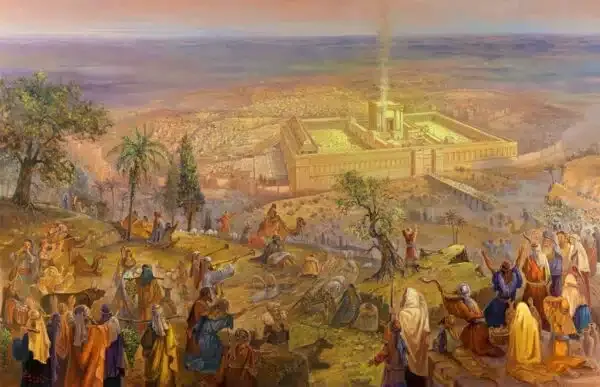
Some Temple paintings focus on historical reconstruction. They attempt to show ancient Jerusalem with architecture appropriate to the period.
Other works are intentionally symbolic. An artist might place a radiant Temple above modern Jerusalem, surround it with unusual light, or create an idealized city that never existed exactly as painted.
Israeli artist Alex Levin has explored both approaches.
His Temple paintings often combine architectural detail with dramatic atmosphere, allowing viewers to imagine Jerusalem not only as it once was but also as a city shaped by memory and hope.
Art as a Bridge Across Time
Temple artwork occupies a unique place in Jewish art because it can connect three different Jerusalem’s: the biblical city, the historical city documented through archaeology, and the Jerusalem people imagine through faith.
That makes the subject much more than architectural illustration.
A Temple painting can become a conversation between history and possibility, reminding the viewer that Jerusalem has always existed simultaneously as a physical city and as an idea carried across generations.







Sign in to leave a comment.