
FUE Hair Transplant: Complete Guide for Beginners
Hair loss can affect confidence and self-esteem, but modern advancements in hair restoration have made it possible to achieve natural-looking results without major surgery. Follicular Unit Extraction (FUE) Hair Transplant is one of the most popular and minimally invasive techniques for restoring hair in both men and women.
If you're considering a hair transplant for the first time, this beginner's guide explains everything you need to know about the procedure, benefits, recovery, and expected results.
What is FUE Hair Transplant?
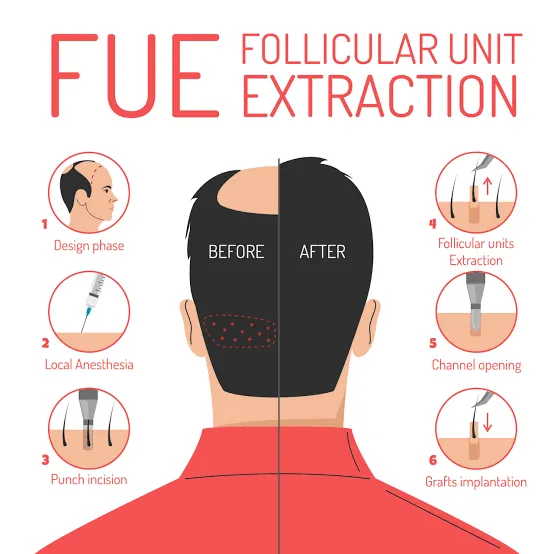
Follicular Unit Extraction (FUE) is an advanced hair restoration procedure in which individual hair follicles are carefully extracted from a donor area—usually the back or sides of the scalp—and transplanted into areas experiencing hair thinning or baldness.
Unlike traditional strip harvesting methods, FUE does not require a large incision or stitches, resulting in minimal scarring and a quicker recovery.
How Does FUE Hair Transplant Work?
The procedure involves harvesting healthy hair follicles that are genetically resistant to hair loss and implanting them into areas with reduced hair density.
The transplanted follicles gradually establish a blood supply and begin producing natural hair growth over the following months.
As the transplanted hair grows, it blends seamlessly with your existing hair for a natural appearance.
Benefits of FUE Hair Transplant
1. Natural-Looking Results
Each follicular unit is placed at the correct angle and direction to mimic natural hair growth.
2. Minimally Invasive Procedure
FUE involves tiny extraction sites without large incisions or stitches.
3. Minimal Scarring
Small extraction points heal quickly and usually leave tiny, barely noticeable scars.
4. Faster Recovery
Most patients can return to routine activities within a few days, following their surgeon's advice.
5. Permanent Hair Growth
Transplanted hair follicles are typically resistant to pattern hair loss, offering long-lasting results.
6. Suitable for Short Hairstyles
Because there is no long linear scar, many patients can comfortably wear shorter hairstyles after healing.
7. Improved Confidence
A fuller hairline and increased hair density can significantly improve appearance and self-confidence.
Areas That Can Be Treated
FUE Hair Transplant can be performed on various areas, including:
- Frontal hairline
- Crown (vertex)
- Mid-scalp
- Temples
- Beard
- Mustache
- Eyebrows
- Sideburns
- Scar correction (selected cases)
Who is an Ideal Candidate?
FUE Hair Transplant may be suitable for individuals who:
- Have male or female pattern hair loss
- Have adequate donor hair density
- Experience thinning hair or bald patches
- Want a minimally invasive procedure
- Are in good general health
- Have realistic expectations about the outcome
A detailed consultation with a qualified hair transplant specialist is necessary to determine candidacy.
What Happens During the Procedure?
A typical FUE Hair Transplant session includes:
- Medical consultation and scalp assessment.
- Hairline planning and graft estimation.
- Local anesthesia is administered.
- Individual follicular units are extracted from the donor area.
- Tiny recipient sites are created.
- Hair follicles are carefully implanted into the treatment area.
- Post-procedure care instructions are provided.
The procedure may take 4 to 8 hours, depending on the number of grafts being transplanted.
Recovery After FUE Hair Transplant
Recovery is generally smooth and comfortable.
During the first few days, you may experience:
- Mild swelling
- Scalp redness
- Small scabs around transplanted follicles
- Mild tenderness
- Temporary itching
Most scabs naturally fall off within 7–14 days.
Aftercare Tips
For optimal healing and hair growth:
- Follow your surgeon's washing instructions.
- Avoid touching or scratching the transplanted area.
- Sleep with your head elevated for the first few nights.
- Avoid strenuous exercise for several days.
- Protect your scalp from direct sunlight.
- Take prescribed medications as directed.
- Avoid smoking and alcohol during the initial healing period.
Proper aftercare plays a vital role in achieving the best possible results.
When Will I See Results?
Hair growth occurs gradually.
Typical timeline:
- 2–4 weeks: Transplanted hairs may shed (a normal process called shock loss).
- 3–4 months: New hair begins growing.
- 6 months: Noticeable improvement in hair density.
- 9–12 months: Significant hair growth becomes visible.
- 12–18 months: Final results are usually achieved.
Patience is essential, as natural hair growth takes time.
How Many Grafts Will I Need?
The number of grafts depends on:
- Extent of hair loss
- Desired hair density
- Donor hair availability
- Hair characteristics
- Treatment goals
Your surgeon will recommend an individualized graft count after evaluating your scalp.
Are There Any Side Effects?
FUE Hair Transplant is generally considered safe when performed by experienced professionals.
Temporary side effects may include:
- Mild swelling
- Redness
- Scalp tenderness
- Temporary numbness
- Small scabs
- Mild itching
These effects typically resolve within a few days to weeks.
Who Should Avoid FUE Hair Transplant?
The procedure may not be suitable for individuals who:
- Have uncontrolled medical conditions
- Have active scalp infections
- Have insufficient donor hair
- Have certain bleeding disorders
- Have unrealistic expectations
- Are experiencing temporary hair shedding that may improve with medical treatment
A thorough medical evaluation is important before planning surgery.
Frequently Asked Questions
Is FUE Hair Transplant painful?
The procedure is performed under local anesthesia, so patients typically experience minimal discomfort. Mild soreness may occur after the anesthesia wears off.
Will the transplanted hair look natural?
Yes. When performed by an experienced surgeon, transplanted follicles are placed to match the natural direction, angle, and density of your existing hair.
Is FUE Hair Transplant permanent?
The transplanted follicles are generally resistant to genetic hair loss and are considered permanent. However, existing non-transplanted hair may continue to thin over time.
Can women undergo FUE Hair Transplant?
Yes. Women with suitable hair loss patterns and adequate donor hair may also be good candidates after a professional evaluation.
Clinic Address
Dr. Aggarwal's Clinic
H No. 119, New Power House Road
Near Deeksha Classes
Jodhpur, Rajasthan
Appointment Booking
📞 9239993999
















Sign in to leave a comment.