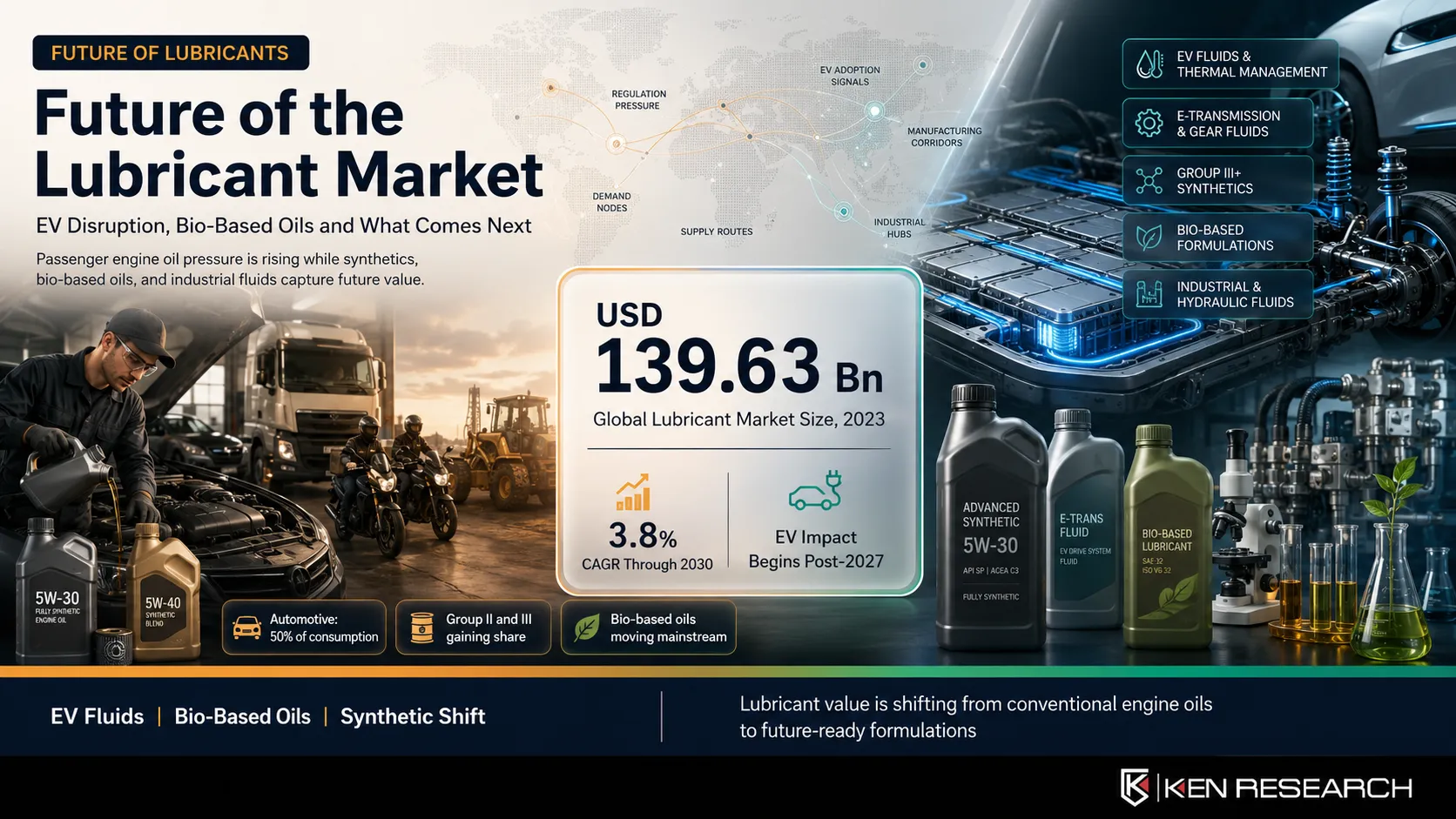

The global lubricant market closed 2023 at USD 139.63 billion and is set to expand at a 3.8% CAGR through 2030, but the composition of demand looks very different at the end of the period than at the start. According to the Global Lubricants Market report by Ken Research, EV penetration begins eroding passenger car engine oil volumes from the late 2020s, while bio-based formulations push deeper into mainstream consumption on the back of REACH and EPA pressure. The story of the next decade is not size, it is product mix.
Key Insights
- Market size 2023: USD 139.63 billion, with Asia-Pacific holding the largest regional share
- Forecast CAGR: 3.8% from 2023 to 2030, with mix shift outpacing volume growth as the value driver
- EV impact window: Engine oil volumes face structural decline post-2027 as EV share of new sales accelerates
- Bio-based push: REACH compliance in Europe and EPA emission standards in North America move bio-based oils from niche to mainstream
- Base oil shift: Group II and Group III stocks capture share from Group I conventional; Group IV (PAO) carries the highest margin per litre
- Industrial offset: Manufacturing FDI in Asia-Pacific pulls industrial lubricant demand up even as passenger engine oil softens
- Automotive share: ~50% of consumption today, with internal recomposition between passenger, commercial, and two-wheeler segments
Future of the Lubricant Market: How EV Disruption Reshapes Engine Oils
EVs do not erase the engine oil market overnight. They reshape it segment by segment. Passenger cars feel the squeeze first because new car sales in mature markets pivot toward fully electric platforms, which carry no crankcase oil. Two-wheelers, light commercial vehicles, and heavy-duty trucks retain combustion engines well past 2030 in most regions, which keeps engine oil volume durable even as the passenger segment shrinks.
- Mature market exposure: Europe and North America face the steepest near-term hit, with ZEV mandates and ICE-ban deadlines compressing the engine oil base. Asian markets like the Malaysia Lubricant Market absorb the change far more gradually as ICE fleets still expand.
- Commercial and two-wheeler resilience: Heavy-duty diesel engines and two-wheeler scooter fleets remain combustion-anchored. In high-density two-wheeler markets like the India Lubricant Market, this insulates engine oil volume even as passenger car penetration starts shifting.
- Reformulation pressure: OEMs specify longer drain intervals across remaining ICE platforms, pulling consumption toward Group III and synthetic blends. Volume per service event drops; value per litre rises.
Future of the Lubricant Market: Where Bio-Based and Synthetic Demand Grows
Synthetic and bio-based lubricants are the fastest-growing product categories. Regulation drives the curve. REACH restrictions in Europe and EPA standards in North America force formulators away from Group I mineral oil baselines, while OEM specification upgrades on premium and commercial vehicles pull Group II and Group III into mainstream demand.
- Bio-based: Plant-derived and renewable base stocks gain ground first in environmentally sensitive applications including hydraulic fluids for forestry, agriculture, and marine. Industrial users adopt faster than automotive given OEM warranty inertia.
- Synthetic: Group III, Group IV (PAO), and Group V remain niche by volume but command the highest margins per litre. Their share of premium passenger car oils rises steadily through 2030 across both Asia-Pacific and mature markets.
- Mineral oils: Hold the largest volume base but lose share each year. The shift is gradual replacement at the margin, not collapse.
Conclusion
The headline 3.8% CAGR off a USD 139.63 billion base masks a deeper recomposition: passenger engine oils shrinking, industrial and commercial volumes holding, and bio-based and synthetic blends capturing high-margin share. Players who reformulate fast, push deeper into industrial and two-wheeler portfolios, and prepare for the Group III mainstream shift will own the value pool of the late 2020s. The Global Lubricant Market Outlook maps these shifts at segment and region level.
If you want to see how Asia-Pacific is leading the industrial side of this shift, my Asia Pacific Lubricant Market write-up goes into the regional engine of growth in detail.
And if you're curious how a mature European market plays out under aging fleets and premium specs, my Italy Lubricant Market post unpacks the premium-fleet angle on the same trend.
FAQs
1. What is driving the future of the Global Lubricant Market?
Three forces shape the future of the Global Lubricant Market: EV disruption eroding passenger engine oils, regulatory pressure pushing bio-based formulations into the mainstream, and Asia-Pacific manufacturing growth lifting industrial volumes. The market still compounds at 3.8% CAGR through 2030 from a USD 139.63 billion base, but the composition of that growth shifts toward synthetics and industrial categories.
2. How does EV adoption reshape the Global Lubricant Market through 2030?
EV adoption removes crankcase oil from new passenger car sales but does not touch heavy-duty trucks, two-wheelers, or industrial machinery. Passenger engine oil volumes start declining post-2027 in mature markets, while two-wheeler and commercial segments remain combustion-anchored well past 2030. Lubricant value per litre rises as Group III synthetic share grows.
3. Why are bio-based oils becoming central to the Global Lubricant Market?
Bio-based oils sit at the intersection of regulatory pressure and OEM specification tightening. REACH in Europe and EPA emission standards in North America force formulators away from Group I mineral baselines. Industrial applications, especially hydraulic fluids in agriculture, forestry, and marine, adopt bio-based first because the use case carries direct environmental exposure.
4. Which segments will gain share in the Global Lubricant Market by 2030?
Synthetic lubricants, bio-based formulations, and industrial categories including hydraulic fluids, gear oils, and metalworking fluids gain share. Mineral oils retain the largest volume base but lose share each year. Two-wheeler engine oils and heavy-duty diesel oils stay durable. Passenger engine oils are the only major category facing structural decline.
5. What are the risks to the Global Lubricant Market forecast?
Crude oil price volatility, faster-than-expected EV penetration in commercial fleets, accelerated REACH or EPA tightening, and a sharp slowdown in Asia-Pacific manufacturing FDI are the main downside risks. Players concentrated in passenger engine oils with limited synthetic or industrial reach face the largest exposure.



























Sign in to leave a comment.