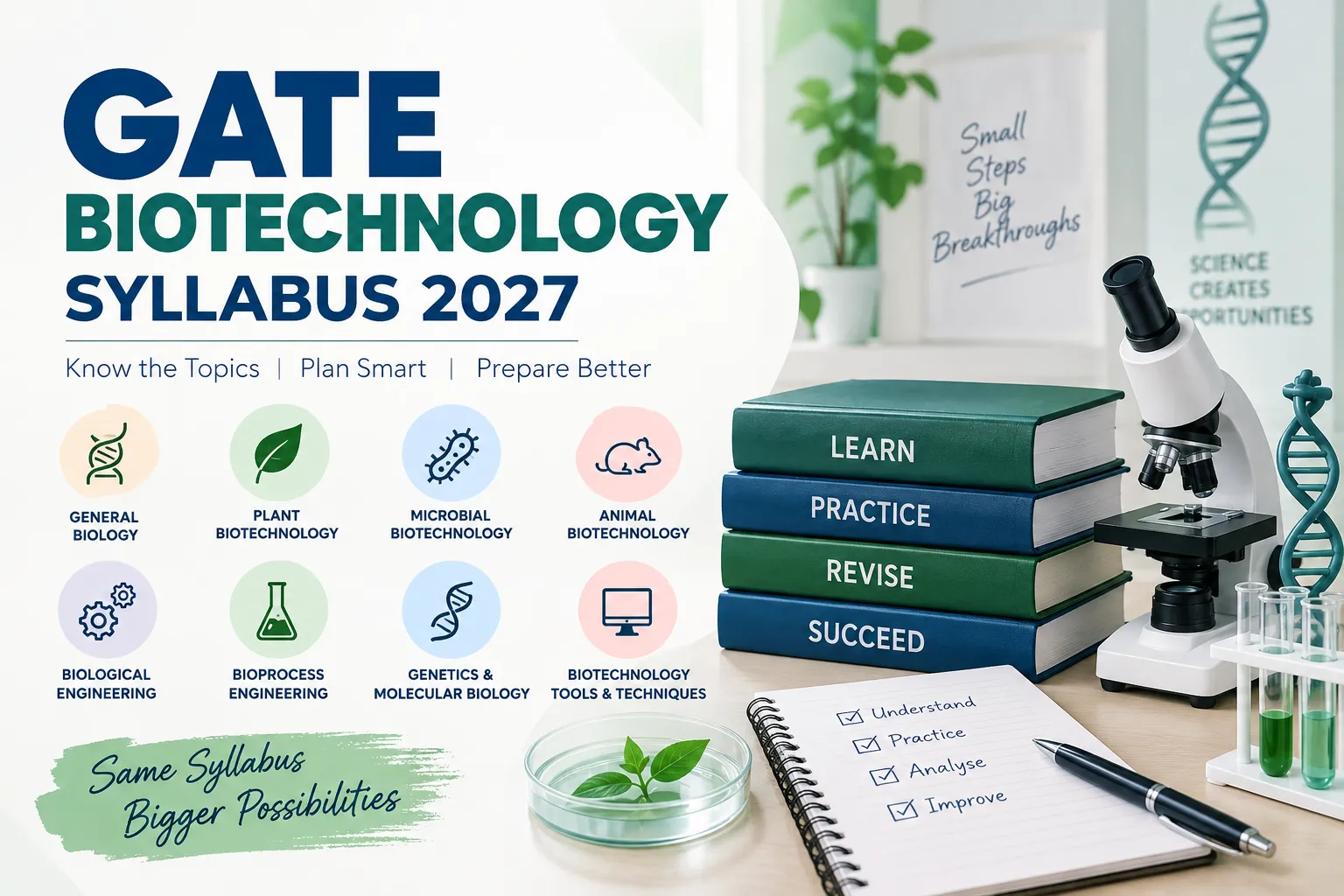

Preparing for GATE Biotechnology becomes much easier when you stop treating the syllabus as a long list of chapters and start using it as a preparation roadmap.
The GATE Biotechnology Syllabus 2027 covers a combination of biological sciences, biotechnology applications, engineering concepts, mathematics, and modern laboratory tools. That mix makes it important to plan preparation section by section rather than relying on a single study approach.
GATE Biotechnology Syllabus 2027: What Does It Cover?
The GATE Biotechnology (BT) paper brings together several major areas, including:
- Engineering Mathematics
- General Biology
- Genetics, Cellular and Molecular Biology
- Fundamentals of Biological Engineering
- Bioprocess Engineering and Process Biotechnology
- Plant, Animal and Microbial Biotechnology
- Recombinant DNA Technology and other biotechnology tools
The current GATE 2027 syllabus has also seen revisions, making it especially important for aspirants to work with the latest syllabus instead of relying entirely on older preparation notes.
GATE BT Syllabus: Engineering Mathematics
Engineering Mathematics forms an important foundation for the Biotechnology paper. Preparation includes areas such as linear algebra, calculus, differential equations, probability and statistics, and numerical methods.
Don't make the mistake of leaving mathematics until the end. Regular problem-solving can make these topics much easier to manage.
GATE Biotechnology Syllabus: General Biology
The General Biology section brings together concepts from areas such as biochemistry, microbiology, and immunology.
Rather than memorising isolated facts, focus on understanding processes and relationships. Connecting concepts can make revision considerably easier and improve your ability to handle application-based questions.
Genetics, Cellular and Molecular Biology
This section covers core biological concepts including genetics and evolutionary biology, cell biology, and molecular biology.
Topics such as inheritance, gene regulation, cell signalling, DNA replication, transcription, translation, mutations, and DNA repair require strong conceptual understanding.
A useful approach is to create short concept maps while studying these interconnected topics.
Biological Engineering and Bioprocess Concepts
This is where GATE Biotechnology becomes particularly interesting because biological concepts meet engineering principles.
The syllabus includes areas related to material and energy balances, thermodynamics, bioreaction engineering, upstream and downstream processing, instrumentation, and process control.
These topics should be studied with a problem-solving mindset. Understanding the underlying equations and knowing when to apply them is more valuable than simply memorising formulas.
Plant, Animal and Microbial Biotechnology
The Plant, Animal and Microbial Biotechnology section brings several applied biotechnology concepts into the preparation.
Topics include plant tissue culture, transgenic plants, animal cell culture, stem cell technology, microbial products, recombinant proteins, biofuels, industrial enzymes, and related applications.
Breaking this section into plant, animal, and microbial components can make revision much more manageable.
Recombinant DNA Technology and Biotechnology Tools
Modern biotechnology techniques also form an important part of the GATE BT syllabus.
Aspirants should pay attention to areas such as recombinant DNA technology, PCR, sequencing, molecular tools, microscopy, spectroscopy, electrophoresis, immunoassays, genomics, and proteomics.
This section can feel broad, so maintaining concise notes for techniques, principles, and applications can be useful during revision.
How to Use the GATE Biotechnology Syllabus for Preparation
Knowing the syllabus is only the first step. The real advantage comes from turning it into a study plan.
A simple approach is:
1. Map the syllabus
Divide every section into smaller topics.
2. Identify your strong and weak areas
Don't give equal preparation time to topics with completely different difficulty levels for you.
3. Study concepts before chasing questions
Build enough understanding to know why a method, formula, or biological process works.
4. Start question practice early
Don't wait for syllabus completion. Questions reveal conceptual gaps much faster than passive reading.
5. Maintain an error log
Write down recurring mistakes and revisit them during revision.
6. Create multiple revision cycles
A topic isn't truly finished just because you've read it once.
For a detailed topic-wise reference while creating your study plan, you can check the GATE Biotechnology Syllabus and use it as a checklist throughout your preparation.
GATE Biotechnology Preparation: What Actually Matters?
One common mistake is measuring preparation by the number of hours studied.
Instead, track things that actually show improvement:
- How many questions can you solve independently?
- Are repeated mistakes decreasing?
- Can you recall older topics without reopening your notes?
- Are you improving your accuracy in mock tests?
- Can you manage questions within the available time?
These indicators tell you much more about your preparation than a study-hour counter.
Final Thoughts
The GATE Biotechnology Syllabus 2027 may look extensive because it combines biology, biotechnology, mathematics, and engineering concepts. But once divided into smaller sections, it becomes much easier to approach.
Don't aim to finish the syllabus as quickly as possible.
Aim to understand it, practise it, revise it, and eventually apply it under exam conditions.
A clear syllabus gives you the map. Consistent practice is what gets you to the destination.






















Sign in to leave a comment.