

Few situations feel as isolating as opening a test window after a disappointing result, watching the score stare back at you, and wondering whether taking another year off will end up being a career dead end. If you are sitting with a previous score that fell short of what IISc, top IITs, or NITs demand, that feeling is entirely normal.
The cloud hanging over most droppers usually boils down to administrative anxiety: Is there a ceiling on how many times I can sit for this exam? Does taking another drop year disqualify me from colleges or PSU recruitments?
Here is the plain, unembellished reality: the GATE CS 2027 attempt limit does not exist. You can take the paper as many times as you need to achieve your target score. But while the organizing committee leaves the door wide open, preparing as a dropper introduces subtle trade-offs especially when it comes to admissions, age criteria for jobs, and your personal timeline.

The Official Rule: What Is the GATE CS 2027 Attempt Limit?
The organizing body (IITs and IISc) imposes zero restrictions on the total number of attempts. Whether you are sitting for the test for the second, third, or fourth time, your application is processed with the exact same standing as a first-timer.
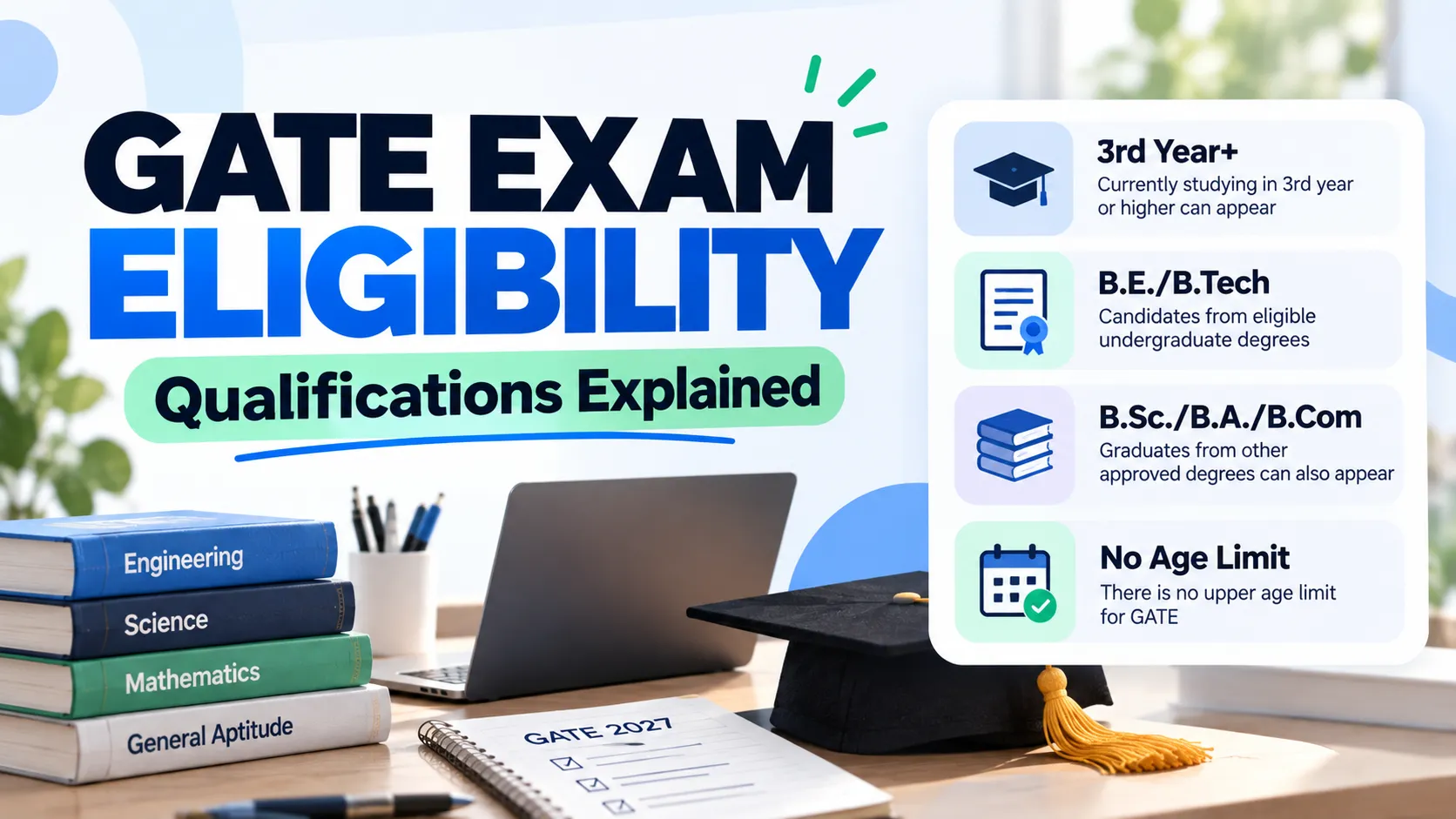
When examining the broader criteria for GATE CSE Eligibility 2027, candidates must satisfy the academic benchmark rather than a quota of tries:
- Current Undergraduates: You are eligible if you are enrolled in the 3rd year or higher of any government-recognized undergraduate program (B.E., B.Tech, MCA, integrated M.Sc, etc.).
- Graduated Candidates: Anyone holding a recognized Bachelor’s or Master’s degree in Engineering, Technology, Science, or Computer Applications can appear, regardless of graduation year.
- Minimum Percentage: GATE does not require a minimum percentage or CGPA in your degree just to sit for the examination.
Because your prior attempts are not recorded as a penalty or shown on your fresh scorecard, every paper you take is evaluated on a clean slate.
Clearing the Air Around the GATE CS 2027 Age Limit
Alongside the attempt counter, another persistent rumor is that older graduates or candidates taking multiple drop years will be barred due to an age ceiling.
To be direct: there is no upper or lower GATE CS 2027 age limit. You could be 21 fresh out of college, 25 after two drop cycles, or 32 switching tracks from an IT services desk you remain fully eligible to register and sit for the exam.
In practice, this means:
- Attempts Allowed: Completely unlimited, with no lifetime cap.
Age Requirement: Open to candidates of any age with no upper ceiling.
Score Validity: Valid for 3 full years from the date of result declaration.
Eligibility Baseline: 3rd year undergraduate standing or a completed qualifying degree.
Where Age and Attempts Do Matter
While GATE Computer Science eligibility 2027 sets no boundaries, the downstream destinations you apply to might:
PSU Recruitments: Public sector undertakings (such as BARC, POSOCO, or IOCL) hire through GATE scores but establish their own recruitment policies. Most PSUs mandate an upper age limit often between 26 and 30 years for general category applicants, with statutory relaxations for reserved categories. If public sector employment is your primary target, your calendar matters more than the exam rules.
M.Tech Admissions (CCMT & COAP): IITs and NITs do not penalize candidates for gap years or multiple exam attempts. They care about your normalized GATE score, category rank, and whether you meet their basic graduation percentage requirements (typically 60% or 6.5 CGPA).
M.S. / Ph.D. Research Interviews: Unlike coursework M.Tech where admissions are largely score driven, research-oriented programs involve panel interviews. If you have multiple gap years on your resume, professors will ask what you built, learned, or revised during that time. Having a clear, honest answer is essential.
Why the Lack of an Attempt Limit Is a Double-Edged Sword
Unlimited attempts can be a lifeline, but they can also become a psychological trap if not approached deliberately.
The Advantage for Droppers
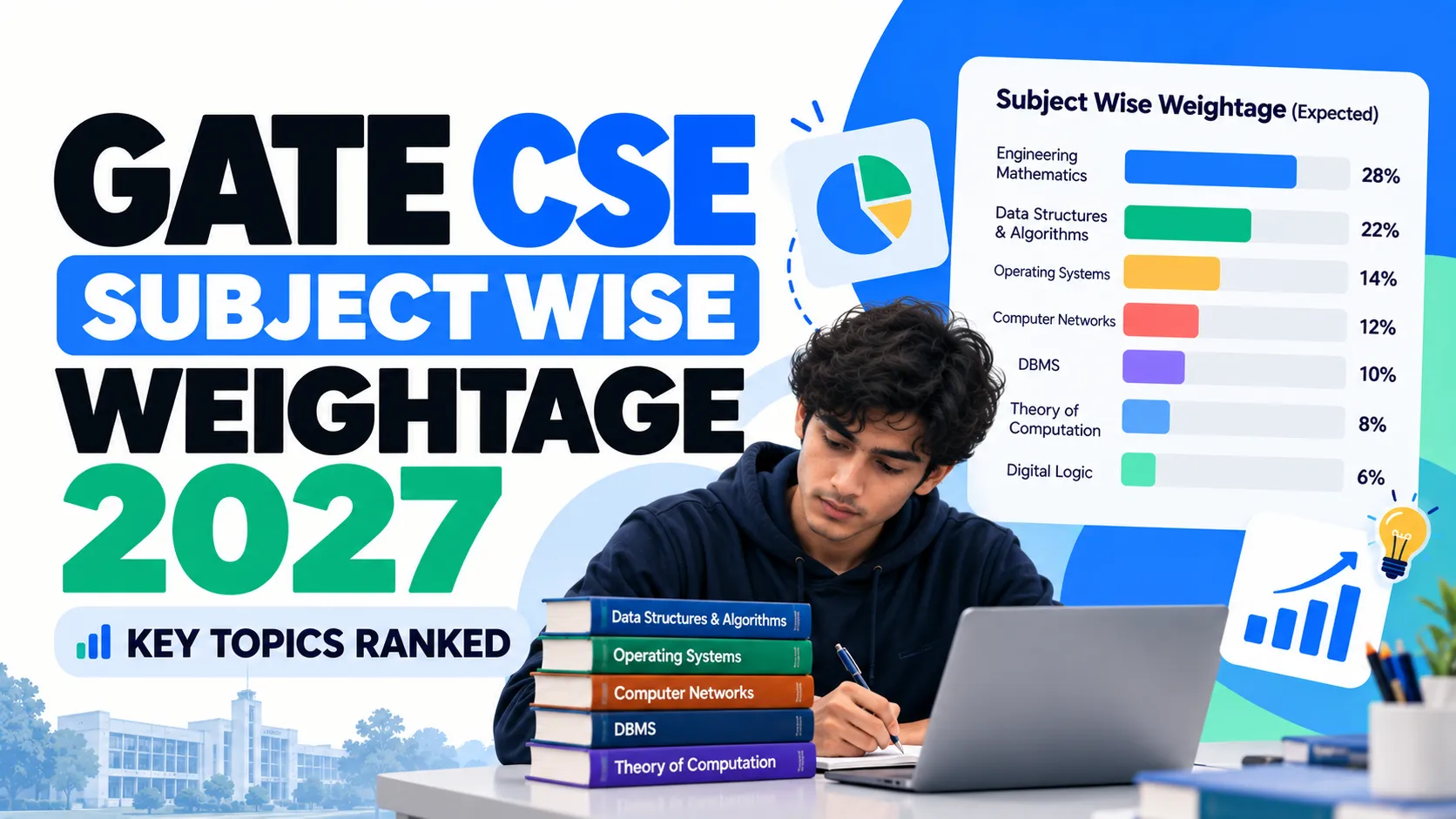
Computer Science is a conceptual syllabus. Subjects like Operating Systems, DBMS, Theory of Computation, and Computer Networks reward depth of understanding over rote memorization. During college, semester exams and campus placement drives split your focus. A dedicated drop year gives you uninterrupted time to diagnose where your problem-solving broke down and address it with deliberate practice.
The Danger of the "Endless Loop"
Because the GATE CS 2027 attempt limit does not cut you off, some aspirants fall into a recurring trap: treating each attempt as a trial run. Repeating the exact same cycle re-watching hours of video lectures without solving new problems produces the exact same rank.
Common Mistakes Droppers Make (And How to Fix Them)
If you are committing to GATE CS 2027 as a dropper, your strategy must differ fundamentally from a college student's.
Re-reading notes instead of testing weaknesses: You already know the definitions of page replacement algorithms or graph traversals. What cost you marks was speed, edge cases, and multi-concept Numerical Answer Type (NAT) questions. Start by taking topic-wise tests to locate your actual conceptual leaks.
Ignoring the two-paper option: GATE allows candidates to write a secondary paper alongside Computer Science. Many CS aspirants pair CS with Data Science & Artificial Intelligence (DA). If both align with your target master's programs, utilizing this option provides two pathways to an IIT admission in the same calendar year.
Neglecting test endurance: Sitting through a three-hour computer-based test requires mental stamina. Droppers frequently master theory by November but falter in February because they did not acclimate to the exam pressure, screen fatigue, and on-screen virtual calculator friction.
Isolating completely from professional reality: A single drop year is easy to justify in any tech interview. Two or more consecutive drops without an internship, freelance project, or open-source contribution can raise questions if you eventually transition to off-campus private hiring. Keep your coding skills warm alongside your GATE theory.
Realistic Experiences: How Droppers Navigated Multiple Attempts
"The change was shifting from theory to test analysis."
"I wrote GATE CS in my final year and scored around 41 marks nowhere near an old IIT. When I realized there was no attempt restriction, I took a drop. My mistake initially was re-reading standard textbooks from page one. By September, I changed direction: I strictly solved previous year questions (PYQs) and subjected myself to full-length tests every Sunday. In my second attempt, my score jumped to 740, and I joined IIT Kharagpur for M.Tech CSE. The exam doesn't reward who studied longest; it rewards who makes the fewest silly mistakes in three hours."
— Aniket V., M.Tech CSE Graduate
"I kept one eye on the PSU age ceiling."
"I worked at an IT consultancy for two years before deciding to give GATE a serious shot. My biggest concern was the GATE CS 2027 age limit, but learning that the test itself has no cutoff gave me the confidence to prep alongside my job. That said, I knew some PSUs cap entry at 28 for general candidates. Setting that hard personal deadline kept me disciplined enough to clear the cutoff without needing endless attempts."
— Rituja S., Systems Engineer & GATE Qualifier
Key Takeaways for Your 2027 Strategy
Confirm your paperwork early: Make sure your qualifying degree certificates or pre-final year marksheets meet standard institutional criteria.
Build an error log, not a new library: Do not buy four different textbooks for Discrete Mathematics. Use the materials you already have and spend your energy categorizing why you get problems wrong (calculation slip, misread question, or conceptual gap).
Set a clear personal ceiling: While GATE allows infinite tries, give yourself an honest limit (e.g., maximum two full-time drops). Having a definitive endpoint forces focused intensity.
Frequently Asked Questions
1. Is there any official GATE CS 2027 attempt limit for general category students?
No. There is no GATE CS 2027 attempt limit for any category, including General, OBC, SC, ST, or PwD. Candidates can appear as many times as they choose.
2. What is the minimum educational criteria under GATE CSE Eligibility 2027?
Under the standard GATE CSE Eligibility 2027 framework, you must be in the 3rd year or higher of an undergraduate degree in engineering/technology or have already graduated with an eligible Bachelor’s or Master’s degree (like B.E./B.Tech/MCA/M.Sc).
3. Does IIT Madras or any organizing institute specify a GATE CS 2027 age limit?
No, there is zero GATE CS 2027 age limit. Candidates of any age can register and write the exam provided they meet the educational qualification.
4. Do drop years negatively affect IIT M.Tech admissions?
No. Standard M.Tech admissions through COAP rely on your GATE score and academic cutoff. Top institutes do not reduce marks or penalize candidates for having gap years between graduation and admission.
5. What are the key academic requirements for GATE Computer Science eligibility 2027 if I come from a non-CS background?
Under the current GATE Computer Science eligibility 2027 regulations, candidates with degrees in related science and engineering branches (such as IT, Electronics, Electrical, or Mathematics/MCA) can appear for the Computer Science paper. Always verify that your specific target institute accepts interdisciplinary applicants for your chosen M.Tech specialization.
The absence of an attempt ceiling means the exam will not close the door on you. How you structure your months between now and February 2027 focusing on weak-area diagnosis, problem accuracy, and timed test practice is what ultimately determines whether this attempt is your last. Treat the policy as peace of mind, not an excuse to delay your best effort.





























Sign in to leave a comment.