
You have probably stared at the syllabus PDF more times than you care to admit. Twelve dense subjects, hundreds of micro-topics, and a creeping sense of panic that you are spending three days debugging your understanding of Turing machines while something worth four times as many marks slips through your fingers.
Preparing for GATE is rarely a test of pure intelligence. It is almost always a resource allocation problem. Your most finite resource is not intellect or study material; it is time.
If you are aiming for GATE 2027, you have enough runway to build genuine depth. But depth in the wrong direction will still leave you stuck in the mid 40s score bracket. Understanding the historical GATE CS subject wise marks distribution is not about hunting for shortcuts or gambling on what to skip. It is about knowing which conceptual pillars the organizing IIT will test with absolute rigor, and where you can harvest steady, predictable marks without getting bogged down.
Let’s look at how the paper actually behaves, what the patterns from recent seasons tell us, and how to calibrate your preparation roadmap.
The Big Picture: How Marks Actually Distribute
Before getting lost in individual algorithms, step back and look at the macro architecture of the exam. Every year, regardless of which IIT sets the question paper, the overarching split remains tightly bound to a standard framework:
- General Aptitude: 15 Marks (Fixed
Engineering Mathematics & Discrete Mathematics: ~13 to 15 Marks
- Core Computer Science Subjects: ~70 to 72 Marks
Within that core 70-mark slice, IIT professors do not treat all subjects as equals. Certain disciplines form the intellectual backbone of academic computer science, and the paper reflects that bias year after year.
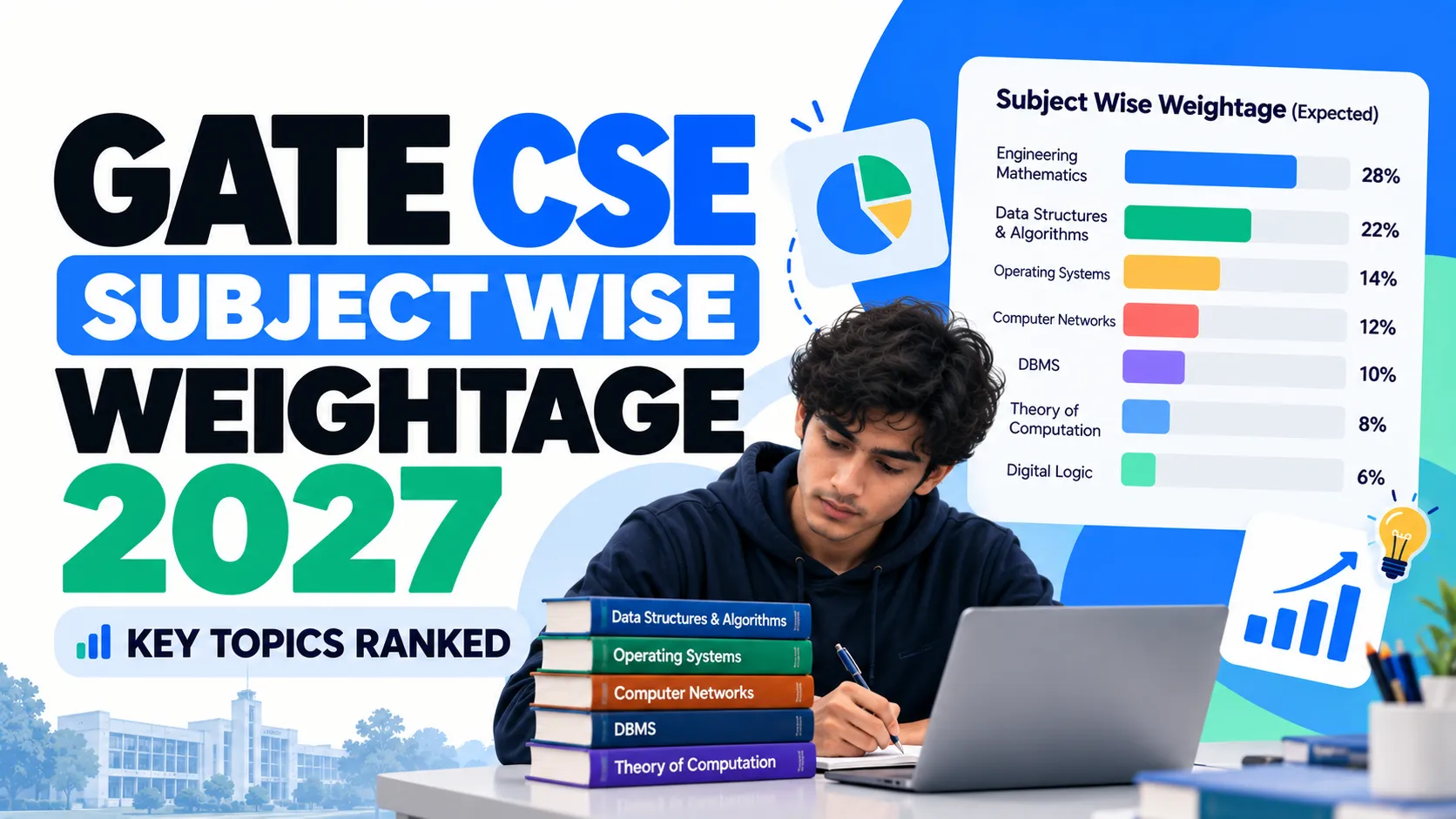
Here is the projected GATE CSE subject wise weightage 2027, derived from multi-year patterns and the trends visible in the GATE CSE subject wise weightage 2026 cycle.
| Subject Area | Typical Weightage (Marks) | Nature of Questions | Priority Tier |
|---|---|---|---|
| General Aptitude | 15 Marks | Analytical, Verbal, Spatial | Tier 1 (Non-negotiable) |
| Engineering & Discrete Mathematics | 13 – 15 Marks | Proof-based, Combinatorics, Linear Algebra | Tier 1 |
| Data Structures & Algorithms | 14 – 17 Marks | Tracing, Complexity, Dynamic Programming | Tier 1 |
| Operating Systems | 8 – 10 Marks | Concurrency, Memory Management, CPU Scheduling | Tier 2 |
| Computer Networks | 7 – 9 Marks | Subnetting, TCP flow/congestion, Routing | Tier 2 |
| Database Management Systems (DBMS) | 6 – 8 Marks | SQL/Relational Algebra, Normalization, Transactions | Tier 2 |
| Theory of Computation (TOC) | 7 – 9 Marks | Decidability, Regular Expressions, PDA/Turing | Tier 2 |
| Compiler Design | 4 – 5 Marks | Parsing (LL/LR), SDT, Liveness analysis | Tier 3 |
| Computer Organization & Architecture (COA) | 8 – 11 Marks | Cache mapping, Pipelining, Addressing modes | Tier 2 |
| Digital Logic | 4 – 6 Marks | Minimization, Counters, Number representations | Tier 3 |
Unpacking the Core: What IITs Truly Prioritize
When you analyze papers across different conducting institutes whether it is IIT Roorkee, IIT Kanpur, or IIT Kharagpur you notice that subject weights rarely drift wildly. What changes is the flavor of the questions.
To turn this GATE CSE subject wise weightage 2027 breakdown into a concrete study plan, look at how the subjects group conceptually.
1. The Foundation: Data Structures, Algorithms, and Discrete Math
If you look at the GATE CSE topic wise weightage across the last decade, this cluster alone decides whether you cross the 60-mark threshold.
Discrete Mathematics: Expect heavy emphasis on Combinatorics, Graph Theory, and Mathematical Logic. Questions here test structural reasoning. A question on planar graphs or recurrence relations will often cross paths with algorithm design.
Data Structures & C Programming: Pointer arithmetic, recursion trees, and binary search trees are constants. IITs love drafting multi-statement MSQs around tree traversals and pointer manipulation that look trivial until you trace edge cases.
Algorithms: Asymptotic notation, Divide & Conquer, Greedy approaches, and Dynamic Programming. Graph algorithms (Dijkstra’s, Bellman-Ford, Prim’s, Kruskal’s) appear almost every single session.
2. Systems Architecture: OS, COA, and Networks
This trio often separates top 500 ranks from the rest of the pack because these subjects demand both mathematical calculation and conceptual precision.
Operating Systems: Concurrency primitives (Semaphores, Mutex) and Virtual Memory (paging, TLB hit rates, inverted page tables) generate high-yield numerical answer type (NAT) questions.
Computer Organization (COA): Pipelining hazards, cache memory organization (direct vs. set-associative mapping, write-back vs. write-through), and memory cycle calculations dominate. The calculations are direct, but a single missed byte-addressable vs. word-addressable assumption ruins the answer.
Computer Networks: The IP addressing and subnetting segment is virtually guaranteed marks if your binary math is sharp. Beyond that, focus on TCP sliding window protocols (efficiency, throughput) and routing algorithms.
3. Formal Computing: TOC and Compiler Design
These two subjects should be studied as a continuous unit.
Theory of Computation: Decidability and closure properties require rigorous conceptual clarity. Do not rely on intuition here; construct formal counterexamples during your practice.
Compiler Design: This is arguably the highest return on investment in the entire syllabus. It carries roughly 4 to 6 marks, but the syllabus is compact. Master First & Follow sets, LR parsing tables, and Syntax Directed Translation (SDT), and you can secure full marks in this block in under two weeks of targeted study.
Lessons from the Recent GATE Season
The paper setting in recent cycles, especially looking back at the GATE CSE subject wise weightage 2026 trends, revealed two notable shifts you must prepare for in 2027:
The Rise of Cross-Disciplinary Questions: The boundary between Discrete Math and Algorithms, or between Operating Systems and COA, is increasingly porous. You might see a question asking for page fault overhead expressed as a recurrence relation, or a graph theory property embedded inside a networking topology problem.
MSQs Punishing Superficial Coverage: Multiple Select Questions (MSQs) do not carry negative marking, but they have zero partial credit. They are deliberately designed to catch candidates who rely on summary formula sheets instead of foundational textbook reading.
4 Costly Mistakes Aspirants Make with Subject Weightage
Relying on a GATE CS subject wise marks distribution table can backfire if you interpret it the wrong way. Keep these practical traps in mind:
Treating Lower-Weightage Subjects as "Optional": Skipping Compiler Design or Digital Logic because they are "only 4 to 5 marks" is a classic error. Those 5 marks are often much easier to solve than a 2-mark tricky problem in Algorithms.
Ignoring Aptitude Until the Final Month: 15 marks sit in General Aptitude. Spending 30 minutes every other day on verbal reasoning, basic quantitative aptitude, and spatial puzzles yields a higher safety net than grinding an extra week of advanced Turing reductions.
Memorizing Without Edge-Case Testing: Knowing how a set-associative cache works in theory does not help when an IIT problem inserts a write-miss condition with dirty bit handling. Always solve standard textbook exercises (Galvin for OS, Hamacher/Stallings for COA, Cormen for Algo) alongside previous years' questions (PYQs).
Over-indexing on Obscure Topics: Spending four weeks trying to master advanced NP-completeness proofs while your process synchronization and paging concepts remain shaky is poor strategy. Prioritize topics that show up every year with mathematical consistency.
Real Candidate Perspectives
"In my first attempt, I obsessed over algorithms and ignored Discrete Math because it felt dry. I ended up missing an IIT seat by six marks. The next year, I gave Combinatorics and Graph Theory the exact same study hours as Dynamic Programming. That balanced approach changed everything."
— Anurag M., M.Tech CSE, IIT Delhi
"I used to skip Compiler Design thinking 4 marks wouldn't hurt. But when you are sitting in the exam hall, those 4 marks from parsing tables are the fastest, most straightforward marks you will ever earn. They keep your composure steady."
— Sneha P., AIR 184 (GATE CSE)
Frequently Asked Questions
Which subject has the highest weightage in GATE CSE?
Historically, Algorithms & Data Structures (combined with C programming) and Engineering & Discrete Mathematics carry the highest weightage, consistently yielding between 28 and 32 marks combined.
How closely will the GATE CSE subject wise weightage 2027 follow previous years?
While exact mark values fluctuate slightly by 1 or 2 marks per subject depending on the organizing institute, the broad framework remains stable. Core systems, mathematical foundations, and data structures will always form the primary base of the paper.
Can I skip Computer Organization & Architecture if I find it too mathematical?
It is not advisable. COA typically carries 8 to 11 marks. Skipping it outright puts immense pressure on your performance in Operating Systems and Algorithms. If pressed for time, focus selectively on high-yield portions: Cache Memory, Pipelining hazards, and Machine Instructions.
How many marks are needed for a top 500 rank in GATE CSE?
The raw score varies depending on the paper difficulty, but historically, a normalized score of 62 to 68 marks often places a candidate safely within the top 500 bracket.
What is the most reliable way to practice the GATE CSE topic wise weightage?
Categorize the last 20 years of GATE questions by topic rather than solving them strictly as mixed mock papers early on. This allows you to recognize recurring structural patterns in topics like subnetting, cache mapping, and relational algebra before you test your timing under full-length exam pressure.
A syllabus this broad is conquered through consistency, not cramming. Take the GATE CSE subject wise weightage 2027 as your baseline compass, organize your schedule to build unshakeable fundamentals in the high yield pillars first, and treat every practice session as an audit of your core concepts.


























Sign in to leave a comment.