
Few things drain your momentum faster than spending months working through calculus problems, only to realize late in the application cycle that a clerical misstep or a misunderstanding of qualifying degree rules might jeopardize your registration.
If you are planning to sit for the examination, understanding the official gate eligibility criteria is just as critical as knowing the syllabus inside out. While the exam authorities have made participation more inclusive in recent years, candidates still fall into avoidable traps during portal registration every single cycle.
Here is an honest, practical breakdown of the gate eligibility criteria 2027, what has changed, and the common mistakes you need to steer clear of before you submit your application.

What Are the Official Requirements for GATE 2027?
The core framework for gate exam eligibility revolves around your current stage of higher education, your qualifying degree, and valid identity documentation.
Under the updated guidelines, you do not need to wait until your graduation day to attempt the paper. The gate 2027 eligibility criteria permit candidates in their pre-final or final year of undergraduate study, as well as those who have already completed their degrees, to sit for the exam.
Degree-Wise Eligibility Breakdown
- B.E. / B.Tech / B.Pharm: Candidates currently in their 3rd year or higher, or those who have already completed their 4-year degree (or 3 years post-diploma lateral entry).
- B.Sc. / B.Com / B.A. (3-Year Programs): Under the extended 10+2+3 pathway, students in their 3rd (final) year or graduates can appear.
- B.Arch / 4-Year B.S. (Research): Candidates in their 3rd year or higher, or graduates.
- M.Sc. / M.A. / MCA: Candidates in their 1st year, final year, or those who have already obtained their Master’s degree.
- Integrated Master’s / Dual Degree Programs (5 Years): Students currently in their 3rd, 4th, or 5th year, or those who have graduated.
- Professional Society Examinations (AMIE, AMICE): Candidates who have completed Section A or equivalent recognized qualifications.
Age Limit and Minimum Marks: Busting Persistent Myths
There are two misconceptions that resurface every registration season:
1. The Age Limit Myth
There is no upper or lower age limit specified in the gate eligibility criteria 2027. You can sit for the exam at 20, 28, or 40. However, keep your end goals distinct from exam entry: while the test itself has no age ceiling, individual Public Sector Undertakings (PSUs) recruiting via GATE scores enforce their own cutoff limits (typically between 26 and 30 years for unreserved categories).
2. The Minimum Percentage Myth
The organizing institute does not specify a minimum percentage or CGPA cutoff to register for the paper. As long as you have a passing status or are actively enrolled in an eligible year, you meet the gate exam eligibility.
With that said, institutional admissions (such as M.Tech programs at IITs or NITs) and PSU shortlists routinely enforce a baseline requirement—usually 60% aggregate marks or a 6.5 CGPA on a 10-point scale.
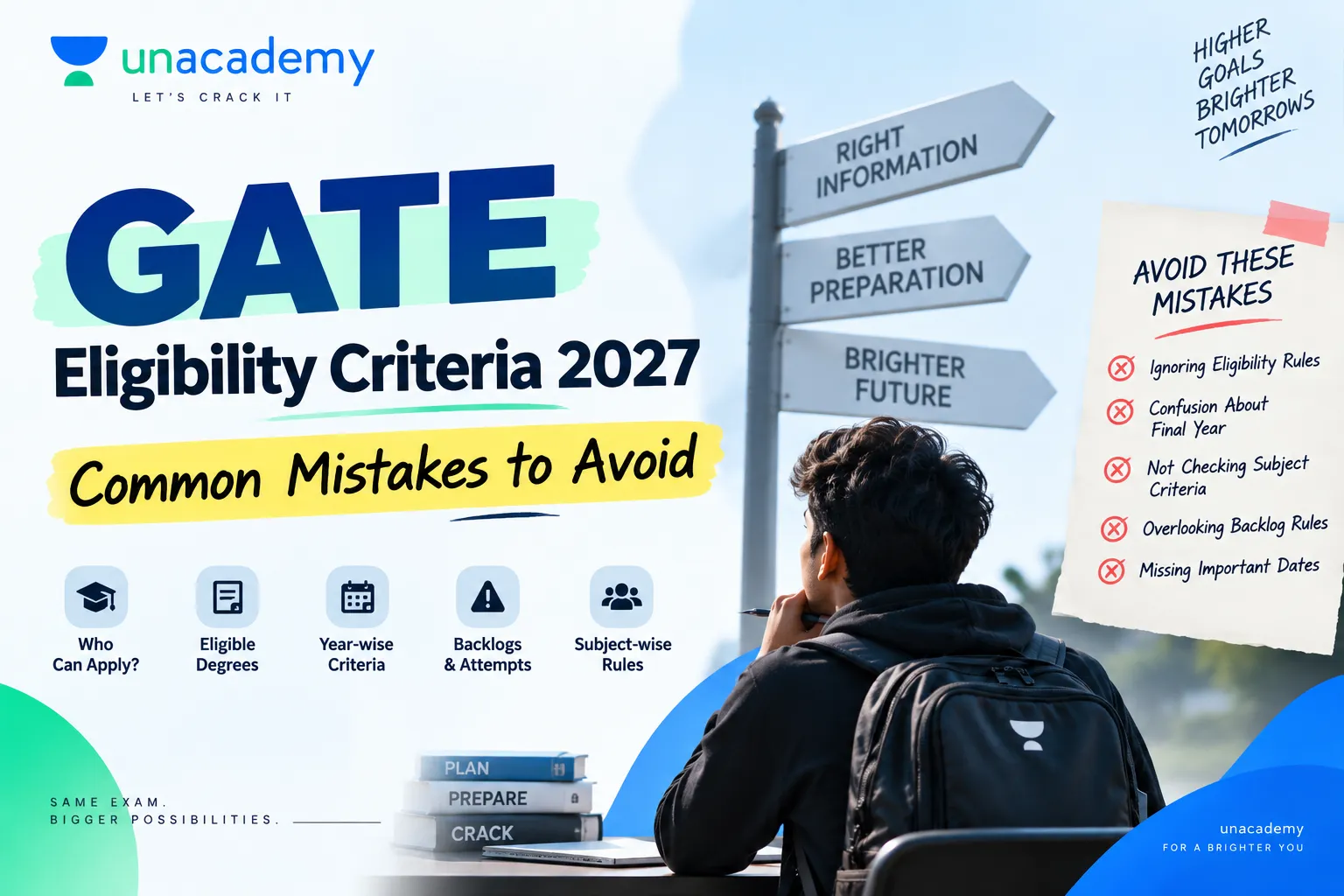
Common Mistakes to Avoid When Applying for GATE 2027
Even if you comfortably fit the academic requirements, errors during the application phase can cause application rejections or complications during post-exam document verification.
1. Confusing Pre-Final Year with 2nd-Year Status
The expansion allowing 3rd-year students to appear applies strictly to 4-year programs (or 3-year bachelor's final years). If you are in the 2nd year of a 4-year B.Tech program, you are not eligible yet. Registering prematurely using false academic years leads to application cancellation and forfeiture of fees.
2. Panicking Over Active Backlogs
One of the most frequent questions from candidates is whether an uncleared subject or an active backlog bars them from appearing. It does not. The gate 2027 eligibility criteria do not disqualify you for pending papers during application. What matters is that your backlogs are cleared and you possess your provisional or final degree certificate by the time actual institute admissions and seat allocations begin.
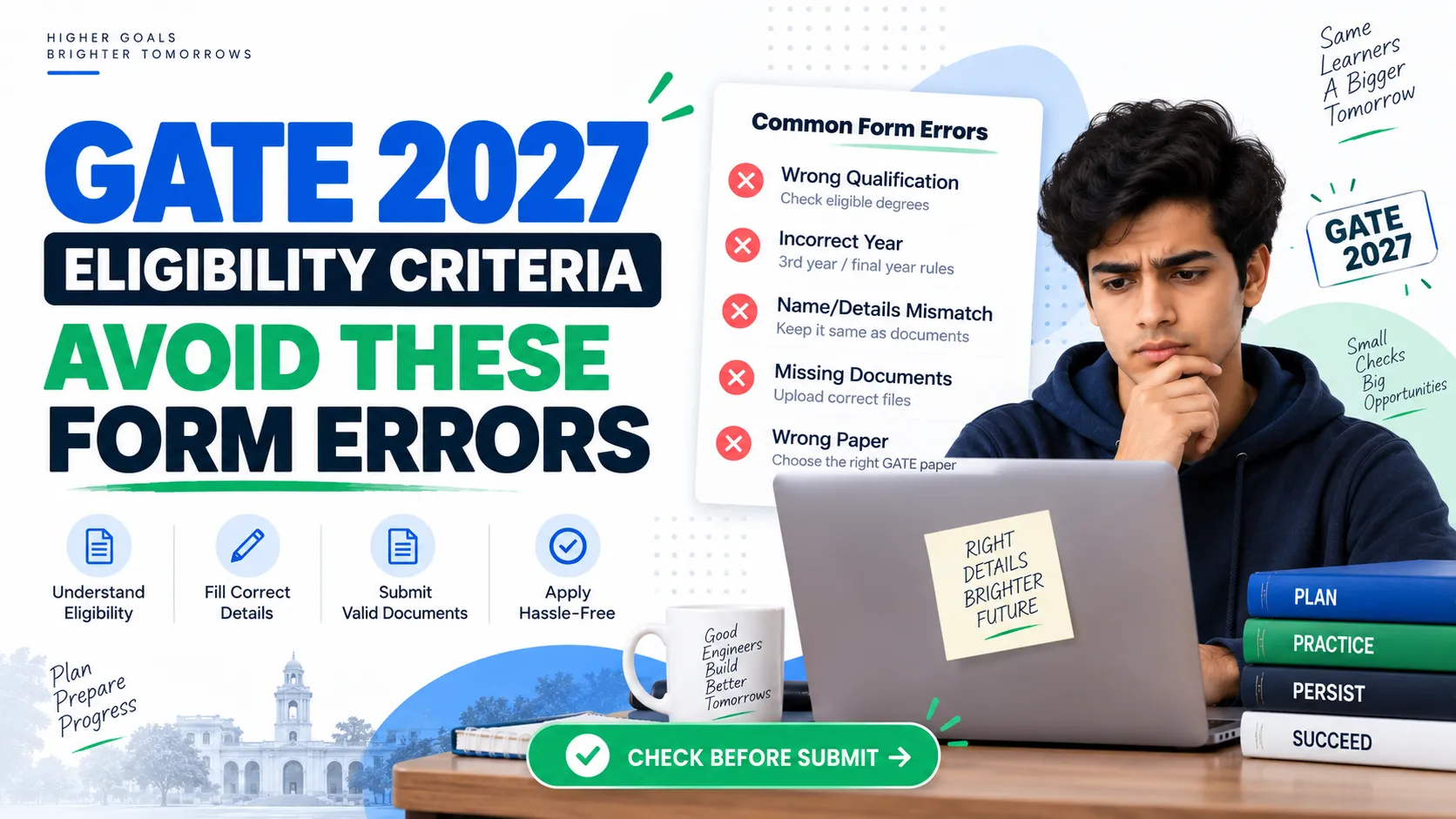
3. Uploading Expired Category or PwD Certificates
If you are applying under EWS, OBC-NCL, SC, ST, or PwD quotas, your certificates must follow the precise Central Government format and valid issuance dates specified in the official information brochure. An OBC certificate issued for state-level benefits or an outdated financial-year EWS certificate will be flagged during review, shifting your application to the General category.
4. Mismatch Between College Records and Photo ID
Ensure the name you enter in the registration portal matches your government photo identity document (Aadhaar card, Passport, PAN card, or Voter ID) character-for-character. Discrepancies between your photo ID, degree enrollment certificates, and application name create major headaches at the exam center gate.
5. Overlooking Lateral Entry Documentation
If you joined an engineering program directly in the second year via a Polytechnic Diploma, make sure your enrollment documentation clearly reflects the lateral entry status so the counting of your academic years aligns with the official portal guidelines.
Real Candidate Perspectives
"I sat for the exam in my third year of mechanical engineering while carrying a pending backlog from semester four. I was nervous my admit card would be withheld, but the process was completely straightforward. Treating it as a serious run without the pressure of placements helped me secure a top-500 rank the following year."
— Rohan M., IIT Roorkee M.Tech Scholar
"A lot of people in my B.Sc. batch assumed GATE was strictly for B.Tech students. When I looked closely at the updated gate eligibility criteria, I realized 3-year science graduates were welcome to take the Mathematics paper. That single step opened up direct interdisciplinary postgraduate admissions I previously thought were out of reach."
— Sneha P., Data Science Post-Graduate
Frequently Asked Questions
Can 3rd-year engineering students apply for GATE 2027?
Yes. Candidates enrolled in the 3rd year or higher of a 4-year undergraduate engineering program (B.E./B.Tech) satisfy the gate eligibility criteria and can register.
How many attempts are allowed under the GATE 2027 eligibility criteria?
There is no attempt limit. You can take the examination as many times as you choose, provided you satisfy the baseline educational prerequisites.
Is there an aggregate percentage cutoff required to sit for the exam?
No. There is no minimum aggregate percentage required simply to appear for the paper. Passing your qualifying examinations (or being on track to graduate) is sufficient for gate exam eligibility, though colleges and PSUs set their own criteria later.
Can I choose a different paper from my graduation branch?
Yes. You are free to select any test paper offered in the exam session, regardless of your undergraduate discipline. Many candidates with degrees in allied sciences or civil engineering opt to appear in computer science or data science papers based on their academic interests.
How long remains my GATE scorecard valid?
Your scorecard is valid for three years from the date results are announced for academic admissions to master's and doctoral programs. However, most recruiting PSUs consider only scores from the current recruitment cycle.
A successful exam attempt begins well before you sit down at the testing terminal. Taking an afternoon to verify your qualifying degree timeline, review the current gate 2027 eligibility criteria, and organize your institutional documents saves you from unnecessary stress later in the cycle, leaving you free to focus entirely on your preparation.























Sign in to leave a comment.