
You decide to take GATE, sit down with a syllabus, and start picking books. Then a sudden doubt derails your train of thought: “Can I sit for the exam in my 3rd year?” or “Does my backlog disqualify me?”
Every year, thousands of students lose sleep over qualifying norms, buried under official 40-page brochures filled with dense institutional legalese. Misinterpreting a single eligibility clause can lead to wasted months of prep or panic when the application window opens.
If you plan to appear for the exam organized by IIT Madras, you do not need to sift through convoluted circulars. Here is the straightforward, no-nonsense breakdown of the gate eligibility criteria 2027, explaining who can sit for the exam, what qualifications count, and where the actual boundaries lie.

Understanding the Core GATE Exam Eligibility: The Baseline Rules
At its heart, the official gate exam eligibility policy is far more inclusive than most competitive exams in India. The organizing IITs operate on a simple principle: if you have a foundational technical or scientific background, you should be allowed to test your aptitude.
The baseline gate eligibility criteria rest on three parameters
- Age Limit: There is absolutely no upper age limit. Whether you are 20, 28, or 40, you are welcome to apply.
Number of Attempts: You can attempt the paper as many times as you wish. There is no restriction on repeat attempts.
Nationality: While primarily designed for Indian nationals, foreign candidates and non-resident Indians (NRIs) who meet equivalent academic qualifications are fully eligible.
Degree-Wise Breakdown: Who Can Apply for GATE 2027?
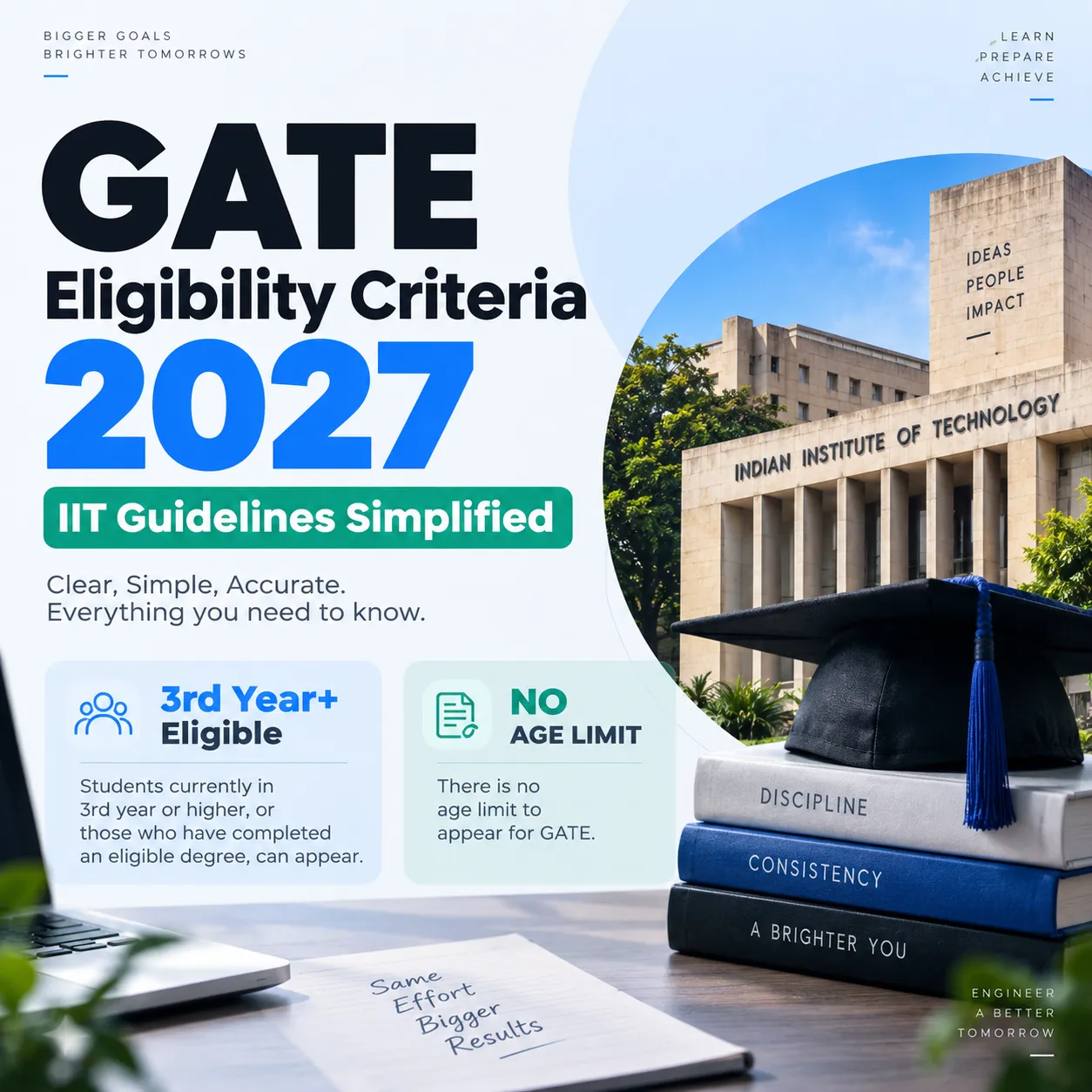
The official gate 2027 eligibility criteria mandate that an applicant must either have completed a recognized university degree or be currently enrolled in the 3rd year or higher of an approved undergraduate program.
| Degree / Program | Minimum Eligible Year / Status | Expected Graduation Year |
|---|---|---|
| B.E. / B.Tech. / B.Pharm. (4-year course) | 3rd year, 4th year, or already graduated | 2027 or 2028 |
| B.Arch. / Planning (4 or 5-year course) | 3rd year or higher, or already graduated | 2027, 2028, or 2029 |
| B.Sc. / B.A. / B.Com. (Standard 3-year degree) | 3rd (final) year or already graduated | 2027 or earlier |
| B.Sc. (Research) / B.S. (4-year course) | 3rd year or higher, or already graduated | 2027 or 2028 |
| M.Sc. / M.A. / MCA (or equivalent) | 1st year or higher, or already graduated | 2027 or earlier |
| Integrated M.E. / M.Tech. / Dual Degree (5-year) | 3rd, 4th, 5th year, or already graduated | 2027, 2028, or 2029 |
| Professional Society Exams (AMIE / ICE etc.) | Completed Section A or equivalent | Recognition rules apply |
(Note: If you have graduated with an MBBS, BDS, or BVSc degree or are in your 5th/6th/7th semester or higher, you also meet the criteria.)
The Pre-Final Year Advantage: Can 3rd-Year Students Appear?
Yes. If you are currently entering or studying in your 3rd year of B.E./B.Tech, you are officially qualified under the gate eligibility criteria 2027.
Appearing in your pre-final year offers distinct strategic advantages:
- Zero pressure test run: You experience the exact computer-based testing interface, pacing, and time crunch without your post-college placement resting entirely on the outcome.
Three-year scorecard validity: Your GATE score remains valid for admissions for three full years. A stellar score achieved in your 3rd year can secure your M.Tech seat or PSU application profile right out of college.
Diagnosing real blind spots: Standard mock tests rarely replicate the physical and mental fatigue of a 3-hour marathon in a secured test center.
Minimum Marks: Exam Eligibility vs. Admission Eligibility
This is the single biggest source of confusion among aspirants.
1. For Writing the GATE Exam
The organizing IIT sets no minimum percentage criteria to appear for the exam. Even if you secured 50% or a 5.2 CGPA in your university semesters, you can register, write the paper, and get a valid scorecard.
2. For M.Tech Admissions and PSU Recruitment
While IITs let you write the paper regardless of your graduation percentages, individual recruiting organizations and academic institutions enforce their own cutoffs
IITs & NITs (via COAP/CCMT): Most departments demand at least 60% aggregate marks (or a 6.5 CGPA) for General/OBC candidates, and 55% (or 6.0 CGPA) for SC/ST/PwD applicants.
Public Sector Undertakings (PSUs): Elite recruiters (such as ONGC, IOCL, and NTPC) typically enforce a strict 60% or 65% minimum marks criterion in the qualifying engineering degree.
Common Mistakes & Things You Should Know
When filling out your forms and confirming your eligibility, watch out for these easily avoided oversights:
Confusing Backlogs with Disqualification: Having active backlogs during college does not stop you from appearing for GATE. As long as you submit valid bonafide documentation or your current mark sheet from your college, you are eligible to sit. You just need to clear all backlogs before formal admissions or PSU document verification.
The DigiLocker / Aadhaar Name Discrepancy: The registration system relies heavily on verified national digital identity protocols. Ensure your full name on your photo ID matches the name printed on your university mark sheet down to the initial.
Mismatch in Degree Specialization vs. GATE Paper: You are free to write any paper you want. A mechanical engineering student can sit for Computer Science (CS) or Data Science & AI (DA), or choose the allowed two-paper combination. However, verify beforehand whether your target IIT department accepts that paper for the specific master's course you want.
Reader Experiences: Practical Perspectives
"I was hesitant about appearing in my 6th semester because people told me it would distract from my semester projects. Looking back, registering for GATE in my 3rd year was the best decision I made. It took the fear out of the exam environment, and that score ended up securing my direct admission offer before my final year was even complete."
— Tanmay S., M.Tech Microelectronics, IIT Bombay
"I switched from Mechanical to Data Science and was anxious whether the committee would accept my educational credentials. The registration went through smoothly without a hiccup. The exam eligibility is remarkably flexible; the only real homework you must do is confirming whether your prospective university department permits interdisciplinary transitions."
— Rhea N., GATE Aspirant
Frequently Asked Questions (FAQ)
1. What are the key educational requirements under the gate eligibility criteria?
Under the official gate eligibility criteria, candidates must either have completed a government-approved degree in engineering, technology, architecture, science, commerce, or humanities, or currently be enrolled in the 3rd year or higher of an undergraduate degree program.
2. Is there any age limit specified under the gate exam eligibility guidelines?
No. The official gate exam eligibility rules do not mandate an upper or lower age limit. Candidates of any age who hold or are pursuing the qualifying degree may sit for the test.
3. How does the gate eligibility criteria 2027 treat students with existing backlogs?
Students with active academic backlogs are still eligible to sit for GATE 2027. You must provide an institutional bonafide certificate or your latest year's mark sheet to prove enrollment. However, all backlogs must be resolved before taking admission into an M.Tech program or joining a PSU.
4. Can students pursuing a 3-year B.Sc., B.A., or B.Com. program register?
Yes. Students in the 3rd year or who have graduated from a 3-year undergraduate course in Science, Arts, or Commerce are eligible under the gate 2027 eligibility criteria. Keep in mind that certain specialized M.Tech programs may still require an additional Master's degree (like M.Sc.) for admissions.
5. Do I need a minimum 60% mark in college to satisfy the gate 2027 eligibility criteria?
No, there is no minimum percentage requirement to take the examination. You only need to pass your qualifying degree courses. Percentage requirements (usually 60% or 6.5 CGPA) only come into play later during institute admissions or PSU recruitment shortlisting.
Conclusion
Figuring out the gate eligibility criteria 2027 boils down to a reassuring truth: the organizing committee wants the doors open wide. If you are at least in your third year of college or hold a recognized bachelor’s or master’s degree, you are cleared to sit for the paper.
Once you confirm your enrollment status and keep your identification documents aligned, you can put the paperwork anxiety behind you. Focus your mental energy where it actually counts: building conceptual clarity, staying consistent with your daily practice problems, and mastering the subject syllabus.

























Sign in to leave a comment.