

GATE Eligibility Criteria: The Fine Print Most Aspirants Miss
If you are planning to crack the Graduate Aptitude Test in Engineering, you have probably spent weeks downloading previous year question papers, comparing test series, and bookmarking subject playlists. But there is an uncomfortable scenario that plays out every year: an aspirant works hard for months, scores an enviable rank, and then realizes during counseling or PSU recruitment that a small eligibility clause disqualifies them on the spot.
Official notification brochures run 40 to 50 pages long. Most candidates glance at the degree table, confirm their branch name is somewhere on the list, and assume they are in the clear.
Understanding the actual gate eligibility criteria requires reading between the lines especially if you are planning your timeline around the gate eligibility criteria 2027 or dealing with academic anomalies like backlogs, lateral entries, or open-university degrees.
Here is what the brochures say, what they actually mean in practice, and where most aspirants get caught off guard.

The Core Baseline: Degree, Age, and Attempts
The baseline rules established by the organizing IITs are remarkably accommodating on paper:
- Age Limit: None. There is no minimum or maximum age ceiling to take the test.
Attempt Restrictions: Unlimited. You can sit for the exam as many times as you want.
- Minimum Pass Percentage for the Exam: Zero. The GATE organizing committee does not demand a 60% aggregate or a 6.5 CGPA just to download an admit card and write the test. As long as you are enrolled in or have graduated from an eligible program, you can register.
Where candidates run into trouble is not this baseline gate exam eligibility, but the specific boundary conditions that apply to your college status, backlog clearance, and post-exam admissions.
1. The Pre-Final Year Catch (The "Safety Attempt" Myth)
Since IIT Bombay opened the exam to third-year undergraduate students, writing the test in your pre-final year has become a popular trial run. For students targeting the gate 2027 eligibility criteria, being in the 3rd year or higher of a 4 year undergraduate course (or 3rd year of a 3 year degree like B.Sc./BCA) makes you fully eligible to appear.
Where people miss the rule:
While your score card remains valid for three years, you cannot use that pre-final score to secure early admission to an M. Tech program while your undergraduate degree remains incomplete. You must produce a completed degree certificate or provisional degree by the cutoff date specified by CCMT/COAP during the actual admission year.
More critically: PSUs generally do not honor scores from pre-final year attempts for recruitment. Most public sector enterprises explicitly state in their vacancy notifications that candidates must have completed their degree in the corresponding passing cycle. Treating your third-year attempt as an automatic ticket to an executive trainee post can lead to bitter disappointment.
2. The Backlog Dilemma: Can You Still Sit for the Exam?
One of the most persistent anxieties in engineering colleges is whether active backlogs disqualify you from the gate exam eligibility pool.
The short answer is no, backlogs do not bar you from writing the exam.
If you are currently in your 3rd or 4th year and carrying an uncleared paper from a prior semester, the GATE committee still allows you to register and sit for the exam. You only need to upload an endorsement certificate from your college principal or head of department confirming your current enrollment status.
The fine print you cannot afford to ignore:
If you have graduated meaning your 4 years are officially over but you have an uncleared backlog, you cannot submit a provisional degree certificate. You must submit your latest available marksheet.
Furthermore, if you clear GATE with flying colors, no IIT, NIT, or PSU will finalize your seat if your qualifying backlog remains uncleared by their admission verification deadline (usually July September of the admission year). Passing the exam does not give you immunity from your home university’s graduation requirements.
3. Exam Eligibility vs. Admission Eligibility: The Critical Disconnect
This is the single biggest trap in the entire GATE ecosystem.
Meeting the official gate eligibility criteria means you have permission to sit in the examination hall. It guarantees absolutely nothing about your eligibility for:
- MTech/M.S. Admissions (COAP / CCMT): While GATE has no minimum percentage requirement, institutes like IIT Madras, IISc Bangalore, and the NITs set their own cutoff percentages (frequently 60% aggregate or 6.5 CGPA on a 10-point scale for General/OBC, and 55% or 6.0 CGPA for SC/ST/PwD).
- PSU Shortlisting: Companies like ONGC, IOCL, NTPC, and NPCIL routinely mandate a minimum first-class degree (typically 60% or 65% aggregate) strictly without grade rounding. A 59.9% is an outright rejection, regardless of whether your GATE AIR is inside the top 50.
Always verify the academic qualification criteria of your ultimate target institute or PSU, not just the GATE portal guidelines.
4. Lateral Entry, Distance Education, and Non-Traditional Degrees
If your academic journey did not follow the straight 10+2 into a 4-year B. Tech path, pay close attention to how the gate 2027 eligibility criteria treat non-standard qualifications:
Diploma to Degree (Lateral Entry): If you completed a 3-year polytechnic diploma and entered directly into the 2nd year of B. Tech, you are eligible once you reach your 3rd year (5th semester) of engineering. Keep your diploma certificates handy, as admission authorities cross-verify the 10+3+3 continuum.
- Distance Learning & Open Universities: Degrees obtained through open and distance learning (ODL) are valid only if the program and university hold explicit approval from the Distance Education Bureau (UGC-DEB) and AICTE during your study period. Degrees from unrecognized distance programs are rejected outright during document verification.
Professional Societies (AMIE, AeSI, IETE): If you are clearing examinations from professional bodies, the Ministry of Education has strict timeline restrictions regarding equivalence recognition. Candidates enrolled with these bodies after specific cut-off dates may face validity disputes in court and counseling portals.
Real Candidate Perspectives
"I cleared GATE in my 3rd year with a rank under 600 in Mechanical. I assumed I could use that score card to apply for PSU openings right after passing out. It wasn't until I read an IOCL notification in my 8th semester that I realized they only accepted scores from the year of graduation. My score got me into an IIT, but my PSU dream required writing the test again in my final year."
— Rohan K., M.Tech Scholar, IIT Roorkee
"I carried two backlogs in my 6th semester and almost didn't register for GATE because friends said backlogs make you ineligible. My professor corrected me: you can sit for the exam, but you must clear the subjects before the July admission verification. That push saved my year—I cleared my backlogs in the supplementary exams and joined an NIT that autumn."
— Ananya S., Structural Engineer
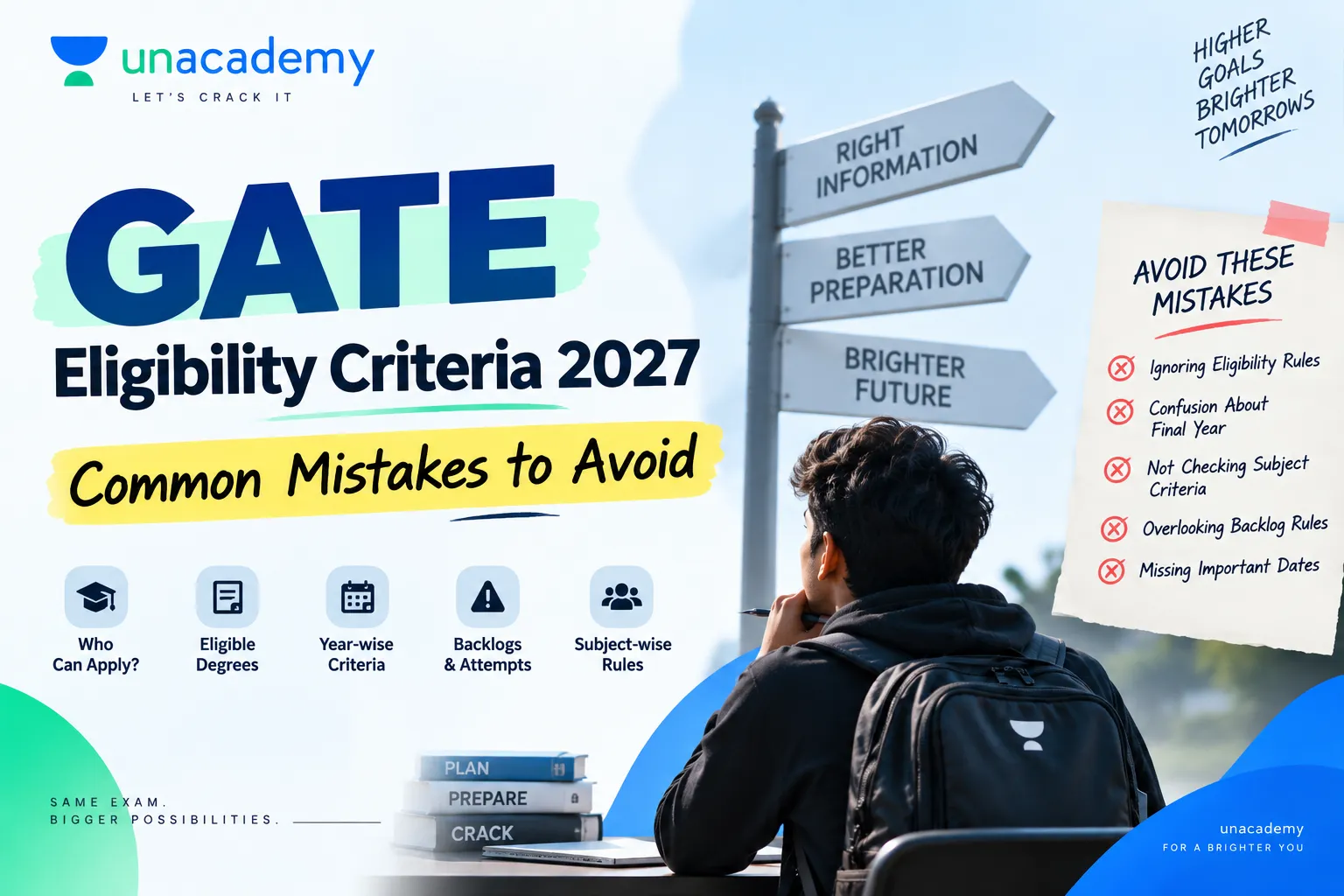
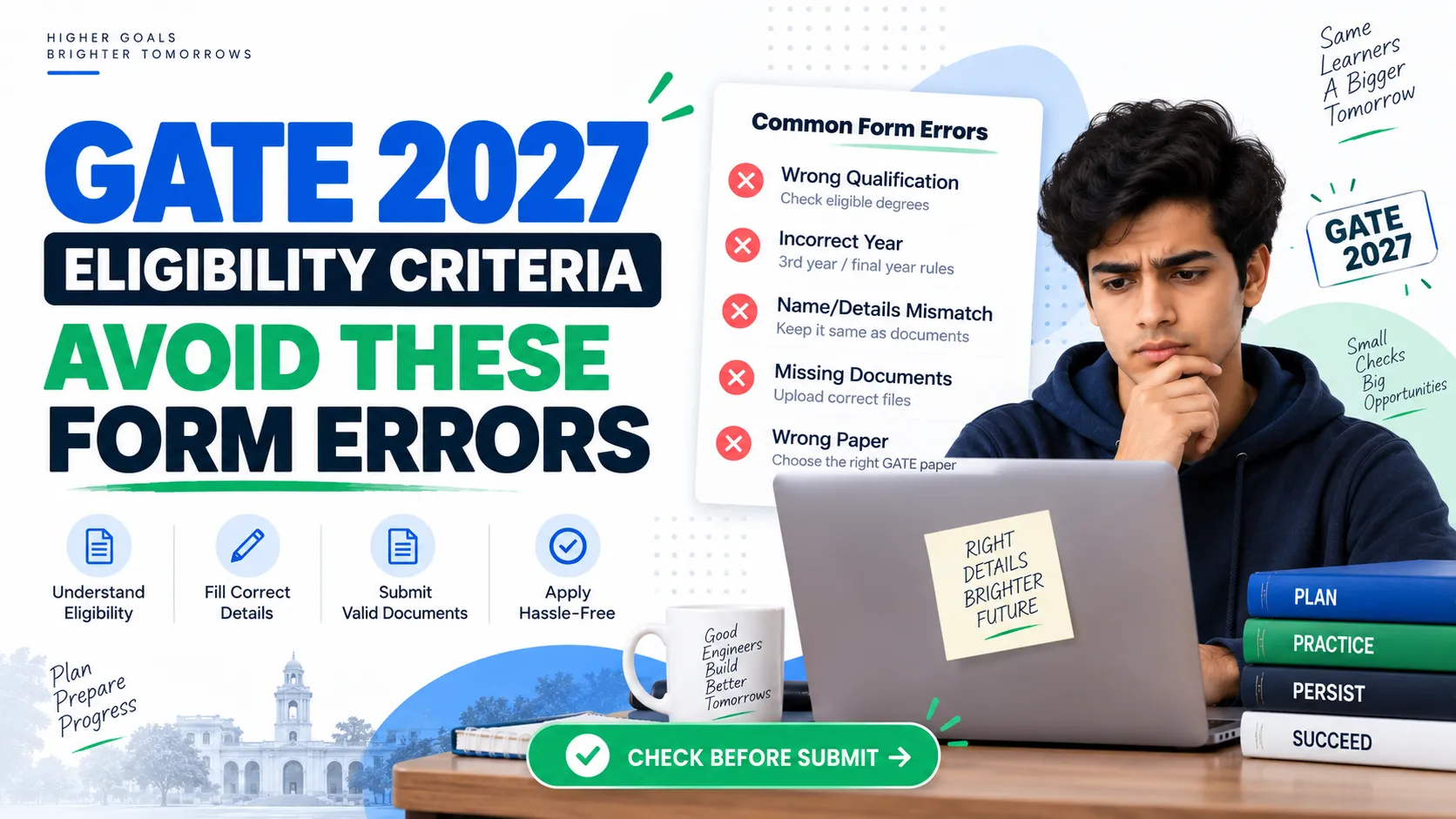
Common Mistakes Aspirants Make with GATE Eligibility
- Confusing the two-paper combination rule: GATE allows you to write up to two papers, but you cannot pick any random pair. You must choose strictly from the approved primary-secondary combinations published in the brochure.
Mismatched names on ID proofs: The name on your application must match your photo identity card (Aadhaar, Passport, or Voter ID) down to the spelling and spacing. Discrepancies at the exam center can cause verification delays or refusal of entry.
- Assuming category certificate formats are standard: Central institutes require OBC-NCL and EWS certificates issued in the specific Government of India format for the financial year of admission, not arbitrary state-level certificates.
Ignoring the final-year marksheet submission window: If you apply as a final-year candidate, your admission remains provisional until your degree certificate is submitted. Missing the university's final deadline results in seat cancellation with zero fee refund.
Frequently Asked Questions
Can a student with active backlogs register for the GATE exam?
Yes. You can register and write the exam even with active backlogs. However, to take admission into an M.Tech program or join a PSU, you must clear all backlogs and provide proof of passing by the reporting deadline set by the respective institution.
What is the age limit under the GATE eligibility criteria 2027?
There is no age limit. Anyone who satisfies the educational qualification can register, regardless of age.
Are 3-year B.Sc. or BCA students eligible under the latest GATE rules?
Yes. Students in the 3rd year or those who have already completed any government-approved 3-year undergraduate degree in Science, Arts, Commerce, or Computer Applications are eligible to apply.
Is there a minimum graduation percentage required to appear for GATE?
No. The official gate exam eligibility rules do not mandate a minimum aggregate percentage to sit for the test. However, IITs, NITs, and PSUs enforce their own percentage minimums (typically 60% or 6.5 CGPA) during counseling and hiring.
Can I change my paper combination after submitting the application?
Organizing institutes open a short correction window after registrations close. During this window, you can change your paper or add a second allowed paper by paying the prescribed administrative fee.
A Grounded Next Step
Navigating the gate eligibility criteria is fundamentally about protecting the effort you put into your preparation. The exam is demanding enough on its own; running into an administrative barrier after scoring well is a setback you can avoid entirely by checking the details early.
Before registering for the gate eligibility criteria 2027 cycle, take thirty minutes to look at the programs and organizations you ultimately want to join. Check their specific minimum percentage thresholds, verify that your degree documentation is up to date, and ensure your university deadlines align with the admission calendar. Once the logistics are settled, you can turn your attention entirely to the syllabus.

























Sign in to leave a comment.