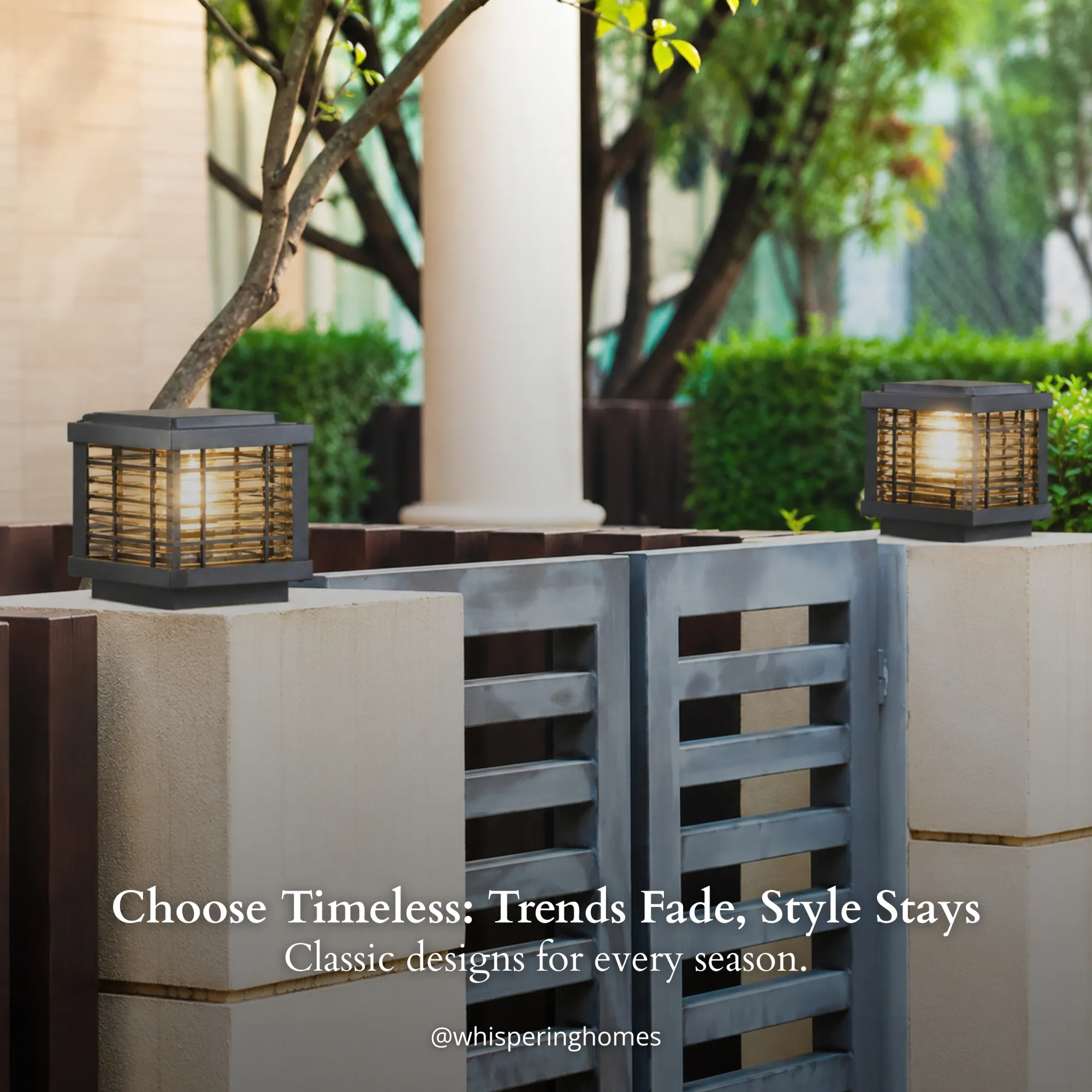

Outdoor gate lights are lights mounted on or beside your gate, pillars or fence posts. They make your entrance visible, safe and welcoming after dark. The best modern options are LED or solar-powered, rated for heavy rain, and set to a warm, glare-free colour.
Your gate is the first thing visitors see and the last thing you check at night. A well-chosen light makes it easy to find the latch, spot the driveway edge, and read the house number. It also tells anyone passing by that the property is looked after.
Why choose eco-friendly gate lights? Traditional outdoor lighting can run all night, every night, for years. That adds up in electricity use and in bulbs sent to landfill. Eco-friendly gate lights solve both problems. LED fixtures use far less power, and solar models use none from the grid. Residential LEDs, especially ENERGY STAR rated products, use at least 75% less energy and last up to 25 times longer than incandescent lighting. A gate light that rarely needs replacing means fewer trips to the shop, less waste and lower running costs.
Going green does not mean giving up performance or style. Today's sustainable gate lights come in modern, traditional and minimalist designs. Many have dusk-to-dawn sensors, motion detection or dimming, so they only shine as brightly as you need. This guide covers how to pick the right type, brightness, colour and weather protection, and how to install and maintain your lights so they last.
What Are the Best Gate Lights for Outdoor Use?
The best gate lights for outdoor use are weatherproof LED pillar or post lights, chosen for your gate's exposure to weather and your need for reliability. Solar suits sunny, decorative spots. Hardwired or low-voltage suits driveways and security.
Here are the main types.
Gate pillar lights sit on top of brick, stone or concrete pillars. They spread light in all directions and give the entrance a finished look. They are the classic choice for driveways and main gates.
Wall-mounted gate lights attach to the side of a pillar or wall. They work well where there is no flat top surface, or where you want light aimed downward to reduce glare.
Post and fence lights fit onto timber or metal posts. They suit garden gates and side entrances.
Floodlights cast a wide, bright beam. Floodlights give strong visibility and add security, because burglars tend to avoid well-lit yards, though they often must be hardwired. They work best as a supplement, aimed at the driveway rather than at neighbours' windows.
Lantern-style Wall lights add a traditional look. They pair well with period homes, wooden gates and cottage gardens.
Whichever style you like, look for LED technology, a suitable IP rating (covered below) and sturdy materials such as die-cast aluminium, stainless steel or solid brass.
Solar vs Hardwired Gate Lights: Which Should You Choose?
Choose solar gate lights when wiring is difficult and the gate gets several hours of direct sun. Choose hardwired or low-voltage lights when you need bright, dependable light every night, such as at a driveway or security entrance.
Solar lights are a popular eco-friendly choice because they use energy from the sun and need no wiring. That makes them easy to fit on a gate pillar far from a power outlet. The trade-off is dependence on weather. Solar pathway lighting is quick to install and budget-friendly, but it relies heavily on sunlight, which can be a problem on cloudy days. The same applies to gate lights, especially in winter or if a tree shades the pillar.
Hardwired lighting is the opposite. It provides a consistent power source, making it more reliable for driveways, patios and security lighting around entrances. It also works with timers, switches and smart controls. The downsides are installation cost and the need for a qualified electrician. Local electrical codes apply, so hiring a qualified electrician is advisable for hardwired outdoor lights.
Low-voltage systems sit in between. A transformer plugs into an outdoor outlet and feeds cables to your lights. These systems deliver steady illumination regardless of sun exposure, which is why they are popular for frequently used walkways.
| Factor | Solar | Low-voltage | Hardwired (mains) |
| Running cost | None | Low | Low (with LED) |
| Installation | Easy, no wiring | Moderate, DIY-friendly | Electrician advised |
| Reliability | Depends on sun | Steady | Steady |
| Brightness | Modest to medium | Medium | Medium to high |
| Best for | Garden gates, decorative light | Front gates, paths | Driveways, security |
| Eco impact | Lowest energy use | Low | Low with LED |
Our view: If your gate gets good sun and you mainly want a welcoming glow, go solar. If the gate is your main entrance and you need light every night, use low-voltage or hardwired LED, and add a dusk-to-dawn sensor to save energy.
How Bright Should Gate Lights Be?
Most gate pillar lights need about 100 to 400 lumens per fixture for a welcoming glow. Security or driveway areas may need 400 lumens or more. Choose by lumens (light output), not watts (power use).
Lumens, not wattage, indicate brightness: more lumens means a brighter light. These are practical starting points based on common lighting practice:
- Decorative glow on pillars: roughly 50 to 200 lumens each.
- Visibility around the gate and latch: roughly 200 to 400 lumens.
- Driveway or security area: 400 lumens or more, ideally with a motion sensor.
More is not always better. Very bright, unshielded lights cause glare, disturb neighbours and waste energy. A shielded or downward-facing fixture puts light where you need it. If a light is dimmable or has adjustable modes, you can set a soft level for evenings and a brighter one when someone approaches.
Exact needs vary with pillar height, distance from the house and surrounding street lighting, so treat these ranges as a guide and check the product's stated lumen output.
What Colour Temperature Is Best for Gate Lights?
Warm white light between 2700K and 3000K is best for most gate lights. It looks inviting and flatters brick, stone and timber. Cooler light above 4000K feels sharper and suits security-focused areas.
Warmer light around 2700K to 3000K creates a welcoming, cosy environment, while cooler light above 4000K gives a more contemporary feel. Another guide notes that warm white (2700K-3000K) offers a welcoming ambiance, while cool white (4000K-5000K) can feel more sterile and secure.
For a home entrance, warm white is usually the better choice. It is gentler on the eyes and less likely to look harsh against your house. If you want a security floodlight aimed at the driveway, a neutral or cool white can make details easier to see. Try not to mix very different colour temperatures on the same gate, as the mismatch looks untidy.
Also check the colour rendering index (CRI). A higher CRI, ideally 80 or above, shows the true colours of your gate, plants and vehicles.
What IP Rating Do Outdoor Gate Lights Need?
Outdoor gate lights should be at least IP44. For gates fully exposed to rain, wind and hose spray, IP65 is the safer choice.
An IP (Ingress Protection) rating has two digits. The first shows protection against dust and solid objects, and the second shows protection against water. The first digit indicates protection against solids and the second indicates protection against water.
Here is what the common ratings mean for a gate:
- IP44: Protected against solid bodies larger than 1mm and water spray from all directions. It suits sheltered spots, such as a gate under a porch or canopy.
- IP54: Better dust protection and still splash-proof. It works in semi-covered areas.
- IP65: Totally dust tight and protected against low-pressure water jets from any direction. This is the sensible standard for open gates and pillars.
- IP67: Handles temporary immersion, so it suits flood-prone or very wet spots.
One guide says IP44 is the minimum for all outdoor lights, while IP65 is advised for permanent installations. Another recommends IP65 for fully exposed areas and IP44 or IP54 for sheltered ones.
A gate pillar usually faces the weather head-on, so we suggest IP65. If you live near the coast, choose corrosion-resistant materials such as marine-grade stainless steel, powder-coated aluminium or solid brass. Salt air attacks cheaper metals quickly.
Also remember that many solar lights have a lower rating than mains-powered ones. Check the product specification before you buy, and do not rely on a general "outdoor" label.
How Do LED Gate Lights Save Energy and Help the Environment?
LED gate lights save energy because they turn more electricity into light and less into heat. They also last far longer than older bulbs, so fewer products are made, shipped and thrown away.
The savings are well documented. Residential LEDs use at least 75% less energy than incandescent lighting and last 25 times longer. Incandescent bulbs release about 90% of their energy as heat, while LEDs emit very little. A gate light may run for 8 to 12 hours a night, so that efficiency matters.
Longevity is an environmental benefit too. Many LED fixtures are rated for tens of thousands of hours. At about 10 hours a night, a 50,000-hour rating would last more than a decade, though real life depends on build quality and weather. LEDs also contain no mercury, unlike compact fluorescent bulbs. To make your gate lighting greener still:
- Use a dusk-to-dawn sensor so lights switch on only when it is dark.
- Add a timer or dimmer to lower the output late at night.
- Fit a motion sensor on driveway lights so full brightness is used only when needed.
- Choose shielded, downward-facing fixtures to reduce light pollution and protect night-time wildlife.
- Pick durable materials so you replace fixtures rarely.
If you are switching from older halogen or incandescent fittings, replacing them with quality LEDs is one of the simplest ways to cut your outdoor energy use.
How Do You Install Gate Lights?
Solar lights can be fixed with screws or adhesive in minutes. Low-voltage lights are usually DIY-friendly. Hardwired mains lights should be installed by a qualified electrician.
Solar gate lights. Position the solar panel where it gets direct sun for most of the day. Check for shade from trees, walls or the gate itself. Charge the battery fully before first use if the instructions say so.
Low-voltage lights. Plan the cable route, mount the fixtures, connect them to the transformer and plug it into a weatherproof outdoor socket. Keep cable joints protected from moisture.
Hardwired lights. For more complex systems, such as hardwired floodlights, hiring a professional electrician is advisable. They can also advise on wiring, protection devices and where each light should go. Electrical rules differ by country, so always follow local regulations.
Some practical placement tips:
- Mount pillar lights at the same height on both sides for a balanced look.
- Aim lights so they light the gate and path, not the eyes of drivers or neighbours.
- Avoid placing lights where branches will block the beam.
- Keep sensors clear of anything that could trigger them falsely, such as swaying plants.
How Do You Maintain Outdoor Gate Lights?
A few minutes of care each season keeps gate lights bright and extends their life.
- Wipe the lens with a damp cloth to remove dust, pollen and bird droppings.
- Clean solar panels so they charge efficiently.
- Check seals and gaskets for cracks, especially after winter.
- Tighten fixings on pillars that are exposed to wind or vibration from the gate.
- Test sensors and timers when the clocks change.
- Replace rechargeable batteries in solar lights when they stop holding a charge.
If a fixture fills with condensation or shows rust on the contacts, replace it rather than trying to dry it out. Water inside an electrical fitting is a safety risk.
How Much Do Outdoor Gate Lights Cost?
Prices vary widely. Basic solar pillar lights are the cheapest to buy and run. Quality LED pillar lights cost more upfront but repay you through lower energy use and longer life. Professionally installed hardwired systems have the highest initial cost.
When comparing options, think about the total cost over several years, not only the shelf price. A cheap fitting that fails in two winters is not a bargain. Look for a solid warranty, a stated IP rating and clear specifications for lumens, colour temperature and materials. Prices change often, so check current listings before you decide.
Frequently Asked Questions About Gate Lights Outdoor
Do solar gate lights work on cloudy days?
Yes, but with reduced output. Solar panels still collect some light in overcast weather, but batteries charge more slowly and lights may dim or switch off early. In areas with long, dark winters, low-voltage or hardwired lights are more reliable.
What is the best light for a gate pillar?
A weatherproof LED pillar light in warm white, with an IP65 rating and a durable metal body, suits most homes. Choose solar for sunny, decorative use and mains or low-voltage for main entrances.
Are LED gate lights worth the extra cost?
Usually, yes. LEDs use far less power and last much longer than older bulbs, so the higher purchase price tends to be recovered over time.
Can I leave gate lights on all night?
You can, but it wastes energy. A dusk-to-dawn sensor, timer or motion sensor is more efficient and reduces light pollution.
How high should I mount gate lights?
Pillar lights sit on top of the pillar. For wall or post lights, mounting around eye level or slightly above helps avoid glare while lighting the gate area. Adjust to suit your gate design.
Do gate lights improve security?
Good lighting can deter opportunistic intruders and helps you see who is at the gate. It works best alongside other measures such as locks, cameras and sensible landscaping.
Do I need an electrician?
For solar and plug-in low-voltage lights, usually not. For mains-wired lights, yes. A qualified electrician keeps the installation safe and compliant.
Final Thoughts: Light Your Gate the Smart Way
Great gate lighting balances five things: the right type, enough brightness, a welcoming colour, proper weather protection and low energy use. Start by deciding whether your gate suits solar or needs steady power. Choose warm white LEDs with an IP65 rating for open, exposed gates. Add sensors or timers so light is used only when needed.
An eco-friendly choice pays off in several ways. You lower your electricity use, replace fixtures less often and give your entrance a safer, more attractive look. Browse our range of outdoor gate lights, or contact our team if you would like help matching a fixture to your gate.


























Sign in to leave a comment.