
GCSE mock exams are the practice papers your school sits you down for in Year 10 and Year 11, and although they never appear on your final certificate, they shape almost everything around it: your predicted grades, your sixth form or college offer, your tier of entry, and how calm you feel walking into the real papers in May.
This guide explains what mocks really are, how teachers mark them, whether they genuinely count, and how to build a GCSE exam preparation routine in the six to eight weeks before the papers land. It also covers the part most students skip: what to do with the results once you get them back.
What Are GCSE Mock Exams and Why Do Schools Run Them?
Quick answer: A mock is a full practice exam set by your school under real exam conditions. It uses a past paper, a specimen paper, or a secure practice paper from the exam board. Mocks are not marked by the board and do not count towards your final grade, but they are used to set predicted grades and decide on interventions.
Your school chooses the paper, the date, and the marking. Some schools run one round a year, others run three. Whichever pattern yours follows, the purpose is the same:
- Give teachers a reliable signal of who is on track
- Give students genuine experience of silence, timing, and invigilators
- Produce the evidence schools need for predicted grades and support plans
Which Exam Boards and Subjects Are Involved
Most UK and international schools set mocks from AQA or Edexcel past papers, especially in the sciences and maths. If you are studying Chemistry, Physics, Biology or Maths at GCSE, IGCSE or O Level, the mock paper in front of you is almost always built from one of those two boards' question banks, which is exactly why practising with board specific past questions matters more than generic worksheets.
How a Mock Differs From the Real Thing
The paper looks identical, but three things are different. The marking is done by your own teachers rather than trained examiners. The grade boundaries are estimates rather than national figures. And the stakes are lower, which is precisely why a mock is the safest place to make your mistakes.
How Mocks Are Marked and Graded
Your teachers mark the papers, normally against the official mark scheme. A single teacher may be working through 60 or 70 scripts in a fortnight alongside full time teaching, so feedback speed and consistency vary between subjects.
Once marked, the raw score is converted into a grade using a boundary borrowed from last year's real exam or set by the school's own judgement.
Why Grade Boundaries on Mocks Are Only an Estimate
Because the whole national cohort has not sat the paper, boundaries cannot be calculated properly. If you finished one or two marks below a grade 6, that does not mean a grade 6 is out of reach in the summer. Treat the number as a direction of travel, not a verdict.
Do Mock Results Actually Count?
They do not appear on your certificate, but they influence three things that do.
1. Predicted Grades
Predicted grades are what your school reports to sixth forms and colleges. They draw on classwork, homework and teacher judgement, but mock scores usually carry the most weight because they are the closest simulation of the real exam.
2. Sixth Form and College Applications
A typical conditional offer asks for five GCSEs at grade 4 or above including English and maths, with grade 6 or 7 in the subjects you want to study at A Level. Selective science and further maths programmes often ask to see mock papers directly.
3. Tiering and Intervention
In Maths and combined science, weak mock results can trigger a conversation about moving between higher and foundation tier. They also unlock extra revision sessions and small group catch ups. Closing a gap in December is far easier than closing it in May.
Building a GCSE Exam Preparation Plan That Works
Six to eight weeks of focused work before a mock is enough to move a grade. The trick is sequencing it properly instead of revising whatever feels comfortable.
A Week by Week Plan for GCSE Mock Exams
- Weeks 8 to 6, audit and plan: list every specification topic and rate it good, okay or weak, then build a timetable weighted towards the weak ones.
- Weeks 6 to 4, content revision: active recall on your weakest topics using flashcards, blurting and mind maps, until everything moves from weak to okay.
- Weeks 4 to 2, past paper questions: timed question practice by topic, marked honestly against the mark scheme.
- Weeks 2 to 1, full papers: one complete paper per subject under exam conditions, then fix whatever it exposes.
- Final week, consolidation: light review, exam technique and sleep. No new content.
Adjust the pace depending on how many subjects you are sitting.
The Two Mistakes That Cost the Most Marks
Mistake 1: Revising what you already know
It feels productive because you get everything right, but it does not move your grade. The uncomfortable topics are the ones the paper will punish.
Mistake 2: Revising by re reading
Highlighting and flicking through notes feels like work. The evidence on retention is clear that active recall, closing the book and writing down what you remember, beats passive review by a wide margin. If you change one habit, change this one.
Technique on the Day
Use roughly one minute per mark, plan longer answers before you write, and move on when your time for a question is up. Never leave an answer blank. Guess on multiple choice and write something relevant on written questions, because marks are awarded for content and a blank always scores zero.
How AMALearning Supports Students Preparing for Mocks
AMALearning is based at Great Portland Street, London, and teaching is delivered entirely online through the AMALearning app. There are no physical classrooms, which means a student in central London gets exactly the same lessons, marking and teacher access as a student anywhere else in the UK or overseas.
Teachers Behind the Platform
Every subject is taught by UK teachers with 15 or more years of classroom experience, including Cambridge University licensed teachers, delivering Chemistry, Physics, Biology and Maths for AQA and Edexcel at GCSE, IGCSE and O Level.
The Features Students Use Most
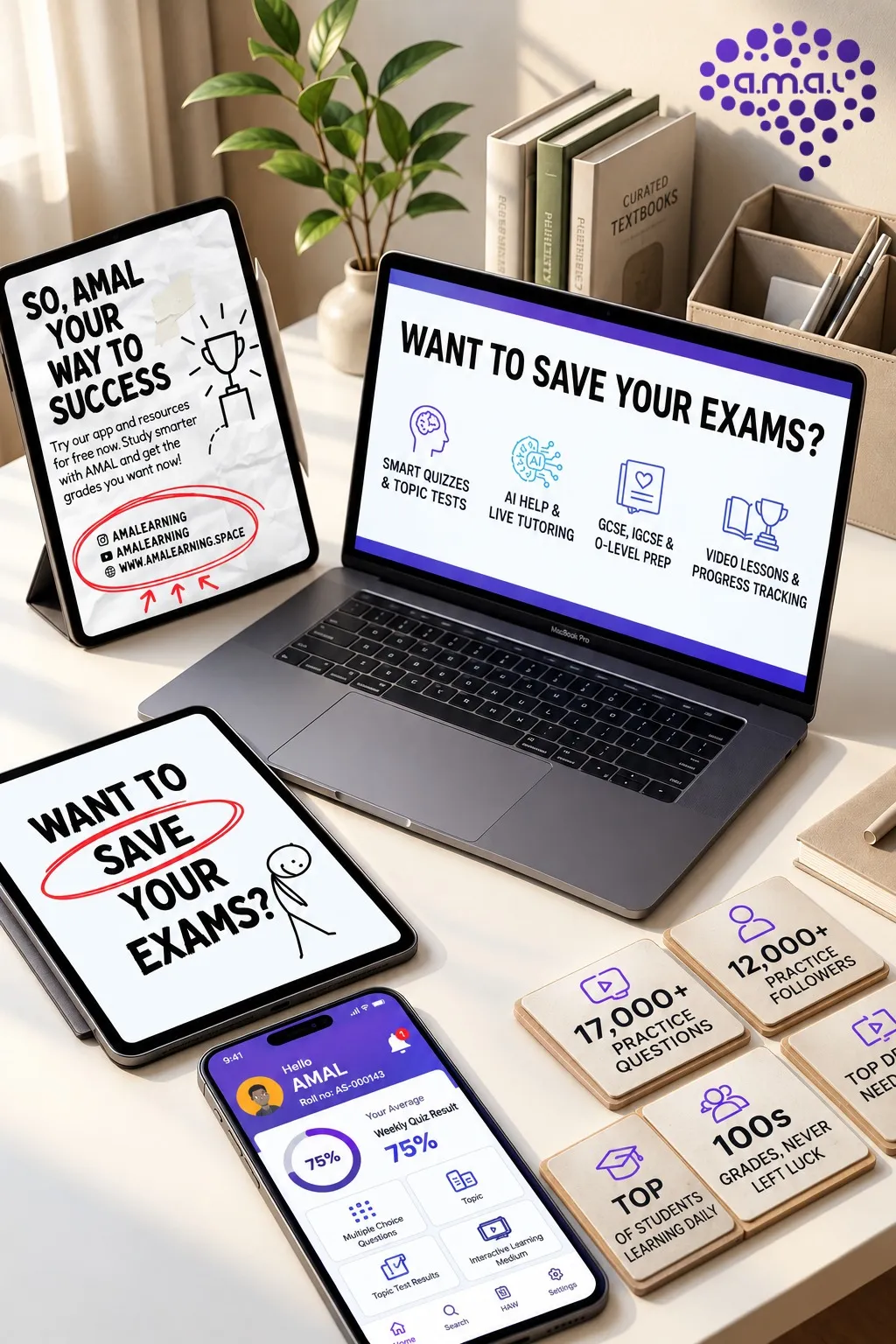
- Smart Quizzes: random and topic based MCQs so you practise little and often
- Topic Tests: high mark questions checked first by AI and verified by teachers
- ILM (Interactive Learning Medium): video lessons covering almost every topic down to specification point level
- Wall of Knowledge: WOK reports showing what is strong, weak and improving at a glance
- AMAL AI: instant explanations and guidance so you are never stuck waiting
- Mocks: full mock papers that mirror the real exams, marked and tracked inside the app
- Homework: set and completed in app with instant marking, so feedback never waits
- LOTS (Live Online Tuition Sessions): real teacher support when self study is not enough
Whether you are a few minutes from our Great Portland Street base or studying from another city entirely, this removes the two usual barriers to structured GCSE exam preparation: finding board specific teaching, and getting written answers marked by someone who knows the mark scheme inside out.
What to Do After Results Day
Ask for the marked paper, not just the grade, and work through every dropped mark.
- Categorise each loss: knowledge gap, technique, timing, or misread
- List the two or three topics that cost you the most marks
- Ask your teacher for one specific thing to fix before the real exam
- Put those topics at the top of your next revision timetable
- Re attempt the questions you lost after revising the topic
- Keep the paper for reference in the spring term
If a Mock Goes Badly
Do not panic. Plenty of students who finished with grade 8s and 9s in the summer had a rough November. Work out honestly whether the problem was no revision, the wrong kind of revision, a bad day, or missing content, then take every intervention the school offers. A bad mock is far better than a bad real exam, because you still have months to fix it.
Frequently Asked Questions
Do GCSE mocks count towards your final grade?
No. Mocks are set and marked by your school and never appear on your certificate. They do influence predicted grades, tier decisions and sixth form offers.
How are mocks marked?
By your own teachers, using the official mark scheme for the paper, with grade boundaries estimated from previous years rather than set nationally.
How long before mocks should I start revising?
Six to eight weeks is the realistic window. That allows time for a topic audit, content revision, timed questions and at least one full paper per subject.
What happens if I fail my mocks?
Nothing final. Your school will usually offer extra sessions or intervention groups, and may review your tier of entry. Poor mock results are common and recoverable.
Do sixth forms and colleges look at mock results?
Indirectly through predicted grades, and directly for competitive courses such as further maths and medicine track sciences, which often ask to see the papers.
Conclusion
GCSE mock exams are the most useful feedback you will receive before the real thing. They tell you which topics are secure, which are not, and how your timing holds up under pressure, and they do it while there is still time to act. Audit your topics early, revise by testing yourself rather than re reading, sit full papers under timed conditions, and treat every dropped mark as instruction rather than judgement.
If you want that process structured for you, AMALearning delivers it online through experienced UK teachers, board specific resources and in app marking.
You can sign up to the AMALearning app for free and start with the quizzes, topic tests and mock papers straight away.
Start your preparation today and turn your next mock into the result you actually want.



























Sign in to leave a comment.