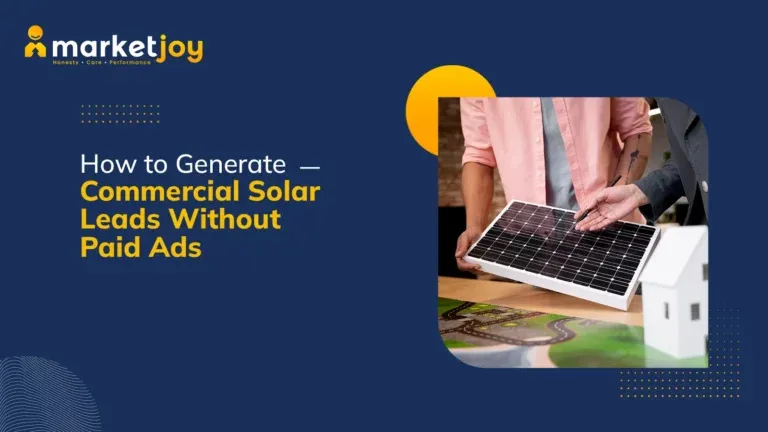

Paid advertising used to be the fastest way to fill a solar pipeline. Today it is one of the most expensive. Competition for clicks keeps rising, audiences get tired of seeing the same messages, and the moment you stop spending, the leads stop too. For commercial solar companies, where deal cycles are long and buyers are careful, that is a poor foundation for growth.
The good news is that commercial solar leads do not have to come from ads. With the right mix of search visibility, outreach, and relationships, you can build a pipeline that keeps producing long after the work is done. This guide shows you how.

Why Organic Lead Generation Works for Commercial Solar
Commercial buyers do not impulse-click an ad and sign a six-figure contract. They research. A CFO compares financing options, a facility manager checks energy costs, and a procurement team asks for references. Organic channels meet buyers at each of those steps, which is why organic leads tend to be:
- More qualified, because they found you while actively looking for answers
- Lower cost over time, since content and rankings keep working
- Longer-lasting, because assets like pages and case studies do not expire
- More trust-driven, because you earned the attention instead of buying it
The trade-off is that organic takes patience. Most companies see early traction within 4-8 weeks, depending on competition and how consistently they execute. But the results compound instead of resetting every month.
1. Optimize Your Website for High-Intent Keywords
Your website is the backbone of any organic strategy. Focus on the phrases buyers use when they are close to a decision, not broad terms like “solar energy.” Strong examples include:
- commercial solar installation services
- commercial solar financing
- solar EPC services
- solar for warehouses
- solar for manufacturing facilities
- commercial solar audits
Give each target industry its own landing page: manufacturing, logistics, retail, agriculture. Add case studies that show ROI, cost savings and energy reduction, and put a clear call to action on every page, such as “Request a Commercial Solar Assessment.” This improves visibility and conversion at the same time.
2. Publish Content Decision-Makers Actually Need
Commercial buyers want data, not generic advice. Write about the questions that sit on their desks:
- Commercial solar ROI breakdowns
- Energy cost reduction for warehouses
- State-by-state commercial solar incentives
- Tax benefit guides
- How solar reduces operating expenses
This kind of content attracts CFOs, facility managers, sustainability officers and procurement heads. They are the people who approve projects, and they tend to trust a company that has already helped them understand the numbers.
3. Use LinkedIn to Reach Decision-Makers Directly
LinkedIn is one of the strongest organic channels for B2B solar. Start by optimizing your company page with industry keywords, then post insights, reports and case studies specific to commercial projects. Connect with operations managers, property owners, facility directors and executives at energy-heavy businesses.
When you reach out, lead with their problem, not your product. A short, personalized message about rising utility costs at their type of facility will outperform a generic pitch every time. Video testimonials and installation walk-throughs add proof that you deliver.
4. Run Value-First Cold Email and Outreach
Cold email remains one of the fastest and most cost-effective ways to book commercial solar appointments, provided it is done well. The process is simple:
- Build a targeted list of high-energy-use industries.
- Send value-based emails instead of sales-heavy ones.
- Offer a free solar audit or energy savings analysis.
- Follow up with data and industry-specific insights.
The key is relevance. A warehouse operator wants to hear about roof space and demand charges. A manufacturer wants to hear about production-hour load profiles. Tailor the message and response rates rise.
5. Build Partnerships and Referral Ecosystems
Your ideal clients already work with people they trust. Partner with them. Commercial builders, real estate developers, EPC firms, sustainability consultants, facility management companies and industrial equipment suppliers all have access to your target buyers.
Referral-driven leads often close faster because trust is built in before the first conversation. Make it easy for partners by giving them simple materials, a clear referral process and a reason to remember you.
6. Create Lead Magnets Built for Commercial Buyers
Businesses want solutions backed by evidence. Offer resources that help them decide, and collect their contact details in exchange. Effective options include:
- A solar ROI calculator
- A commercial solar savings whitepaper
- An energy audit checklist
- Industry-specific case studies
- A solar financing comparison guide
Promote them on LinkedIn, in email signatures, in newsletters and in industry communities. Each download is a warm lead who has already shown interest.
7. Get Listed in Authoritative Directories
Directories are an underused source of commercial installation leads. Listings in energy industry directories, EPC service directories, solar provider lists and sustainability vendor lists put you in front of buyers who are actively searching for vendors. Keep your profile complete, consistent and current.
8. Let Customer Stories Build Trust
Nothing persuades a cautious commercial buyer like measurable results from a similar company. Share video case studies, written testimonials, before-and-after energy savings reports and facility walk-throughs. Publish them on your website, on LinkedIn and inside your email sequences so prospects meet proof at every touchpoint.
9. Invest in Local SEO
Many commercial buyers prefer local or regional installers. Optimize for searches such as “commercial solar company near me” and “industrial solar installation services,” and build service-area pages for each city you cover. Strengthen your Google Business Profile with industry photos, case studies, FAQs and reviews. Local SEO is consistently one of the best sources of high-intent commercial leads.
Bringing It All Together
No single tactic will carry the whole pipeline. The companies that win combine them: SEO brings buyers to the site, content builds credibility, LinkedIn and email start conversations, partners send warm introductions, and case studies close the gap between interest and a signed contract. Track which channels produce booked appointments, not just clicks, and put more effort into what works.
Consistency matters more than perfection. A steady stream of useful content and outreach beats a big burst followed by silence.
Ready to Build a Predictable Commercial Solar Pipeline?
At MarketJoy, we help solar and renewable energy companies generate qualified commercial appointments through outbound prospecting, content strategy, account-based marketing and appointment setting, without relying on ad spend.
MarketJoy, Inc
Email: [email protected]
Phone: +1 (484) 638-6389
Address: 186 N Palafox Street, Pensacola, FL 32502
Get a Free Strategy Call: https://meetings.hubspot.com/curtis-bendt/inbound-round-robin-for-discovery-calls




















Sign in to leave a comment.