Generative AI in Healthcare: How AI Is Supporting Personalized Medicine and Treatment Research

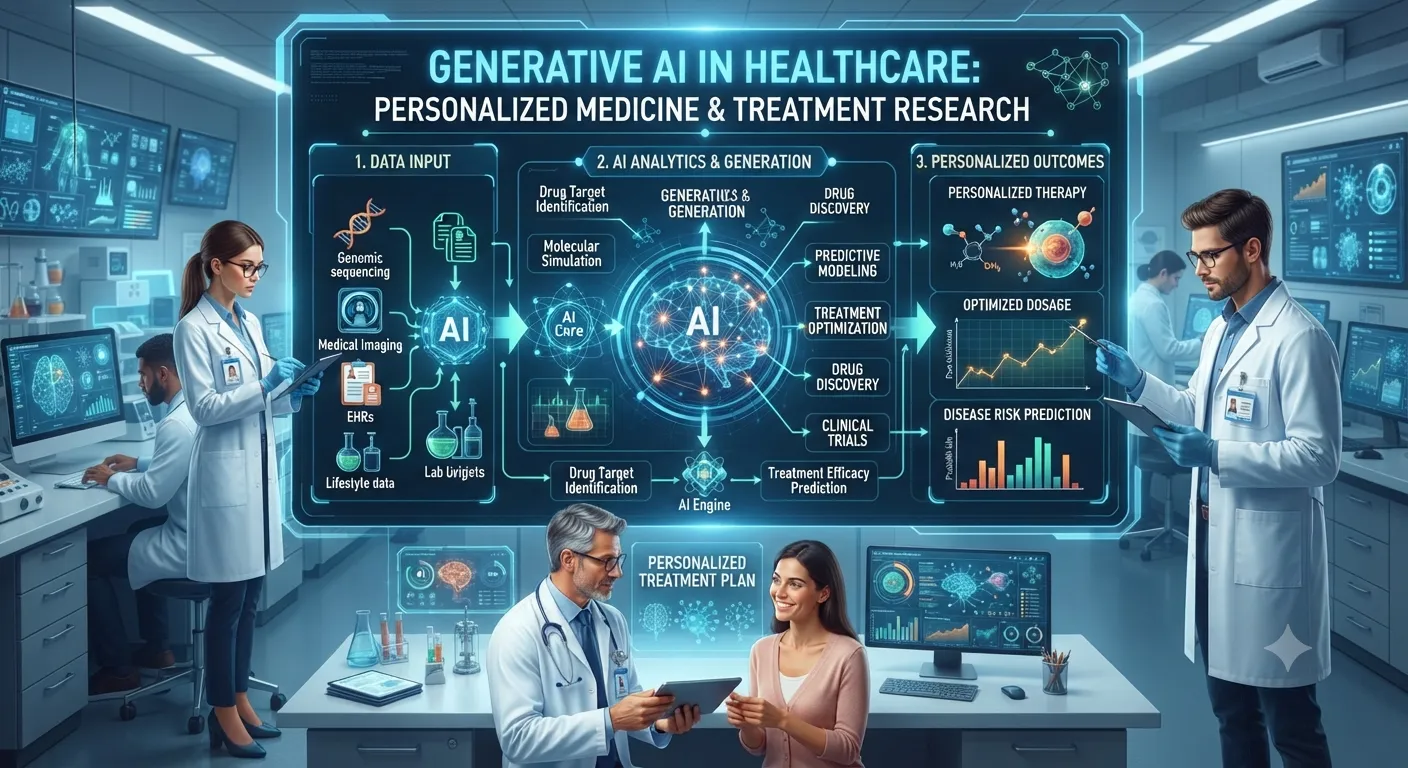
Healthcare is moving toward a more individualized approach to diagnosis, treatment planning, and medical research. Instead of relying only on population-level evidence, healthcare organizations are increasingly exploring how patient-specific clinical information, genetics, medical history, lifestyle factors, and real-world data can support more personalized decisions.
At the center of this transformation is Generative AI in Healthcare.
Generative AI can process and synthesize large volumes of complex information, helping researchers and healthcare professionals identify patterns, generate insights, summarize scientific evidence, and support personalized treatment workflows. When integrated responsibly with clinical systems and healthcare data, it can become an important technology for advancing precision medicine and accelerating treatment research.
For healthcare providers, pharmaceutical companies, healthtech businesses, and medical research organizations, the opportunity extends beyond experimenting with AI. The focus is increasingly shifting toward building secure, scalable, and clinically useful AI-powered solutions.
What Is Generative AI in Healthcare?
Generative AI refers to artificial intelligence systems capable of producing new content or insights based on patterns learned from large datasets. Unlike conventional software that follows predefined rules, generative AI models can work with unstructured information such as clinical notes, scientific publications, medical reports, and patient communications.
In healthcare, these capabilities can support activities such as:
- Summarizing patient histories
- Analyzing medical literature
- Supporting treatment research
- Generating clinical documentation
- Assisting healthcare professionals with information retrieval
- Identifying relevant patient information
- Supporting drug discovery research
- Creating patient-specific educational content
- Assisting clinical trial workflows
The value of Generative AI in Healthcare becomes particularly interesting when these capabilities relate to healthcare data platforms, EHR systems, research databases, and clinical workflows.
How Generative AI Supports Personalized Medicine
Personalized medicine aims to tailor healthcare decisions according to the characteristics of individual patients. These characteristics may include genetic information, medical history, biomarkers, treatment history, lifestyle factors, and other relevant clinical information.
The challenge is that healthcare data is often fragmented and extremely complex.
Generative AI can help organize and synthesize this information, allowing healthcare professionals and researchers to work with large volumes of data more efficiently.
For example, an AI-powered healthcare platform could analyze authorized patient information and generate a structured summary highlighting relevant medical history, previous treatments, laboratory results, and other information that may be useful for clinical review.
The generated output can then be reviewed by qualified healthcare professionals rather than replacing clinical judgment.
1. Supporting Patient-Specific Treatment Research
One of the potential applications of Generative AI in Healthcare is helping researchers explore treatment options based on patient characteristics.
A patient may have multiple clinical factors that need to be considered simultaneously. Reviewing all relevant information manually can be time-consuming.
Generative AI can help researchers synthesize information from medical literature, clinical research, and patient data to identify potentially relevant evidence for further investigation.
For example, a research platform could retrieve relevant studies and generate a summary organized around a specific patient characteristic or treatment question.
This does not mean that an AI model independently determines which treatment a patient should receive. Instead, it can reduce information-processing workloads and help professionals reach relevant evidence more efficiently.
2. Accelerating Drug Discovery
Drug discovery is another area where generative AI is attracting significant interest.
Traditional drug discovery can require extensive research and experimentation. Researchers need to evaluate molecular structures, biological targets, potential compounds, safety considerations, and other variables.
Generative AI models can assist researchers by generating or evaluating potential molecular structures and identifying patterns within complex biological datasets.
This can help research teams explore a broader range of possibilities during early-stage research.
The technology does not eliminate laboratory validation. Candidate molecules still require rigorous scientific testing, preclinical evaluation, and clinical development.
However, AI can potentially help researchers reduce the time required for certain computational research activities.
3. Improving Clinical Trial Design
Clinical trials depend on identifying suitable participants, designing appropriate protocols, analyzing research data, and monitoring outcomes.
Generative AI can assist with several information-heavy aspects of clinical research.
For example, AI can help researchers review eligibility criteria, summarize clinical trial information, analyze medical documentation, and support the identification of potentially relevant patient populations.
AI-powered systems can also help research teams process large amounts of scientific literature when designing or updating trial strategies.
By integrating generative AI with clinical research platforms, organizations can create workflows that reduce repetitive research activities while keeping critical decisions under expert oversight.
4. Supporting Biomarker and Genomic Research
Personalized medicine increasingly relies on understanding relationships between biological characteristics and disease outcomes.
Genomic and biomarker datasets can contain extremely large and complex information.
Generative AI can help researchers summarize genomic findings, analyze relationships across datasets, and generate research hypotheses for further validation.
For example, a research platform could combine genomic information with relevant scientific literature and generate a structured research summary highlighting areas that deserve additional investigation.
Such applications can help researchers navigate complex information more efficiently while maintaining the need for laboratory and clinical validation.
5. Creating Personalized Patient Education
Personalized medicine is not limited to clinical research. Patients also need information that is relevant to their specific circumstances.
Generative AI can help healthcare applications create patient education content based on approved clinical information and individual needs.
For example, an AI-enabled patient portal could explain a complex medical concept in simpler language or generate educational material related to a patient's treatment plan.
However, healthcare organizations need appropriate safeguards to ensure that generated information is accurate, understandable, and aligned with approved medical content.
6. Connecting AI With EHR Data
The potential of Generative AI in Healthcare increases significantly when AI applications can securely access relevant information from electronic health record systems.
EHRs contain valuable information such as:
- Patient demographics
- Clinical notes
- Diagnoses
- Medication history
- Laboratory results
- Imaging reports
- Treatment history
- Care plans
A healthcare AI application can use authorized data from these systems to provide more contextually relevant outputs.
For healthcare software companies, this creates opportunities to develop AI-powered applications that sit on top of existing healthcare infrastructure rather than requiring organizations to replace their current systems.
Secure APIs, interoperability standards, access controls, audit logging, and appropriate data governance are essential when designing these integrations.
7. Supporting Clinical Knowledge Discovery
Medical research produces new evidence continuously. Healthcare professionals and researchers can struggle to keep up with the volume of published information.
Generative AI can assist by summarizing research papers, extracting relevant findings, comparing evidence, and organizing information around specific research questions.
A research-focused AI platform could allow users to ask questions in natural language and retrieve relevant information from approved sources.
This can reduce the time researchers spend manually searching through large collections of literature.
The quality of the underlying sources remains critical, and AI-generated outputs should be reviewed before being used for important clinical or research decisions.
Challenges of Generative AI in Personalized Medicine
Despite its potential, implementing Generative AI in Healthcare requires careful consideration of several challenges.
Data Privacy and Security
Personalized medicine depends on sensitive patient information. Healthcare organizations need robust security controls to protect data throughout collection, storage, processing, and transmission.
AI Accuracy
Generative AI systems can produce incorrect or misleading information. Healthcare applications therefore require validation mechanisms, trusted data sources, monitoring, and human review.
Data Quality
AI cannot produce reliable insights from poor-quality or incomplete information. Organizations need strong data governance and processes to maintain accurate healthcare data.
Interoperability
Personalized healthcare applications may need to connect with EHRs, laboratory systems, genomic databases, research platforms, and other healthcare applications. Integration architecture is therefore an important part of implementation.
Regulatory and Ethical Considerations
Healthcare AI applications need appropriate governance around privacy, transparency, accountability, clinical oversight, and responsible use.
How Healthcare Organizations Can Implement Generative AI
Organizations planning to use Generative AI in Healthcare should begin with a specific business or research problem rather than simply selecting an AI model.
A practical implementation approach can include:
Identify the use case: Determine where AI can solve a measurable problem.
Assess the data: Identify relevant clinical, research, genomic, or operational data sources.
Design the architecture: Determine how the AI model, knowledge sources, APIs, databases, and healthcare systems will interact.
Implement security: Establish access controls, encryption, auditability, and data governance.
Build human oversight: Define where healthcare professionals or researchers must review AI-generated outputs.
Validate performance: Test accuracy, reliability, usability, and workflow impact.
Deploy gradually: Begin with a controlled use case and expand after successful validation.
This approach allows organizations to move from an AI experiment toward a production-ready healthcare solution.
Building AI-Powered Personalized Healthcare Solutions
For healthcare organizations, the greatest opportunity may not come from using a standalone AI chatbot. It can come from integrating AI into the software systems professionals already use.
A custom healthcare AI solution can combine Generative AI with EHR integration, healthcare APIs, clinical knowledge bases, analytics platforms, patient portals, and workflow automation.
For example, a healthtech company could develop an AI-powered platform that helps researchers analyze clinical literature, supports patient-specific research workflows, integrates with healthcare data sources, and provides structured insights through a secure interface.
Developing such a platform requires more than AI expertise. It requires knowledge of healthcare workflows, interoperability, security, data architecture, software engineering, and AI governance.
The Future of Generative AI in Personalized Medicine
The future of Generative AI in Healthcare will likely involve deeper integration with clinical data, research platforms, genomic information, and intelligent healthcare software.
Generative AI may increasingly help researchers identify research opportunities, summarize evidence, explore potential treatment approaches, and accelerate drug discovery workflows.
At the same time, healthcare organizations will need to maintain strong human oversight. AI should support professionals rather than remove accountability from important clinical and research decisions.
As AI models become more capable and healthcare systems become more connected, organizations that build secure and scalable foundations today can be better positioned to explore more advanced applications tomorrow.
Conclusion
Generative AI in Healthcare is creating new possibilities for personalized medicine and treatment research by helping healthcare professionals and researchers work with complex information more efficiently.
From supporting patient-specific research and genomic analysis to accelerating drug discovery, clinical trial workflows, medical literature review, and personalized patient education, generative AI can contribute across multiple stages of the healthcare ecosystem.
However, successful implementation requires more than selecting an AI model. Healthcare organizations need secure data infrastructure, reliable integrations, strong governance, human oversight, and scalable software architecture.
For healthcare providers, pharmaceutical companies, research organizations, and healthtech businesses exploring AI-powered personalized healthcare, the next step is to identify a practical use case and build the technology around measurable outcomes.




Sign in to leave a comment.