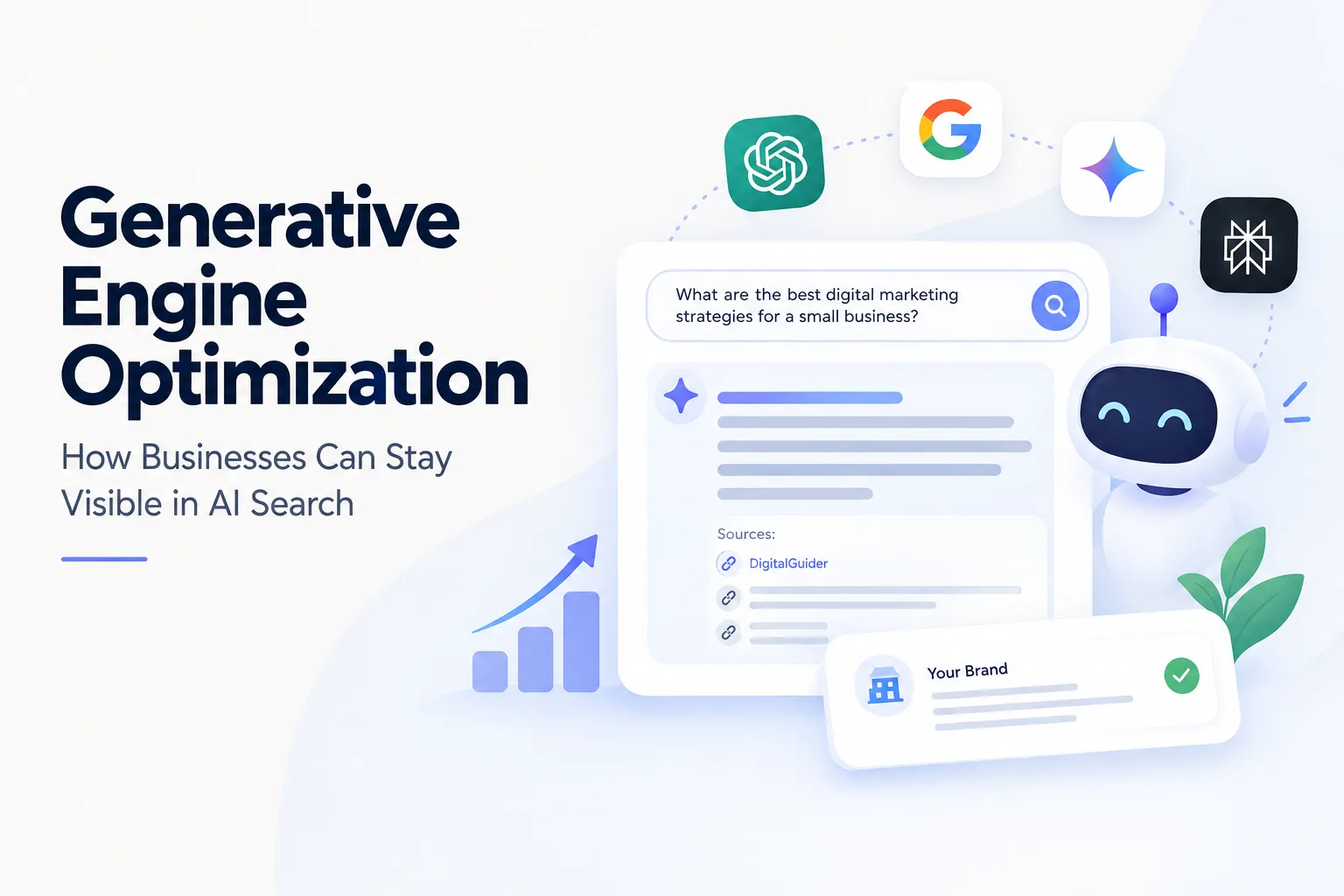

Search is changing quickly. People are no longer relying only on traditional search engines to find information, compare businesses, or research products and services. They are also asking AI platforms such as ChatGPT, Google AI experiences, Perplexity, Gemini, and other conversational tools for direct answers.
This shift has created a new challenge for businesses: how do you make sure your brand gets noticed when AI generates the answer?
This is where Generative Engine Optimization, or GEO, comes into the picture.
What Is Generative Engine Optimization?
Generative Engine Optimization is the practice of improving a brand's online content and presence so that AI-powered search systems can understand, retrieve, reference, and potentially cite it in generated answers.
Traditional SEO focuses heavily on helping pages rank in search results. GEO adds another layer by considering how information may be selected and presented inside AI-generated responses.
For example, someone might search:
“What are the best digital marketing strategies for a small business?”
Instead of scanning several search results, they may ask an AI platform and receive a summarized answer containing recommendations, explanations, and sources.
If your business is consistently mentioned or cited in these responses, you have an additional opportunity to reach potential customers.
Research into GEO has already shown that optimization can influence visibility in generative search environments, although results vary depending on the query, industry, and system being tested.
Why AI Search Visibility Matters
The biggest difference between traditional search and AI search is how information is consumed.
With traditional search, users usually receive a list of pages and decide which one to visit.
With generative search, the system may combine information from several sources and provide a direct response.
That means your website does not always have to be the first blue link to influence a potential customer. Being included as a trusted source can also matter.
Recent industry research and commentary increasingly point toward AI visibility becoming an important part of digital marketing, particularly as AI-generated answers become more common across search and conversational platforms.
For businesses, this means search visibility is expanding beyond rankings.
GEO Does Not Replace SEO
One common misconception is that businesses need to choose between SEO and GEO.
They do not.
A strong SEO foundation still matters because AI systems need to discover, understand, and retrieve information from the web.
Technical accessibility, useful content, clear website structure, relevant entities, internal linking, and authority signals can all contribute to making information easier to understand.
GEO builds on these fundamentals.
Think of it this way:
| Traditional SEO | GEO |
|---|---|
| Focuses on search rankings | Focuses on AI-generated visibility |
| Targets search result pages | Targets AI answers and recommendations |
| Optimizes pages for search engines | Optimizes information for AI retrieval and understanding |
| Measures rankings and organic traffic | Can also consider mentions, citations, and AI visibility |
The two approaches overlap significantly. A business with poor SEO fundamentals should not expect GEO tactics alone to solve its visibility problems.
Create Content That Answers Real Questions
One of the most practical ways to prepare for AI search is to create content around the questions your audience actually asks.
Instead of producing articles simply because a keyword has search volume, consider the complete information need behind that keyword.
For example, a cybersecurity company could create content answering:
- How does cybersecurity insurance work?
- What should a small business do after a data breach?
- How often should passwords be changed?
- What cybersecurity services does a growing company need?
This approach creates useful information that can address specific user needs.
Clear questions also make content easier to navigate. When a page directly addresses a question and supports its answer with useful details, it becomes easier for both people and machines to interpret.
Make Important Information Easy to Understand
AI systems process enormous amounts of information. Your content should not make the important answer difficult to find
Avoid hiding key information beneath unnecessary introductions or complicated wording.
Instead:
- Define important concepts clearly.
- Use descriptive headings.
- Keep paragraphs focused.
- Explain technical terms.
- Use lists where appropriate.
- Support important claims with reliable sources.
- Provide specific examples.
- Keep business information consistent across the web.
For example, if a company offers SEO services, simply repeating "SEO services" throughout a page provides limited context.
A stronger page could explain what the service includes, who it is for, what problems it solves, how the process works, and what outcomes businesses can reasonably expect.
That gives AI systems more meaningful information to interpret.
Build Authority Beyond Your Website
Your website is only one part of your online presence.
AI search systems can draw information from multiple sources. This makes third-party mentions, publications, industry websites, reviews, directories, interviews, and other credible references increasingly relevant to a brand's overall visibility.
A 2025 research study examining AI search found significant differences between AI systems and traditional search in the types of sources they use, highlighting the importance of earned media and authoritative third-party sources.
This is one reason businesses should think beyond publishing content on their own website.
A strong digital presence should create a consistent picture of the brand across relevant platforms.
Keep Your Information Consistent
Imagine that your website says your company specializes in e-commerce SEO, while several third-party profiles describe you as a general web design company.
That inconsistency can make it harder for users and machines to understand what your business actually does.
Keep important information consistent across:
- Website pages
- Business profiles
- Industry directories
- Social profiles
- Press coverage
- Author profiles
- Review platforms
- Partner websites
This does not mean copying the same description everywhere. Instead, the core facts about your business should remain accurate and consistent.
Think in Topics, Not Just Keywords
Traditional keyword research is still useful, but businesses should also consider the broader topic surrounding each keyword.
Suppose you are targeting “local SEO.”
Your content could naturally cover related concepts such as Google Business Profile optimization, local rankings, citations, reviews, location pages, local search intent, and customer discovery.
This creates topical depth rather than a page built around repeated keyword variations.
AI systems need context to understand relationships between concepts. Comprehensive topical coverage can therefore make your content more useful for complex queries.
Measure AI Visibility Carefully
GEO is different from traditional SEO measurement.
You can track rankings, clicks, impressions, and conversions through conventional SEO platforms. For AI search, businesses may also monitor whether their brand appears in relevant AI responses, which sources are cited, how competitors are represented, and whether visibility changes across different prompts and platforms.
However, one AI response should not be treated as a definitive result.
AI-generated answers can change based on wording, context, time, and the system being used. Research on GEO measurement specifically highlights the need for repeated observations rather than relying on a single AI response.
Start Preparing for AI Search Now
Generative search is not a reason to abandon the fundamentals of digital marketing. It is a reason to make those fundamentals stronger.
Create genuinely useful content. Make your website easy to understand. Build authority through credible sources. Keep your business information accurate. Answer real customer questions. And monitor how your brand appears across emerging AI search experiences.
GEO is still evolving, and there is no single formula that guarantees inclusion in every AI-generated answer. But businesses that build clear, authoritative, useful digital footprints will be better positioned as search continues to move toward conversational and generative experiences.






















Sign in to leave a comment.