
Important Notice:
This article is intended for qualified researchers and educational evaluation. The compounds discussed are offered strictly for controlled laboratory research and are not intended for human or animal consumption, clinical use, or self-administration.
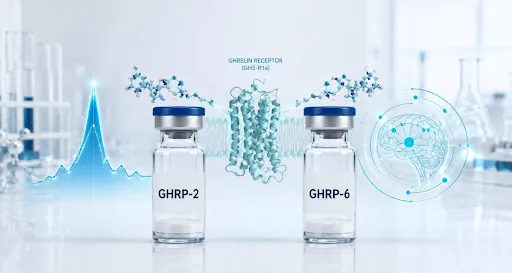
GHRP-2 for sale and GHRP-6 are often listed beside each other, but they are not interchangeable research compounds. Both activate the same ghrelin receptor (GHSR-1a) and are studied for their effects on growth hormone release. The practical difference is that GHRP-2 is generally associated with stronger GH-releasing activity, while GHRP-6 is better known for its pronounced effect on appetite-related signaling.
When researchers evaluate growth hormone-releasing peptides, choosing between these two compounds comes down to the primary focus of the study. Neither peptide is universally "better"; rather, each answers different experimental questions.
Quick Answer
- GHRP-2: Commonly studied when stronger growth hormone release and a less pronounced feeding response are the main considerations.
- GHRP-6: Commonly studied when appetite stimulation and broader ghrelin-related signaling are central experimental goals.
- Both: Act primarily through the ghrelin receptor and may influence additional hormone levels depending on the research model and study design.
1. Key Differences in Structure
Both compounds are synthetic hexapeptides, meaning they contain six amino-acid residues linked in a chain. Their amino acid sequences are different, which helps explain why they activate the same receptor yet produce somewhat different experimental response profiles:
- GHRP-2: H-D-Ala-D-2-Nal-Ala-Trp-D-Phe-Lys-NH₂ (Molecular Weight: ~818.0 Da) — incorporates a modified amino-acid component (D-2-naphthylalanine).
- GHRP-6: His-D-Trp-Ala-Trp-D-Phe-Lys-NH₂ (Molecular Weight: ~873.0 Da).
2. Growth Hormone Release and Appetite Responses
Although both compounds stimulate growth hormone release, comparative research indicates that GHRP-2 often shows higher potency per dose in generating a GH response.
The most noticeable operational distinction appears in appetite signaling:
- GHRP-6 (Stronger Feeding Response): GHRP-6 triggers a prominent appetite-related response in animal models. This makes it a frequent choice for investigations focusing on metabolic rate, energy balance, or ghrelin-mediated feeding behavior.
- GHRP-2 (Lower Relative Orexigenic Effect): GHRP-2 also influences appetite-related pathways, but this effect is generally less pronounced than with GHRP-6. While it shouldn't be described as completely absent, it causes less feeding disruption in studies focused purely on growth hormone pathways.
3. Practical Comparison Table
| What researchers compare | GHRP-2 | GHRP-6 |
|---|---|---|
| Main receptor | Ghrelin receptor (GHSR-1a) | Ghrelin receptor (GHSR-1a) |
| GH-releasing activity | Strong; varies by model | Strong; varies by model |
| Appetite-related response | Generally less pronounced | Usually more pronounced |
| Common research interest | Growth hormone release comparisons | Appetite and ghrelin signaling |
| Effects on other hormones | Possible (cortisol, prolactin) | Possible (cortisol, prolactin) |
| Best choice | Depends on the experimental endpoint | Depends on the experimental endpoint |
4. Secondary Hormone Effects and Quality Benchmarks
Under certain experimental conditions, both compounds can trigger modest changes in other hormones, such as cortisol and prolactin. Because differences between research models can influence these secondary hormone responses, researchers should measure these markers directly rather than making assumptions based on general compound descriptions.
When labs prepare to buy GHRP-6 for research or acquire GHRP-2, verifying analytical quality is crucial for data reproducibility:
- HPLC Purity: The reported purity should ideally be ≥99% by High-Performance Liquid Chromatography (HPLC), with a batch-specific chromatogram supplied to document the principal peak and observable impurity profile.
- Mass Spectrometry: MS testing should support expected compound identity and molecular mass.
- Documentation: Handling and storage parameters should follow supplier Certificates of Analysis (CoA).
5. Frequently Asked Questions (FAQ)
Q1: Why do GHRP-2 and GHRP-6 produce different appetite responses?
Answer: Both target the ghrelin receptor, but sequence differences alter how they interact with central appetite pathways in the brain. GHRP-6 stimulates a significantly stronger feeding response.
Q2: Can these peptides be evaluated alongside GHRH analogs?
Answer: Yes. Studies often examine GHRP compounds together with GHRH analogs because they act through complementary signaling pathways. In many models, combined stimulation produces a greater growth hormone response than using either peptide alone.
Q3: How should research teams evaluate peptide quality before testing?
Answer: Batch-specific HPLC supports an assessment of chromatographic purity and may reveal impurities or degradation-related peaks. It should be evaluated together with mass-spectrometry identity data and the relevant CoA.













Sign in to leave a comment.